
Operating Principles of Francis Turbine Apparatus
Product Specification Sheet
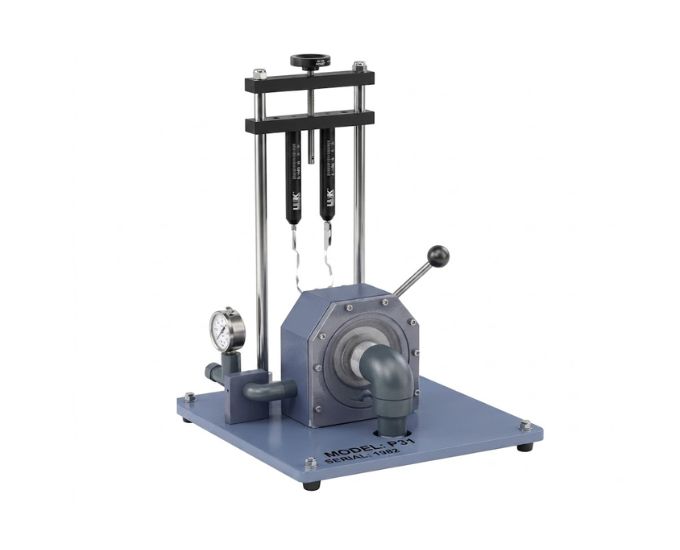
Operating Principles of Francis Turbine Apparatus
Model Number: MTHB-150.18
The Operating Principles of Francis Turbine Apparatus is an educational hydraulic machinery laboratory system designed to demonstrate the operation of a reaction turbine with adjustable guide vanes. The apparatus enables students to determine turbine characteristic curves and efficiency while investigating the relationship between flow rate, pressure head, rotational speed, torque, power output, and guide vane position
Product Specification
The Operating Principles of Francis Turbine Apparatus is a practical educational laboratory system developed for studying the operating characteristics and performance of a Francis reaction turbine.
Manufactured by Micro Technologies, the apparatus provides students with hands-on understanding of reaction turbine operation and the conversion of hydraulic energy into mechanical rotational energy.
The Francis turbine is a reaction-type hydraulic turbine in which water flows through adjustable guide vanes before entering the turbine runner. Unlike a pure impulse turbine, pressure changes occur as the water passes through the runner, making both pressure energy and kinetic energy important in turbine operation.
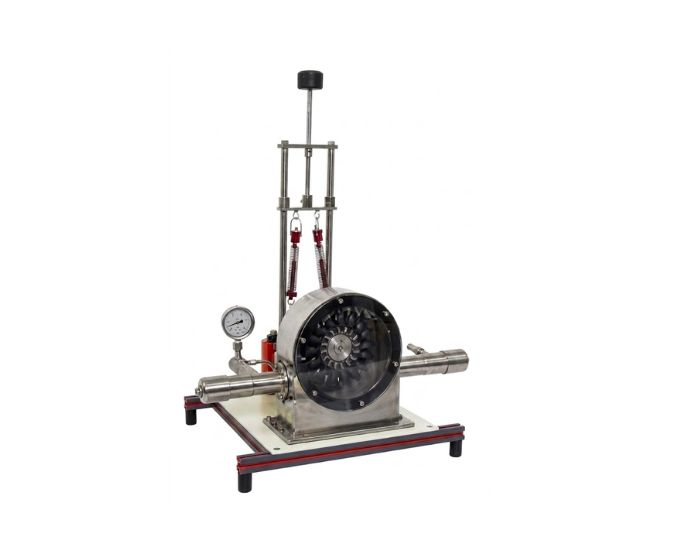
The apparatus incorporates a Francis turbine runner, adjustable guide vanes, water supply arrangement, pressure measuring facility, turbine loading system, speed measurement arrangement, and suitable flow-measuring components.
The adjustable guide vanes regulate the quantity and direction of water entering the runner. By changing the guide vane position, students can investigate how water admission affects turbine speed, torque, output power, and efficiency.
Water entering the turbine passes through the guide vane arrangement and is directed toward the runner blades. The interaction between the flowing water and runner produces rotational motion at the turbine shaft.
A suitable loading arrangement allows different mechanical loads to be applied to the turbine. Measurements can then be taken at different operating conditions to calculate output power and determine turbine performance.
One of the main experiments performed with the apparatus is the determination of characteristic curves. By varying operating conditions and recording parameters such as flow rate, pressure head, rotational speed, and load, students can prepare performance curves representing the behaviour of the turbine.
The apparatus also enables the determination of Francis turbine efficiency by comparing useful mechanical output with the hydraulic energy supplied to the turbine.
This system provides an effective link between theoretical hydraulic machinery concepts and actual turbine performance measurements, making it suitable for engineering education, demonstrations, and laboratory practicals.
Features
- Educational Francis turbine test apparatus
- Reaction turbine operating principle
- Adjustable guide vanes
- Francis turbine runner
- Controlled water supply arrangement
- Pressure measurement facility
- Flow-rate measurement arrangement
- Turbine speed measurement
- Mechanical loading arrangement
- Torque investigation
- Characteristic curve determination
- Turbine efficiency determination
- Hydraulic input power study
- Mechanical output power study
- Adjustable operating conditions
- Compact laboratory configuration
- Suitable for repeated student practicals
Benefits
- Provides practical understanding of Francis turbine operation
- Demonstrates reaction turbine principles
- Allows guide vane position to be adjusted
- Enables characteristic curves to be determined
- Allows turbine efficiency to be calculated
- Helps students understand flow, head, speed, and torque relationships
- Demonstrates hydraulic-to-mechanical energy conversion
- Allows turbine performance under different loads to be compared
- Supports theoretical and experimental analysis
- Suitable for hydraulic machinery practical examinations
Product Specifications
| Specification | Details |
|---|---|
| Product Name | Operating Principles of Francis Turbine Apparatus |
| Product Type | Hydraulic Turbine Experimental Apparatus |
| Turbine Type | Francis Reaction Turbine |
| Working Medium | Water |
| Water Regulation | Adjustable Guide Vanes |
| Primary Study | Francis Turbine Operating Principles |
| Performance Study | Characteristic Curves & Efficiency |
| Pressure Measurement | Pressure Gauge Arrangement |
| Flow Measurement | Suitable Flow Measurement Facility |
| Speed Measurement | Turbine Speed Measurement Arrangement |
| Loading | Mechanical Loading / Braking Arrangement |
| Parameters Studied | Head, Flow, Speed, Torque, Power & Efficiency |
| Energy Conversion | Hydraulic Energy to Mechanical Energy |
| Installation | Laboratory Experimental Setup |
| Operation | Educational / Experimental |
| Application | Hydraulic Machinery & Fluid Mechanics Laboratories |
Main Components
The apparatus typically incorporates:
- Francis turbine runner
- Turbine casing
- Adjustable guide vanes
- Guide vane control mechanism
- Water inlet arrangement
- Water outlet arrangement
- Pressure gauge
- Flow measurement arrangement
- Turbine shaft
- Mechanical loading mechanism
- Speed measurement facility
- Supporting base and frame
Experiments Performed
- Study the operating principle of a Francis turbine
- Demonstrate reaction turbine operation
- Determine turbine characteristic curves
- Determine Francis turbine efficiency
- Study the effect of adjustable guide vanes
- Measure turbine rotational speed
- Investigate turbine torque
- Determine hydraulic input power
- Determine mechanical output power
- Study the relationship between flow rate and turbine performance
- Investigate the effect of pressure head on turbine performance
- Study turbine behaviour under different loading conditions
- Investigate the effect of guide vane position on turbine output
- Determine performance at different operating points
- Plot characteristic performance curves
Parameters Studied
The apparatus can be used to investigate:
- Water flow rate
- Inlet pressure
- Pressure head
- Guide vane position
- Turbine rotational speed
- Turbine torque
- Mechanical load
- Hydraulic input power
- Mechanical output power
- Turbine efficiency
- Turbine operating point
- Overall turbine performance
Characteristic Curves
Experimental measurements obtained at different operating conditions can be used to prepare characteristic curves showing relationships between important turbine parameters.
Depending on the experimental procedure, students can investigate:
- Speed versus load
- Power versus speed
- Efficiency versus operating condition
- Flow rate versus operating condition
- Torque versus speed
- Turbine output versus guide vane position
These characteristic curves help students understand how the Francis turbine performs under changing hydraulic and mechanical conditions.
Efficiency Determination
The apparatus allows students to investigate the efficiency of the turbine by comparing the useful mechanical power developed at the turbine shaft with the hydraulic power supplied by the flowing water.
The basic relationship can be represented as:
Turbine Efficiency = Mechanical Output Power / Hydraulic Input Power × 100
Experimental measurements of flow, head, rotational speed, and load can be used for performance calculations.
Operating Principle
A Francis turbine works primarily on the reaction principle.
Water under pressure enters the turbine and passes through the adjustable guide vanes. These vanes control both the quantity and direction of water entering the runner.
As water flows through the runner passages, changes in pressure and velocity produce forces on the blades. These forces generate torque and rotate the turbine shaft.
The basic energy conversion is:
Hydraulic Energy → Runner Mechanical Energy → Shaft Power
The guide vane arrangement enables the water admission to be controlled according to the required operating condition.
Role of Adjustable Guide Vanes
The adjustable guide vanes are an important part of the Francis turbine system. They are used to regulate water entering the runner and influence its direction.
Changing the guide vane position enables students to study variations in:
- Water flow rate
- Runner speed
- Turbine torque
- Mechanical output
- Turbine efficiency
- Overall operating characteristics
Educational Objectives
The apparatus helps students understand:
- Francis turbine operation
- Reaction turbine principle
- Adjustable guide vane operation
- Hydraulic energy conversion
- Turbine characteristic curves
- Turbine efficiency
- Flow rate and head
- Turbine speed
- Torque generation
- Mechanical power output
- Hydraulic input power
- Turbine performance analysis
Engineering Applications
The principles demonstrated by the apparatus are relevant to:
- Hydroelectric power plants
- Medium-head hydropower installations
- Hydraulic power generation
- Water turbine systems
- Renewable energy projects
- Hydraulic machinery
- Turbine selection and performance analysis
- Power engineering
- Water resource engineering
Applications
- Hydraulic Machinery Laboratories
- Fluid Mechanics Laboratories
- Hydraulic Engineering Laboratories
- Mechanical Engineering Laboratories
- Civil Engineering Laboratories
- Energy Engineering Laboratories
- Renewable Energy Laboratories
- Water Resources Engineering Laboratories
- Engineering Colleges
- Universities
- Polytechnic Institutes
- Technical Training Centres
- Research Laboratories
FAQs
What is a Francis Turbine Apparatus?
A Francis Turbine Apparatus is an educational hydraulic machinery system used to demonstrate reaction turbine operation and experimentally investigate turbine characteristics and efficiency.
What is the main objective of this apparatus?
The main objective is to study a reaction turbine with adjustable guide vanes and determine its characteristic curves and efficiency.
What type of turbine is a Francis turbine?
A Francis turbine is a reaction turbine in which both pressure and velocity changes contribute to energy transfer between the flowing water and turbine runner.
What is the purpose of adjustable guide vanes?
The adjustable guide vanes regulate the amount and direction of water entering the runner, allowing turbine performance to be investigated under different operating conditions.
Can turbine characteristic curves be determined?
Yes. Measurements taken at different operating conditions can be used to prepare characteristic curves for analysing Francis turbine performance.
Can Francis turbine efficiency be determined?
Yes. Hydraulic input and mechanical output measurements can be used to calculate turbine efficiency.
What parameters can be studied?
Students can investigate flow rate, pressure head, guide vane position, rotational speed, torque, power output, and turbine efficiency.
How is a Francis turbine different from a Pelton turbine?
A Francis turbine operates primarily as a reaction turbine with pressure changes occurring through the runner, whereas a Pelton turbine operates as an impulse turbine using high-velocity water jets.
Where are Francis turbines commonly used?
Francis turbines are widely associated with hydroelectric power generation, particularly where suitable combinations of water head and flow are available.
Is this apparatus suitable for engineering colleges?
Yes. It is suitable for mechanical, civil, hydraulic, fluid mechanics, hydraulic machinery, energy, and water resources engineering laboratories.
Why Choose Our Products
- Practical Francis turbine demonstration
- Adjustable guide vane arrangement
- Characteristic curve determination
- Efficiency analysis
- Flow, head, speed, and torque studies
- Reaction turbine performance experiments
- Practical engineering-focused design
- Robust laboratory construction
- Suitable for repeated student experiments
- Institutional and bulk laboratory supply
- Customized configurations available
- Technical and project support
Call to Action
Looking for a reliable Francis Turbine Apparatus for your hydraulic machinery laboratory? Micro Technologies manufactures and supplies hydraulic turbine, fluid mechanics, and hydraulic engineering laboratory equipment for universities, engineering colleges, polytechnics, research institutes, and technical training centres. Contact us for complete laboratory setups, customized configurations, institutional projects, bulk requirements, distributor inquiries, or a competitive quotation.