
Racing Rings – Electrical Resistance Demonstration Apparatus
Product Specification Sheet
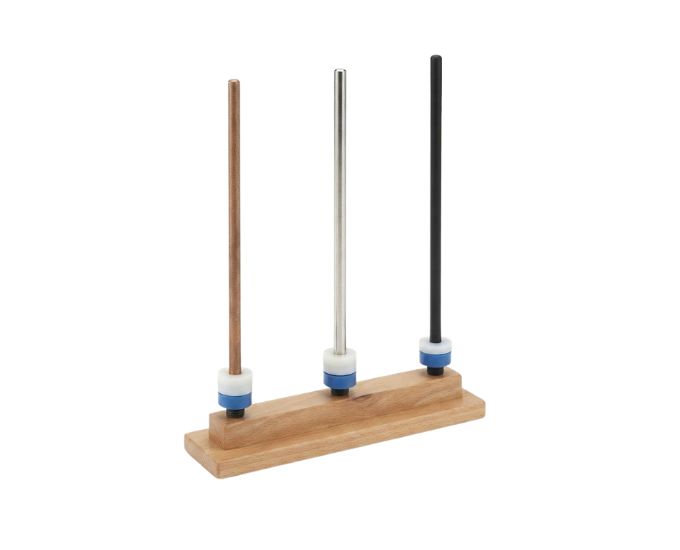
Racing Rings – Electrical Resistance Demonstration Apparatus
Model Number: MTME-32
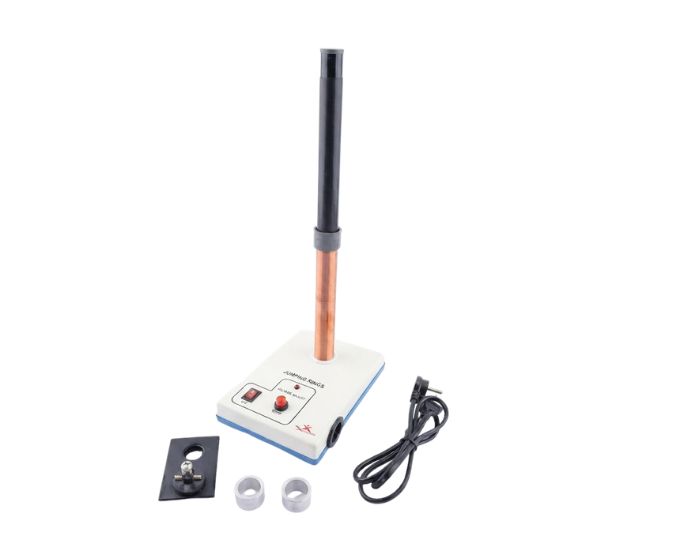
The Racing Rings apparatus is designed to compare the electrical properties of copper, aluminium, and PVC through the different falling rates of metal rings around vertical rods. The apparatus consists of three rods—one each of copper, aluminium, and PVC. When a ring magnet is dropped down the PVC rod, it falls essentially unobstructed, while its descent around the metal rods is slowed by electromagnetic effects. Since copper and aluminium have different electrical resistance, the rings fall at different rates, providing a clear comparative demonstration.
Product Specification
The Racing Rings apparatus provides a visually engaging method for comparing the electrical behaviour of copper, aluminium, and PVC using electromagnetic effects. Instead of relying only on electrical meters, the apparatus produces an easily observable difference in the rate at which rings descend along rods made from different materials.
Micro Technologies supplies the apparatus with three vertically mounted rods, consisting of one copper rod, one aluminium rod, and one PVC rod. The rods are arranged on a common supporting base for convenient side-by-side comparison.
When a suitable ring magnet is released around the PVC rod, it falls essentially unobstructed because PVC is an electrical insulator and does not support significant induced circulating currents.
The behaviour changes when the ring moves along the copper or aluminium rods. The moving magnetic field produces induced electrical currents in the conductive metal. These currents generate their own magnetic fields, which oppose the change that produced them.
This electromagnetic opposition produces a braking effect on the falling ring, causing it to descend more slowly along the conductive rods than along the PVC rod.
The effect is related to Lenz's law and electromagnetic induction. The induced magnetic field opposes the motion responsible for generating the induced currents, producing a visible example of electromagnetic damping.
Copper and aluminium have different electrical resistivities. As a result, the strength of the induced-current effect differs between the two metal rods, causing the rings to descend at different rates.
The apparatus therefore provides a convenient qualitative comparison of the electrical properties of different materials while simultaneously demonstrating electromagnetic induction, conductivity, induced currents, and magnetic braking.
Its simple three-rod configuration makes the differences between an insulating material and two conducting metals immediately observable during the same experiment.
Features
- Three vertical rod configuration
- One copper rod
- One aluminium rod
- One PVC rod
- Ring magnets used for comparison
- Demonstrates differences in electrical resistance
- Shows conductor versus insulator behaviour
- Demonstrates electromagnetic induction
- Illustrates Lenz's law
- Demonstrates electromagnetic braking
- Different ring fall rates can be observed
- Side-by-side material comparison
- Stable common supporting base
- No external electrical supply required
Benefits
- Provides an easily visible comparison between copper, aluminium, and PVC
- Demonstrates how conductivity affects induced-current behaviour
- PVC rod provides a useful insulating reference
- Different falling rates make material differences easy to observe
- Combines resistance, induction, and magnetic braking concepts in one apparatus
- Requires no external electrical power
- Simple experimental arrangement minimizes setup time
- Suitable for repeated comparative investigations
Product Specifications
| Specification | Details |
|---|---|
| Product Name | Racing Rings |
| Internal Model No. | MT-41232 |
| Product Type | Electrical Resistance & Electromagnetic Induction Apparatus |
| Number of Rods | 3 |
| Rod 1 | Copper |
| Rod 2 | Aluminium |
| Rod 3 | PVC |
| Experimental Element | Ring Magnets |
| PVC Rod Behaviour | Ring Falls Essentially Unobstructed |
| Metal Rod Behaviour | Ring Descent is Electromagnetically Retarded |
| Comparison | Copper vs. Aluminium vs. PVC |
| Principles Demonstrated | Conductivity, Induction & Lenz's Law |
| External Power Supply | Not Required |
| Primary Application | Comparative Electrical Resistance Demonstration |
Applications
- Electrical resistance comparison
- Copper and aluminium conductivity comparison
- Conductor versus insulator demonstration
- Electromagnetic induction experiments
- Lenz's law investigations
- Induced-current demonstrations
- Magnetic braking experiments
- Electromagnetic damping investigations
- Comparative material experiments
Available Variants
- MT-41232 – Standard Racing Rings Apparatus
- Copper-Aluminium-PVC Racing Rings
- Electrical Resistance Demonstrator
- Electromagnetic Braking Apparatus
- Customized configurations for bulk requirements
SKU System
- MT-RR-STD – Standard Racing Rings
- MT-RR-CAP – Copper, Aluminium & PVC Configuration
- MT-RR-IND – Induction Experiment Configuration
- MT-RR-RES – Resistance Comparison Configuration
- MT-RR-CUS – Customized Configuration
FAQs
What is the Racing Rings apparatus used for?
It is used to compare the electrical behaviour of copper, aluminium, and PVC by observing differences in the falling rates of ring magnets around the three rods.
Which rods are included in the apparatus?
The apparatus consists of three rods: copper, aluminium, and PVC.
What happens when the ring is dropped around the PVC rod?
The ring falls essentially unobstructed because PVC is an electrical insulator and does not support significant induced currents.
Why does the ring fall more slowly around the metal rods?
Movement of the magnetic ring relative to a conducting metal rod produces induced currents. Their magnetic effect opposes the motion, creating electromagnetic braking.
Why do the rings fall at different rates on copper and aluminium rods?
Copper and aluminium have different electrical resistivities. This affects the magnitude of the induced currents and therefore the strength of the electromagnetic braking effect.
Does Racing Rings demonstrate Lenz's law?
Yes. The slowing of the ring illustrates Lenz's law because the induced magnetic effect opposes the change responsible for producing it.
Does the apparatus demonstrate electromagnetic induction?
Yes. Electromagnetic induction is responsible for producing currents in the conductive rods as the magnetic rings move relative to them.
What does the PVC rod demonstrate?
The PVC rod acts as an insulating comparison. Since it does not conduct electricity like copper or aluminium, the ring experiences essentially no induced-current braking effect.
Can copper and aluminium be compared directly?
Yes. Their different electrical properties result in different ring descent rates, allowing a direct visual comparison.
Does the apparatus require electricity?
No external electrical supply is required. The effect is produced by the interaction between the moving ring magnets and the conductive rods.
What other concepts can be demonstrated?
The apparatus can also demonstrate induced currents, electromagnetic damping, magnetic braking, conductivity, and conductor-versus-insulator behaviour.
Can Racing Rings apparatus be supplied in bulk?
Yes. Micro Technologies can supply Racing Rings apparatus in bulk for laboratories, universities, colleges, research facilities, scientific equipment distributors, and institutional procurement.
Why Choose Our Products
- Copper, aluminium, and PVC rods in one apparatus
- Clear comparison of conducting and insulating materials
- Visible differences in ring fall rates
- Demonstrates electromagnetic induction and Lenz's law
- No external power source required
- Simple and reusable construction
- Suitable for comparative experiments
- Bulk supply available
Call to Action
Make electrical resistance and electromagnetic induction easier to visualize with the Racing Rings apparatus from Micro Technologies. Contact us for competitive quotations, bulk orders, distributor requirements, institutional procurement, and complete physics laboratory equipment solutions.