
Human muscle figure model
Product Specification Sheet
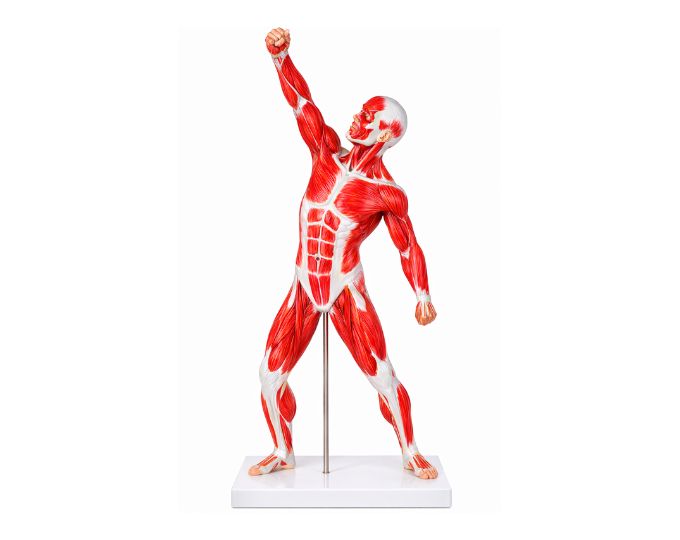
Human muscle figure model
Model Number: MT-053
The Human Muscle Figure Model is an anatomical teaching model designed to demonstrate the muscular structure of the human body. This model clearly displays the major muscles of the body, allowing students to study muscle arrangement, shape and anatomical position. It helps learners understand how muscles work together to support body movement, posture and strength. The model provides a clear visual representation of the muscular system, making it easier to study the relationship between different muscle groups. With a height of approximately 45 cm, the model offers a compact yet detailed view of the human muscular system. This anatomical model is widely used in medical colleges, nursing institutes, physiotherapy training centers and biology laboratories for teaching human anatomy and musculoskeletal structure.
Product Specification
The Human Muscle Figure Model by Micro Technologies is a precision-crafted anatomical teaching aid developed to provide a clear and detailed understanding of the human muscular system. It accurately displays the major muscle groups, enabling students and educators to study muscle arrangement, shape, and anatomical positioning with ease.
Standing at approximately 45 cm in height, this model offers a compact yet comprehensive representation of the muscular system, making it ideal for classrooms and laboratory settings with limited space. The Human Muscle Figure Model helps learners understand how muscles interact to support movement, posture, and overall body strength. It is widely used in medical colleges, nursing institutes, physiotherapy training centers, and biology laboratories for teaching musculoskeletal anatomy.
Designed for repeated educational use, the Human Muscle Figure Model ensures durability, clarity, and long-term value for institutional buyers.
Features
- Clearly displays major human muscle groups
- Compact 45 cm size for easy handling and storage
- Accurate anatomical positioning and muscle detailing
- Durable construction for long-term use
- Ideal for demonstrating muscle structure and arrangement
- Suitable for classrooms, labs, and training centers
Benefits
- Enhances understanding of muscular system structure
- Supports efficient and engaging anatomy teaching
- Space-saving design without compromising detail
- Cost-effective solution for institutional training needs
- Improves visual learning and student retention
Product Specifications
| Specification | Details |
|---|---|
| Product Name | Human Muscle Figure Model |
| Model No. | MT-053 |
| Type | Anatomical Teaching Model |
| Material | High-quality durable polymer |
| Size / Model | Approx. 45 cm |
| Usage | Medical education, anatomy training, labs |
FAQs
What is the ideal use of the human muscle figure model?
This model is primarily used for teaching and learning the structure of the human muscular system. It is ideal for medical colleges, nursing institutes, physiotherapy centers, and biology laboratories where a clear visual understanding of muscle arrangement and function is required.
Is the model detailed enough despite its compact size?
Yes, despite its compact 45 cm size, the model provides a highly detailed representation of major muscle groups. It is carefully designed to balance portability with anatomical accuracy, making it suitable for both demonstrations and individual study.
How durable is this model for daily academic use?
The model is made from high-quality, durable materials that can withstand frequent handling in classrooms and labs. Its robust construction ensures long-term usability, making it a reliable investment for institutions.
Can this model be used for physiotherapy and advanced training?
Yes, the model is suitable for both basic and intermediate-level anatomy training, including physiotherapy education. It helps learners understand muscle relationships and functions, which are essential for clinical and therapeutic studies.
Why Choose Our Products
- Manufactured to meet professional educational standards
- Durable and long-lasting for institutional environments
- Accurate anatomical detailing for reliable learning
- Easy to use, maintain, and suitable for bulk procurement
Call to Action
Enhance your anatomy training setup with reliable and space-efficient models trusted by professionals. Request a quote today or contact us for bulk orders to get the best pricing for your institution.