
Force on Conductor Balance
Product Specification Sheet
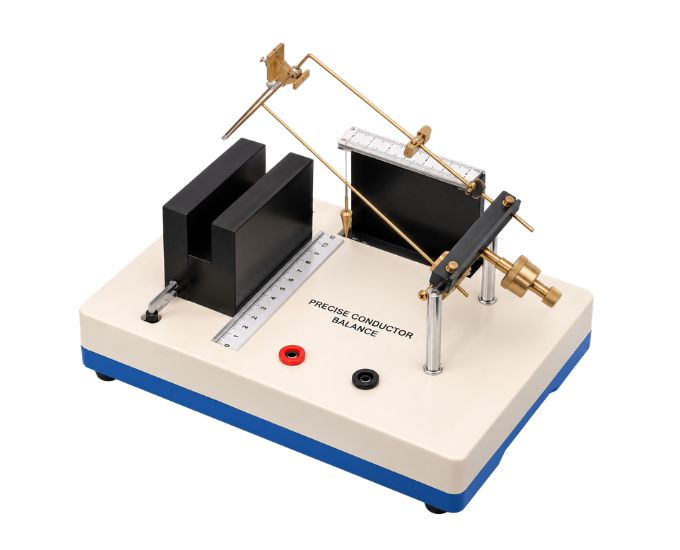
Force on Conductor Balance
Model Number: MTME-39
The Force on Conductor Balance is a precision experimental apparatus designed to demonstrate that a current-carrying conductor placed in a magnetic field experiences a force whose direction depends on the direction of current. Micro Technologies supplies the apparatus with a plastic base, white contact pillars, enamelled circuit wire, a balanced beam, knife-edge bearings, two screwed masses, a sliding rider, a powerful neodymium magnet, and a calibrated scale. The arrangement allows the electromagnetic force acting on the conductor to be balanced and measured quantitatively.
Product Specification
The Force on Conductor Balance is designed for quantitative investigation of the mechanical force produced when electric current passes through a conductor positioned within a magnetic field. The apparatus provides a practical method for observing and measuring the fundamental motor effect.
The apparatus is constructed on a plastic base approximately 9 × 6 × 1 inch and incorporates two white contact pillars. An enamelled circuit wire is arranged across the pillars to form the current-carrying section used during the experiment.
A balanced beam is supported by the pillars on two knife-edge bearings, providing low-friction movement and high sensitivity to small changes in force.
Micro Technologies provides two screwed masses in the beam system. One moving vertically is used for adjusting the sensitivity of the balance, while the other moves horizontally to establish the equilibrium or zero position when no current is flowing.
A powerful neodymium magnet is positioned so that the current-carrying conductor lies within its magnetic field. When current passes through the conductor, an electromagnetic force acts on it and disturbs the balance.
The direction of this force depends on the relative directions of the electric current and magnetic field. Reversing the current direction can therefore reverse the direction of the observed force.
A calibrated rider is used to restore the beam to equilibrium. The rider position provides a convenient method for determining the force required to balance the electromagnetic effect.
The apparatus incorporates a scale marked from 0 to 80 × 1 mm, with a rider mass of approximately 1 gram. This arrangement enables quantitative measurements rather than only qualitative observation of conductor movement.
The Force on Conductor Balance therefore provides a useful experimental setup for investigating electromagnetic force, the motor effect, current direction, magnetic-field interaction, and the relationship between electrical and mechanical quantities.
Features
- Precision Force on Conductor Balance
- Demonstrates force on a current-carrying conductor
- Powerful neodymium magnet
- Enamelled circuit wire
- Balanced beam arrangement
- Knife-edge bearing support
- Two adjustable screwed masses
- Vertical sensitivity adjustment
- Horizontal equilibrium adjustment
- Calibrated rider arrangement
- Approx. 1 g rider
- 0–80 × 1 mm scale
- Plastic supporting base
- Quantitative force measurement
- Suitable for repeated electromagnetic experiments
Benefits
- Allows electromagnetic force to be measured quantitatively
- Clearly demonstrates the motor effect
- Shows how current direction affects force direction
- Knife-edge bearings provide sensitive beam movement
- Adjustable masses allow accurate sensitivity and zero setting
- Neodymium magnet provides a strong magnetic field
- Rider-based balancing provides convenient measurement
- Compact base makes the apparatus suitable for bench-top experiments
Product Specifications
| Specification | Details |
|---|---|
| Product Name | Force on Conductor Balance |
| Internal Model No. | MT-41172B |
| Product Type | Electromagnetic Force Measuring Apparatus |
| Base Material | Plastic |
| Base Size | Approx. 9 × 6 × 1 inch |
| Contact Pillars | 2 |
| Conductor | Enamelled Circuit Wire |
| Beam Type | Balanced Beam |
| Beam Support | Knife-Edge Bearings |
| Adjustable Masses | 2 Screwed Masses |
| Magnet Type | Neodymium Magnet |
| Scale Range | 0–80 mm |
| Scale Division | 1 mm |
| Rider Mass | Approx. 1 g |
| Primary Principle | Force on a Current-Carrying Conductor |
| Primary Application | Electromagnetic Force Measurement |
Applications
- Force on current-carrying conductor experiments
- Motor effect investigations
- Electromagnetic force measurement
- Magnetic-field and current interaction experiments
- Current direction versus force direction
- Quantitative magnetism experiments
- Magnetic force balancing experiments
- Electromagnetism investigations
Available Variants
- MT-41172B – Standard Force on Conductor Balance
- Electromagnetic Force Balance
- Current-Carrying Conductor Balance
- Magnetic Force Measurement Apparatus
- Customized configurations for bulk requirements
FAQs
What is a Force on Conductor Balance used for?
It is used to demonstrate and quantitatively measure the force acting on a current-carrying conductor placed within a magnetic field.
What principle does the apparatus demonstrate?
It demonstrates the motor effect, in which a current-carrying conductor experiences a force when positioned in a magnetic field.
What type of magnet is used?
The apparatus uses a powerful neodymium magnet.
What type of conductor is provided?
An enamelled circuit wire is used as the current-carrying conductor.
What is the approximate size of the base?
The plastic base measures approximately 9 × 6 × 1 inch.
How is the beam supported?
The balanced beam is supported on two knife-edge bearings to provide sensitive movement.
What are the two screwed masses used for?
One mass moves vertically to adjust the sensitivity of the balance, while the other moves horizontally to establish equilibrium when no current is flowing.
What is the scale range?
The scale is marked from approximately 0 to 80 mm with 1 mm divisions.
What is the mass of the rider?
The calibrated rider has a mass of approximately 1 gram.
How is the electromagnetic force measured?
When current produces a force on the conductor, the balance is disturbed. The calibrated rider is repositioned until equilibrium is restored, allowing the corresponding force to be determined.
Does reversing the current affect the force direction?
Yes. Reversing the direction of current while maintaining the magnetic-field direction reverses the direction of the electromagnetic force.
Can the apparatus be used for quantitative experiments?
Yes. The calibrated scale, rider, balanced beam, and adjustment system allow quantitative force investigations.
Can Force on Conductor Balances be supplied in bulk?
Yes. Micro Technologies can supply Force on Conductor Balances in bulk for laboratories, universities, colleges, research facilities, scientific equipment distributors, and institutional procurement.
Why Choose Our Products
- Quantitative electromagnetic force measurement
- Powerful neodymium magnet
- Sensitive knife-edge beam arrangement
- Adjustable sensitivity and equilibrium
- Calibrated 1 g rider
- 0–80 mm measuring scale
- Compact and reusable construction
- Bulk supply available
Call to Action
Measure electromagnetic force with precision using the Force on Conductor Balance from Micro Technologies. Contact us for competitive quotations, bulk orders, distributor requirements, institutional procurement, and complete magnetism and electromagnetism laboratory equipment solutions.