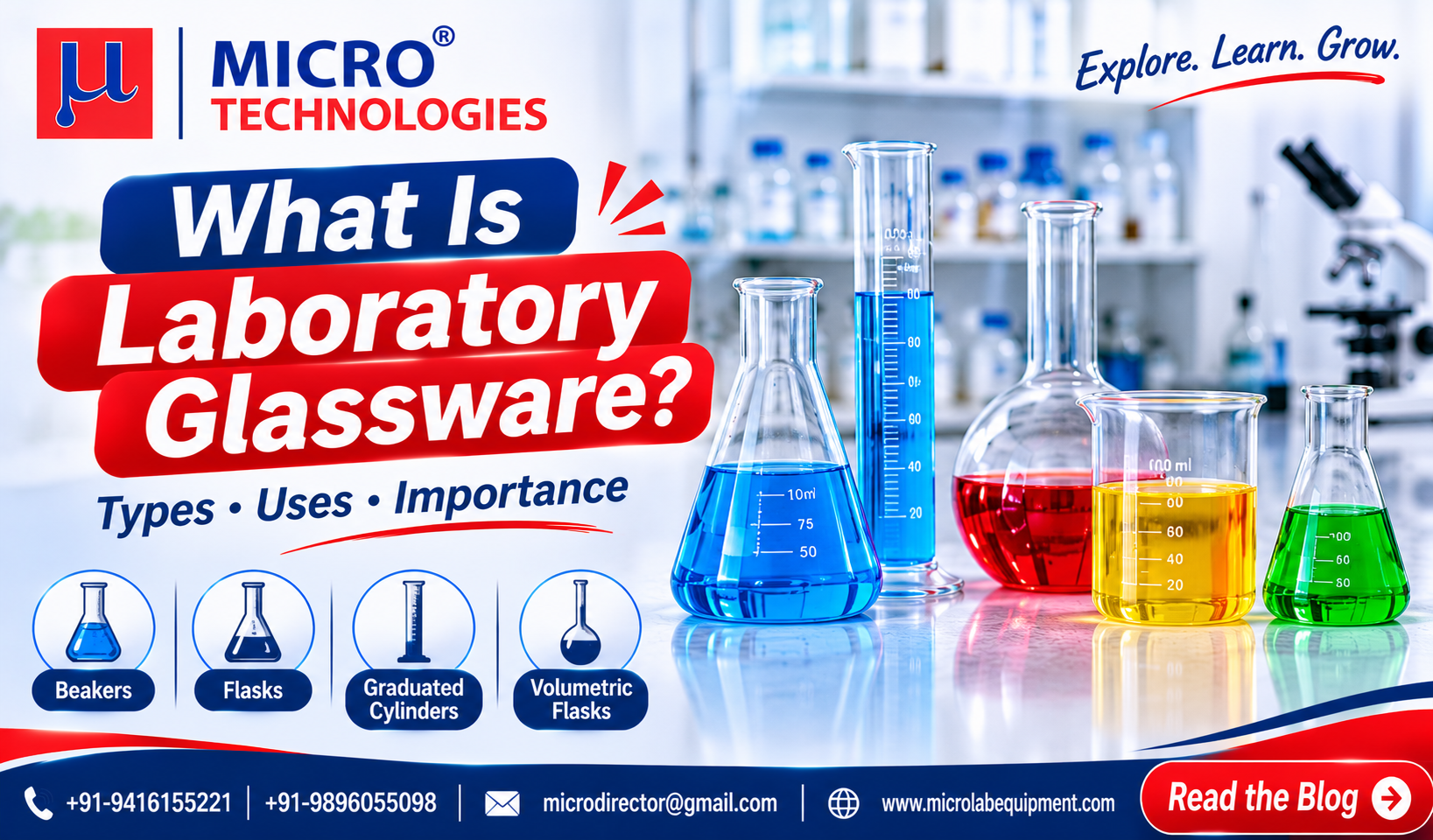
In scientific Indsutrry, Laboratory glassware consists of glass vessels and apparatus used in scientific laboratories to hold, mix, transfer, heat (when designed for it), store, filter and observe liquids or samples. Common examples include beakers, test tubes, flasks, measuring cylinders, pipettes and burettes. Calibrated volumetric glassware is designed for accurate liquid-volume measurement.
What Is the Purpose of Laboratory Glassware?
Laboratory glassware is an essential part of scientific experiments, chemical analysis, pharmaceutical research, and educational practicals. It provides suitable containers and tools for performing different laboratory operations under controlled conditions.
Unlike ordinary household glass containers, laboratory glassware is designed for specific scientific applications. Depending on its material, construction, and calibration, it can be used for handling chemicals, measuring liquids, preparing solutions, heating samples, and carrying out separation processes.
The main purposes of laboratory glassware include:
1. Holding and storing substances: Glass containers such as beakers, reagent bottles, and laboratory vials are used to hold suitable liquids, chemicals, and samples.
2. Measuring liquid volumes: Graduated cylinders, volumetric flasks, pipettes, and burettes are used for different volume measurements and transfer requirements.
3. Mixing chemical solutions: Beakers, conical flasks, and glass stirring rods help combine liquids and prepare solutions.
4. Heating laboratory materials: Suitable borosilicate glassware can be used for heating and temperature-related experiments when its design and specifications permit.
5. Separating mixtures: Funnels, separating funnels, and distillation glassware support filtration, liquid-liquid extraction, and separation procedures.
6. Supporting scientific observations: Glass slides, Petri dishes, and other suitable glass containers help researchers observe samples and conduct laboratory investigations.
The correct glassware depends on the experimental procedure, chemical compatibility, required volume accuracy, and operating temperature.
What Are the Different Types of Laboratory Glassware?
Laboratory glassware is available in different shapes, sizes, and designs. Each type is developed for a particular purpose, such as measuring, mixing, heating, transferring, or storing substances.
Here are some commonly used types of laboratory glassware and their functions.
1. Beaker
A beaker is one of the most frequently used pieces of laboratory glassware. It is a cylindrical container with straight sides, a flat bottom, and a small pouring spout.
Beakers are commonly available in capacities ranging from small laboratory sizes to larger containers. They are generally made from borosilicate glass or other suitable materials.
Main uses of a beaker:
- Holding liquids during laboratory experiments.
- Mixing chemical solutions.
- Dissolving suitable solid substances.
- Heating compatible liquids.
- Temporarily containing laboratory samples.
- Transferring liquids into other containers.
Where is it used?
Beakers are widely used in chemistry laboratories, pharmaceutical research, educational institutions, and industrial testing facilities.
Important consideration: Beaker graduation markings are generally approximate. They should not be used as substitutes for calibrated volumetric instruments when accurate measurement is required.
2. Conical Flask (Erlenmeyer Flask)
A conical flask, also called an Erlenmeyer flask, is laboratory glassware with a wide flat base, sloping sides, and a narrow neck.
Its structure makes it useful for mixing liquids through gentle swirling while helping reduce splashing.
Main uses of a conical flask:
- Mixing chemical solutions.
- Preparing laboratory mixtures.
- Holding samples during titration.
- Carrying out selected chemical reactions.
- Supporting suitable microbiological procedures.
- Temporarily holding prepared solutions.
Where is it used?
Conical flasks are commonly used in analytical chemistry, pharmaceutical laboratories, microbiology facilities, and educational laboratories.
Their narrow neck makes them particularly useful when a solution needs to be swirled repeatedly during an experiment.
3. Volumetric Flask
A volumetric flask is specialized laboratory glassware designed to contain a precisely specified volume of liquid at its stated calibration temperature.
It generally features a bulb-shaped body, narrow neck, calibration mark, and stopper.
Main uses of a volumetric flask:
- Preparing standard solutions.
- Making solutions of known concentrations.
- Diluting concentrated solutions to a specified final volume.
- Preparing reagents for analytical testing.
- Supporting quantitative chemical analysis.
Where is it used?
Volumetric flasks are commonly used in analytical chemistry, pharmaceutical testing, quality-control laboratories, and scientific research.
Important feature: A volumetric flask is calibrated for a particular volume. It is not intended for general-purpose heating or rough liquid measurement.
4. Measuring Cylinder (Graduated Cylinder)
A measuring cylinder is a tall, narrow laboratory container with volume graduation markings. It is designed to measure liquid volumes more appropriately than general-purpose vessels such as beakers.
It is commonly manufactured from glass or suitable laboratory plastic.
Main uses of a measuring cylinder:
- Measuring liquids during experiments.
- Preparing chemical mixtures.
- Measuring solvents and water.
- Transferring specified liquid quantities.
- Supporting educational volume-measurement practicals.
Where is it used?
Measuring cylinders are found in chemistry, pharmaceutical, educational, food-testing, and research laboratories.
Important consideration: Read the liquid level at eye height and follow the appropriate meniscus-reading procedure. Select the cylinder according to the required measurement tolerance.
5. Laboratory Test Tube
A test tube is a narrow cylindrical glass container with an open upper end and a rounded bottom. It is designed to hold small quantities of substances.
Test tubes are used in a wide variety of laboratory demonstrations and experimental procedures.
Main uses of test tubes:
- Holding small liquid samples.
- Performing small-scale chemical reactions.
- Observing color changes and precipitation.
- Conducting suitable heating experiments.
- Preparing and temporarily holding specimens.
Where is it used?
Test tubes are commonly used in chemistry, biology, microbiology, medical, and educational laboratories.
Different sizes and designs are available depending on the sample, temperature, and experimental requirements.
6. Laboratory Pipette
A pipette is laboratory glassware used to transfer a measured quantity of liquid from one container to another.
Different pipettes are designed for different volume ranges and accuracy requirements.
Common types of laboratory pipettes:
- Volumetric pipette.
- Graduated pipette.
- Mohr pipette.
- Serological pipette.
- Pasteur pipette.
Main uses of a pipette:
- Transferring measured liquid volumes.
- Preparing chemical solutions.
- Handling liquid samples.
- Adding reagents during experiments.
- Performing analytical procedures.
Volumetric pipettes are designed to deliver a specified volume, whereas graduated pipettes provide multiple measurement markings.
Safety point: Use a suitable pipette filler or mechanical pipetting device. Never pipette liquids by mouth.
7. Laboratory Burette
A burette is a long, graduated glass tube fitted with a stopcock at its lower end. It is used to dispense controlled quantities of liquid.
Burettes are particularly important in analytical chemistry and volumetric analysis.
Main uses of a burette:
- Performing acid-base titration.
- Dispensing measured liquid quantities.
- Conducting volumetric analysis.
- Adding titrant gradually to a sample.
- Supporting quantitative chemical experiments.
Where is it used?
Burettes are widely used in chemistry laboratories, pharmaceutical testing facilities, academic institutions, and analytical research laboratories.
A burette differs from a pipette because it can dispense variable measured volumes through controlled operation of its stopcock.
8. Laboratory Funnel
A laboratory funnel is a cone-shaped glass apparatus with a wide opening and a narrow stem. It is used for transferring liquids and supporting filtration procedures.
Main uses of a laboratory funnel:
- Transferring liquids into narrow-necked containers.
- Supporting filter paper.
- Separating insoluble solids from liquids.
- Pouring suitable powders and liquid samples.
- Supporting gravity filtration.
Common types:
- Glass funnel.
- Filter funnel.
- Powder funnel.
- Separating funnel.
- Büchner funnel.
The funnel design should match the type of transfer or filtration required.
9. Separating Funnel
A separating funnel is a specialized glass vessel equipped with a stopcock near its lower end. It is used to separate immiscible liquids that form different layers.
Main uses of a separating funnel:
- Liquid-liquid extraction.
- Separating oil and water.
- Separating suitable solvent layers.
- Isolating components from liquid mixtures.
- Supporting chemical purification procedures.
Where is it used?
Separating funnels are commonly used in organic chemistry, pharmaceutical research, chemical laboratories, and extraction processes.
10. Watch Glass
A watch glass is a shallow, circular piece of glass with a slightly curved surface.
It is commonly used for handling small quantities of laboratory materials.
Main uses of a watch glass:
- Holding small solid samples.
- Covering beakers to reduce contamination.
- Supporting small-scale evaporation.
- Weighing or displaying solid substances.
- Temporarily holding laboratory materials.
Watch glasses are commonly used in chemistry laboratories, educational institutions, and research facilities.
11. Reagent Bottle
A reagent bottle is a laboratory container designed for storing suitable chemicals and prepared solutions.
It may be manufactured from clear or coloured glass, depending on the storage requirements.
Main uses:
- Storing laboratory reagents.
- Holding prepared chemical solutions.
- Organising chemicals.
- Protecting suitable contents from contamination.
- Storing light-sensitive materials in appropriate amber bottles.
Important consideration: The bottle material, closure and storage conditions should be compatible with the chemical being stored. Every container should be correctly labelled.
12. Glass Stirring Rod
A glass stirring rod is a straight cylindrical glass tool used to mix liquids and assist with liquid transfer.
Main uses:
- Stirring chemical solutions.
- Helping dissolve suitable substances.
- Mixing laboratory mixtures.
- Guiding liquid while pouring.
- Supporting basic sample preparation.
It is simple laboratory glassware but is widely used during everyday chemistry practicals.
13. Glass Condenser
A laboratory condenser is a glass apparatus used to cool vapours and convert them into liquids. It is commonly used in distillation and reflux arrangements.
Common types include:
- Liebig condenser.
- Allihn condenser.
- Graham condenser.
- Dimroth condenser.
Main uses:
- Condensing vapours during distillation.
- Supporting reflux operations.
- Recovering suitable volatile solvents.
- Cooling vapours in chemical processing.
- Supporting laboratory separation procedures.
Different condenser designs provide different cooling arrangements and should be chosen according to the experimental setup.
14. Desiccator
A desiccator is a sealed laboratory container designed to maintain a low-moisture environment using a suitable desiccant.
Glass desiccators commonly include a lid, a body and an internal plate that holds the sample above the desiccant.
Main uses:
- Keeping moisture-sensitive materials dry.
- Cooling suitable heated samples under controlled dry conditions.
- Storing hygroscopic substances.
- Preventing unwanted moisture absorption.
- Supporting certain weighing and analytical procedures.
15. Laboratory Vials
Laboratory vials are small containers used for holding, storing and transporting suitable samples.
They may be made from glass and are available in different shapes, capacities and closure types.
Main uses:
- Holding analytical samples.
- Storing prepared solutions.
- Collecting small quantities of laboratory materials.
- Keeping suitable reagents.
- Supporting laboratory sample handling.
Vial selection depends on the sample, closure compatibility, chemical resistance and storage conditions.
16. Petri Dish and Microscope Slides
Glass Petri dishes and microscope slides are specialised items used in biological and scientific observations.
Petri dishes:
- Holding suitable culture media.
- Supporting microbiological demonstrations.
- Observing biological samples.
- Conducting selected sample studies.
Microscope slides:
- Holding specimens for microscopic examination.
- Supporting sample preparation.
- Observing biological structures.
- Preserving prepared specimens for examination.
Petri dishes and slides are also available in plastic or other materials, depending on the application.
What Materials Are Used to Make Laboratory Glassware?
The material used to manufacture laboratory glassware affects its chemical compatibility, thermal performance, transparency and suitability for particular procedures.
Different glass compositions are selected according to the intended application.
1. Borosilicate Glass
Borosilicate glass is widely used for laboratory glassware because of its comparatively low thermal expansion and good resistance to many chemicals.
It is commonly selected for products that may be exposed to heating, temperature changes and laboratory reagents.
Common applications:
- Beakers.
- Conical flasks.
- Volumetric flasks.
- Test tubes.
- Laboratory condensers.
- Distillation glassware.
- Reagent bottles.
Its suitability still depends on the chemical, temperature, concentration and operating conditions.
2. Soda-Lime Glass
Soda-lime glass is a widely used glass composition found in many general glass products and some laboratory containers.
It may be suitable for applications where the temperature and chemical requirements are compatible with the material.
Common applications:
- Certain storage bottles.
- General-purpose containers.
- Laboratory vials.
- Selected glass accessories.
It should not automatically be treated as interchangeable with borosilicate glass for heating applications.
3. Quartz Glass
Quartz glass is manufactured primarily from high-purity silica and has specialised optical and thermal properties.
It is used in applications where ordinary laboratory glass may not meet the required temperature or optical-transmission conditions.
Common applications:
- Specialised laboratory vessels.
- Optical applications.
- UV-related laboratory equipment.
- High-temperature scientific processes.
Quartz glass is a specialised material and is generally selected for specific technical requirements.
4. Amber Glass
Amber glass describes coloured glass rather than a completely separate base glass composition. Its dark appearance helps reduce light exposure for suitable light-sensitive contents.
Common applications:
- Light-sensitive reagent bottles.
- Chemical storage containers.
- Laboratory sample bottles.
- Specialised pharmaceutical containers.
What Is Heavy-Wall Laboratory Glassware?
Heavy-wall glassware refers to glassware manufactured with thicker walls for particular construction or handling requirements.
Wall thickness is a design feature rather than a separate glass composition. It does not automatically make a product suitable for every high-temperature or pressure application.
Volumetric vs Non-Volumetric Laboratory Glassware
One of the most important distinctions when selecting laboratory glassware is whether the product is designed for general handling or calibrated volume measurement.
Volumetric Glassware
Volumetric glassware is calibrated to contain or deliver a specified volume within a defined tolerance.
Examples include:
- Volumetric flasks.
- Volumetric transfer pipettes.
- Graduated pipettes.
- Burettes.
- Graduated measuring cylinders.
These products are used when the measured or delivered volume matters to the experiment or analytical result.
Non-Volumetric Glassware
Non-volumetric glassware is mainly designed for general laboratory operations rather than precise liquid-volume measurement.
Examples include:
- Beakers.
- Conical flasks.
- Test tubes.
- Round-bottom flasks.
- Watch glasses.
- General-purpose funnels.
Their graduation markings, where present, are generally approximate.
What Do TC and TD Mean on Laboratory Glassware?
You may find these markings on calibrated volumetric glassware:
TC – To Contain: The instrument is calibrated to contain the specified volume when filled to the calibration mark.
TD – To Deliver: The instrument is calibrated to deliver the specified volume under the stated conditions and correct operating procedure.
A volumetric flask is generally a TC instrument, while many transfer pipettes and burettes are TD instruments.
These markings are important when choosing glassware for accurate analytical work.
What Is the Difference Between Class A and Class B Laboratory Glassware?
Class A and Class B are commonly used designations for the tolerance of specified volumetric glassware.
Class A Glassware
Class A glassware is manufactured to tighter volumetric tolerances and is generally selected for analytical work where higher volume accuracy is required.
Common examples:
- Class A volumetric flasks.
- Class A transfer pipettes.
- Class A burettes.
- Class A graduated cylinders.
Class B Glassware
Class B glassware has comparatively wider permitted tolerances than equivalent Class A instruments.
It may be suitable for routine laboratory procedures where the required accuracy is less demanding.
Important selection point: Always check the specific instrument standard, capacity, marking and stated tolerance. Class designation alone should not replace verification of the product specification.
How to Choose the Right Laboratory Glassware?
Selecting the correct laboratory glassware involves more than checking the product name and capacity. The material, calibration, intended use and operating environment should all be considered.
1. Identify the Intended Application
First, determine whether the glassware is required for mixing, storing, heating, transferring, measuring or filtering substances.
For example, a beaker is suitable for general liquid handling, while a calibrated volumetric flask is appropriate for preparing a solution to a specified volume.
2. Select the Appropriate Glass Material
Check whether borosilicate, soda-lime, quartz or another specialised material is appropriate for the chemicals and temperature involved.
Review the manufacturer's chemical compatibility and operating-temperature information.
3. Check Capacity and Dimensions
Choose the size according to the expected sample volume and the laboratory procedure.
Using an excessively large or small vessel may make handling inconvenient or affect the suitability of the measurement.
4. Review Calibration and Accuracy
If the glassware is required for measurement, check its calibration marking, tolerance class and intended method of use.
Look for relevant TC or TD markings where applicable.
5. Consider Temperature Requirements
Not all laboratory glassware is designed for direct heating or rapid temperature changes.
Confirm that the product can withstand the intended conditions and avoid sudden temperature shock.
6. Inspect Product Construction
Check the rim, base, joints, graduations, stopper and other relevant features.
The finish and dimensions should be suitable for the intended laboratory application.
7. Check Quality Documentation
For calibrated volumetric glassware, review applicable specifications, calibration information and quality documentation.
For other products, check the relevant product datasheet and material information.
8. Compare Supplier Support
Consider the supplier's product range, specifications, quotation clarity, availability, delivery arrangements and after-sales support.
A suitable supplier should help buyers identify products according to their actual laboratory requirements.
Applications of Laboratory Glassware in Different Industries
Laboratory glassware is used in numerous industries because different scientific and testing procedures require suitable vessels, containers and transfer tools.
1. Chemistry Laboratories
Chemistry laboratories use beakers, conical flasks, measuring cylinders, pipettes, burettes and other glassware for preparing solutions, mixing chemicals, performing reactions and carrying out analytical experiments.
2. Pharmaceutical Laboratories
Pharmaceutical laboratories use suitable laboratory glassware for sample preparation, reagent storage, solution preparation, analytical testing and research activities.
The required glassware depends on the formulation, testing method and quality-control procedure.
3. Medical and Diagnostic Laboratories
Medical and diagnostic facilities may use glass sample containers, slides, vials, test tubes and other suitable glass products for sample collection, preparation and examination.
The choice depends on the test method and whether disposable or reusable materials are appropriate.
4. Educational Institutions
Schools, colleges and universities use laboratory glassware to teach scientific concepts and demonstrate experiments.
Beakers, test tubes, flasks, funnels and measuring cylinders are frequently used in chemistry and general science practicals.
5. Research and Development Laboratories
Research laboratories use specialised and general-purpose glassware for experimental preparation, material studies, solvent handling, extraction and scientific investigation.
6. Food and Beverage Testing Laboratories
Food-testing laboratories may use suitable glassware for sample preparation, chemical analysis, solution measurement and selected testing procedures.
The material and cleaning requirements should match the substances and analytical methods involved.
How to Clean and Maintain Laboratory Glassware
Cleaning and maintenance are important for preserving laboratory glassware and reducing the risk of sample contamination.
Follow suitable laboratory procedures for the type of material and chemical residue.
1. Clean After Use
Remove chemical residues according to the laboratory's approved cleaning procedure. Do not allow substances to remain unnecessarily in containers after experiments.
2. Use Compatible Cleaning Agents
Choose cleaning solutions according to the glass material and substances previously handled.
Avoid chemicals that may damage the glass, markings, surface treatment or attached components.
3. Rinse Thoroughly
After cleaning, rinse glassware appropriately to remove remaining detergent or cleaning-agent residues.
Where required by the application, use suitable purified or deionised water for the final rinse.
4. Dry Properly
Allow glassware to dry using an appropriate method. Some procedures require clean, dry glassware, while others may permit the use of rinsed but wet equipment.
Follow the requirements of the specific experiment or analytical method.
5. Inspect for Damage
Check glassware for cracks, chips, scratches and damaged joints.
Damaged glassware should be removed from use where it may cause injury, leakage or unreliable results.
6. Store Glassware Carefully
Store glassware in clean, dry and suitable storage areas.
Avoid stacking or placing delicate glassware where it may fall, strike other objects or become contaminated.
7. Prevent Thermal Shock
Avoid sudden heating or cooling that could cause glass to crack. Use glassware only within its specified temperature conditions and follow appropriate heating and cooling procedures.
Common Mistakes to Avoid When Using Laboratory Glassware
Incorrect glassware selection or handling can affect experimental results and create avoidable safety problems.
Some common mistakes include:
- Using a beaker for precise volumetric measurement.
- Heating volumetric flasks directly.
- Selecting glassware without checking chemical compatibility.
- Ignoring Class A and Class B tolerance requirements.
- Assuming all laboratory glass can withstand sudden temperature changes.
- Using cracked or chipped glassware.
- Storing chemicals in unsuitable containers.
- Ignoring calibration markings and TC/TD specifications.
- Using inappropriate cleaning agents.
- Storing glassware without adequate protection.
Understanding the intended function and limitations of each product helps prevent these errors.
Laboratory Glassware Manufacturer and Supplier in India – Micro Technologies
Laboratory glassware is required for scientific education, pharmaceutical research, chemical testing, industrial laboratories, and many other applications.
Choosing a suitable product involves evaluating the material, capacity, construction, intended use, and technical specifications.
Micro Technologies is an Indian laboratory equipment manufacturer and supplier offering scientific, laboratory, and educational product categories for different institutional and professional requirements.
Its laboratory product range includes glassware and other laboratory supplies that can be explored according to the needs of schools, colleges, universities, research facilities, and industries.
Explore Laboratory Glassware and Related Products
Laboratory Glassware: Explore glassware for holding, measuring, transferring, and handling suitable laboratory samples.
https://www.microlabequipment.com/products/labware/glassware
Laboratory Equipment: Discover a range of scientific equipment for laboratory applications.
https://www.microlabequipment.com/laboratory-equipment
Why Consider Micro Technologies?
- Laboratory and scientific product categories.
- Glassware and laboratory apparatus options.
- Products for educational and research institutions.
- Equipment information for different applications.
- Institutional and bulk procurement enquiries.
- Product selection according to laboratory requirements.
Planning to Purchase Laboratory Glassware?
Whether you need glassware for a chemistry laboratory, pharmaceutical testing facility, research centre or educational institution, begin by identifying the required products, capacities, materials and specifications.
Visit Micro Technologies at https://www.microlabequipment.com/ to explore available products and discuss your laboratory glassware requirements.
Micro Technologies – Your Trusted Laboratory Equipment Manufacturer and Supplier.
Frequently Asked Questions About Laboratory Glassware
What are the different types of laboratory glassware?
Common types include beakers, conical flasks, volumetric flasks, measuring cylinders, test tubes, pipettes, burettes, funnels, watch glasses, reagent bottles, separating funnels, condensers and desiccators.
Why is borosilicate glass used in laboratories?
Borosilicate glass is widely used because it has relatively low thermal expansion and good resistance to many chemicals. It is suitable for many laboratory applications involving heating and chemical handling, subject to the material specifications and operating conditions.
Which laboratory glassware is used for accurate liquid measurement?
Volumetric flasks, transfer pipettes, graduated pipettes, burettes and calibrated measuring cylinders are used for different volume-measurement tasks. The appropriate instrument depends on the required accuracy and whether the volume must be contained or delivered.
What is the difference between a beaker and a measuring cylinder?
A beaker is primarily used for holding, mixing and heating suitable liquids, while a measuring cylinder is specifically designed to measure liquid volumes. Beaker graduations are generally approximate, whereas calibrated measuring cylinders provide defined measurement tolerances.
What is the difference between volumetric and non-volumetric glassware?
Volumetric glassware is calibrated to contain or deliver specified liquid volumes within defined tolerances. Non-volumetric glassware is mainly used for general laboratory tasks such as mixing, heating, holding, and storing materials.
What is the difference between Class A and Class B laboratory glassware?
Class A volumetric glassware generally has tighter permitted measurement tolerances than equivalent Class B glassware. Class A is preferred when greater volumetric accuracy is required, while Class B may be suitable for less demanding routine applications.
Can all laboratory glassware be heated?
No. Not every glassware item is suitable for direct heating. Heating suitability depends on the glass composition, wall construction, design and manufacturer specifications. Volumetric flasks and other precision glassware should not be directly heated unless specifically permitted.
How should laboratory glassware be cleaned and stored?
Clean glassware using a suitable laboratory procedure and compatible cleaning agents. Rinse thoroughly, dry as required, inspect for damage and store in a clean, protected location to reduce contamination and breakage.
10. How do I choose a laboratory glassware supplier in India?
Check the supplier's product range, material specifications, capacities, calibration information, quality documentation, pricing, availability and after-sales support. Choose products according to your actual laboratory application rather than relying on product names alone.
Conclusion
Laboratory glassware is an essential part of scientific research, laboratory education, pharmaceutical testing and chemical analysis. From basic beakers and test tubes to specialised volumetric flasks, pipettes, burettes, condensers and separating funnels, every glassware item serves a particular purpose.
Selecting suitable glassware requires understanding its material, construction, capacity, measurement accuracy and intended application. Correct handling, cleaning and storage are equally important for maintaining product condition and supporting reliable laboratory work.
For educational institutions, research centres, pharmaceutical facilities and industrial laboratories looking for laboratory glassware and scientific products, Micro Technologies offers a range of laboratory equipment categories to explore.
Visit Micro Technologies to discover relevant products and discuss your laboratory requirements.