What laboratory rubberware products does every research lab need?
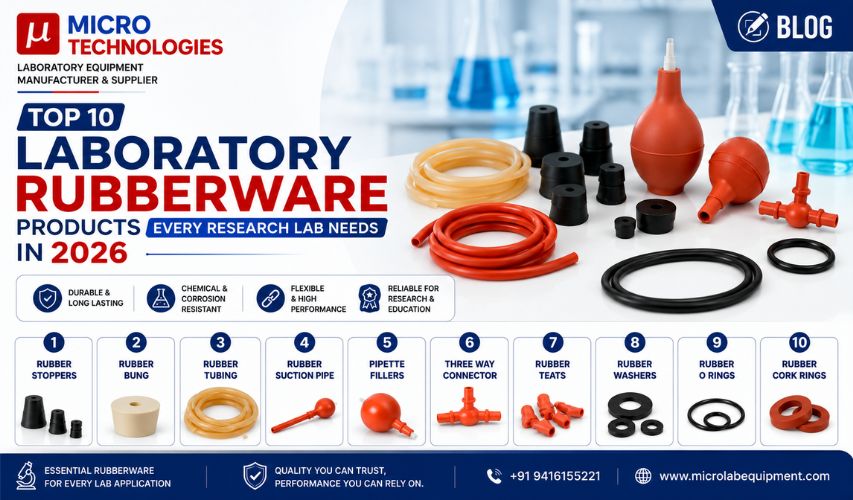
The 10 essential lab rubberware products are rubber stoppers, silicone rubber tubing, rubber pipette bulbs, rubber O-rings and gaskets, rubber lab mats, rubber connectors and adapters, neoprene tubing, rubber septum caps, rubber finger cots, and rubber diaphragm valves. Each product serves a critical sealing, fluid transfer, or safety function in pharmaceutical, research, and industrial laboratories.
Why Laboratory Rubberware Is the Backbone of Every Research Lab
The global laboratory consumables market was worth USD 15.8 billion in 2024. It is expected to reach USD 26.58 billion by 2030. This reflects an 8.65% CAGR. Growth is mainly driven by rising R&D investment in pharmaceuticals and biotechnology.
Within this expanding ecosystem, laboratory rubberware plays a role that is easy to underestimate but impossible to replace. From sealing a flask under vacuum to safely transferring a corrosive reagent, rubber-based lab products sit at the intersection of safety, precision, and compliance. As a trusted laboratory rubberware manufacturer and supplier, Micro Technologies helps research institutions, pharmaceutical companies, and industrial laboratories equip their operations with the right rubberware — products that meet international standards and perform under real laboratory conditions.
This article covers the 10 essential laboratory rubberware products every research lab should have in 2025 — what they are, why they matter, the right material to choose, and how to select a reliable lab rubberware supplier.
What Is Laboratory Rubberware?
Laboratory rubberware refers to a category of lab consumables and semi-durable products manufactured from natural rubber, silicone, neoprene, butyl rubber, nitrile (NBR), or EPDM elastomers. These products are engineered to provide chemical resistance, sealing integrity, temperature stability, and flexibility in laboratory settings.
Common applications include:
- Sealing and containment of liquids, gases, and biological samples
- Fluid and gas transfer between laboratory apparatus
- Vacuum system sealing
- Protection of lab personnel and bench surfaces
- Precise liquid handling through pipettes and dispensers
The choice of rubber material is critical. As GlobalSpec’s Laboratory Stoppers Selection Guide notes, common laboratory stopper materials include rubber, silicone, and glass. These materials are chosen for flexibility or rigidity. They also resist chemicals and form a tight seal. The same principle governs all lab rubberware selection.
Top 10 Laboratory Rubberware Products Every Research Lab Needs in 2025
1. Rubber Stoppers (Rubber Bungs / Rubber Corks)
What They Are: Rubber stoppers — also called rubber bungs or rubber corks — are tapered, pliable plugs that create airtight or watertight seals in the openings of laboratory glassware including test tubes, flasks, bottles, and vials.
Why Labs Need Them: Laboratory rubber stoppers are essential for containing liquids, gases, biological samples, chemicals, and reagents during storage, experimentation, and analysis, while preventing contamination, evaporation, or spillage in controlled laboratory environments.
Sizing Standard: They conform to standardized sizing systems, typically numbered from #000 to #16, with specific top and bottom diameters to ensure compatibility with various container openings, as recommended by ASTM specifications for laboratory equipment.
Material Options & When to Use Each:
Silicone: Silicone stoppers offer excellent resistance to water, ozone, and extreme temperatures. Ideal for high-temperature applications and pharmaceutical labs.
Neoprene: Neoprene provides good protection against oils, alcohols, and mild acids. Best where rubber would be attacked by reagents.
Butyl Rubber: Butyl rubber excels in low gas permeability and resistance to strong oxidizing agents. Widely used in parenteral drug packaging.
Pro Tip from Micro Technologies: Always match stopper size to container opening precisely. As confirmed by Thomas Scientific, neoprene stoppers can be used in areas where rubber would be attacked by reagents or solvents. Selecting the wrong material is a leading cause of container seal failure in research labs.
2. Silicone Rubber Tubing
What It Is: Flexible, heat-resistant tubing manufactured from medical or lab-grade silicone, used for transferring fluids and gases between laboratory components.
Why Labs Need It: In laboratory and analytical settings, silicone tubing's flexibility, non-contaminating properties, and resistance to a broad range of chemicals make it indispensable for sample conveyance in instrumentation, chromatography, fluid handling, and peristaltic pump applications.
Key Performance Properties: Silicone rubber tubing maintains excellent thermal stability with an operating range from –50°C to 250°C, with high flexibility and kink resistance for smooth fluid or gas transfer.
Compliance Standards: Compliance with USP Class VI, FDA, and NSF-51 standards adds an additional layer of quality assurance for regulated industries.
When to Choose Platinum-Cured Silicone: Platinum-cured silicone tubing minimizes extractables and leachable, which is critical in maintaining the integrity and viability of harvested cells — making it the gold standard for bioprocessing and pharmaceutical fluid transfer.
Alternative: Neoprene Rubber Tubing is the preferred choice when handling petroleum-based substances, as it provides good resistance to oils, greases, and moderate chemicals.
3. Rubber Pipette Bulbs (Safety Pipette Fillers)
What They Are: Rubber or silicone bulbs that attach to the top of a pipette to create suction for aspirating liquids — replacing the dangerous practice of mouth pipetting.
Why Labs Need Them: Using the right aspirator improves safety. It prevents mouth pipetting and reduces exposure to corrosive, toxic, or biological substances. It also allows smoother aspiration and dispensing.
How They Work: The classic three-valve format identifies three key functions: A (Air) releases air from the bulb to prepare it for aspiration, S (Suction) creates suction so the liquid rises through the pipette, and E (Empty) releases the aspirated liquid in a controlled manner.
Size Range: Rubber pipette bulbs come in small, medium, large, and special shapes. They fit pipettes from 1 mL to 50 mL.
Autoclavable Option: Per Medilab Exports' product documentation: silicone bulbs are autoclavable at standard laboratory conditions, making them reusable across sterile workflows.
Who Uses Them: Rubber suction bulbs are suitable for industrial and mineral laboratories, agricultural laboratories, food laboratories, and chemical laboratories.
4. Rubber O-Rings and Gaskets
What They Are: These are round or flat seals. They are made from elastomers. Examples include nitrile (Buna-N), fluorocarbon (Viton/FKM), silicone, EPDM, and FFKM (perfluoro elastomer). They help prevent fluid and vapor leaks in laboratory equipment.
Why Labs Need Them: Rubber seals, O-rings, and gaskets all serve the same basic function: to join two parts of a machine or apparatus by filling and sealing the space between them. This prevents fluid and vapor leakage, keeps debris out, and maintains pressure, ensuring safety and proper function.
Vacuum-Grade Performance: Compressing an O-ring by 25% to 35% with a flange surface finish of 32 rms or better will form a vacuum seal compatible with 10⁻⁷ Torr or mbar.
Material Selection Guide:
Buna-N is a synthetic rubber that is inexpensive, resistant to helium, and useful in applications not heated above 80°C.
Viton is widely used for O-rings, valve seals, and gaskets in temperatures up to 150°C. Low outgassing makes it suitable for both high and ultrahigh vacuum systems.
Important Exclusion: A notable exception for vacuum service is Teflon — it does not allow adequate compression to form a reliable, vacuum-tight seal.
5. Rubber Lab Bench Mats (Safety Mats)
What They Are: Non-slip, chemical-resistant rubber mats placed on laboratory bench surfaces to protect equipment, prevent slipping, and absorb impact from accidental drops.
Why Labs Need Them: Genie Scientific’s lab safety guide says anti-fatigue lab mats can reduce muscle and joint strain. They can also improve circulation. This helps create a safer, more productive lab. It supports scientists and technicians who stand for long periods.
Silicone Variant Performance: Non-slip laboratory safety mats made of silicone rubber are temperature resistant up to +260°C — making them suitable even near hot plates and heat blocks.
Sterile Environment Applications: Sterile room anti-fatigue mats are perfect for laboratories and operating rooms that require a microbe-free environment, with anti-microbial surfaces that withstand extensive sterilization in an autoclave.
Chemical Resistance: Lab bench rubber mats from quality lab rubberware suppliers are formulated to resist common chemicals and solvents, with beveled edges for worker safety — as documented by Mats Inc. product specifications.
6. Rubber Connectors and Adapters
What They Are: Short-body rubber pieces used to connect two glass or plastic tubes of the same or different diameters, creating flexible, airtight joins between laboratory apparatus components.
Why Labs Need Them: In complex distillation setups, vacuum filtration systems, or any multi-component lab assembly, rigid connections are a liability. Rubber connectors absorb vibration, accommodate minor misalignments, and maintain airtight seals under pressure changes that would crack glass-to-glass joints.
Common Types Listed by Micro Technologies' Rubberware Catalogue: Rubber adapters are categorized alongside rubber mats, rubber teats, rubber corks, rubber sheets, and rubber tubing — all part of the broader lab rubberware family used in apparatus assembly.
Material: Typically manufactured from natural rubber or neoprene, with silicone variants available for high-temperature setups.
7. Neoprene Rubber Tubing
What It Is: Tubing manufactured from neoprene (polychloroprene) rubber, specifically engineered for applications involving oils, greases, and moderate organic solvents where standard natural rubber would degrade.
Why Labs Need It: Neoprene rubber tubing provides good resistance to oils, greases, and moderate chemicals, and is commonly used in laboratories handling petroleum-based substances.
Chemical Resistance Profile: Neoprene provides good protection against oils, alcohols, and mild acids — making it suitable for a broader range of lab chemicals than natural rubber.
Temperature Range: Neoprene stoppers, per Thomas Scientific's product specifications, withstand exposure to temperatures up to 120°C, making neoprene-family products viable for moderate-heat lab setups.
When to Use It Over Silicone: Choose neoprene tubing when cost efficiency matters more than extreme temperature performance, or when oil-containing reagents are in use. Choose silicone when biocompatibility, USP Class VI compliance, or temperatures above 150°C are required.
8. Rubber Septa (Septum Caps)
What They Are: Thin, disk-shaped rubber membranes used to seal vials, bottles, and chromatography columns. They allow needle penetration (for syringe access or gas injection) without releasing the sealed atmosphere.
Why Labs Need Them: Septa are the critical interface between sealed containers and analytical instruments in HPLC, GC, and headspace sampling. A low-quality septum leaches into the sample or produces bleed peaks in chromatograms — directly compromising analytical results.
Material Considerations: Butyl rubber is manufactured from natural or synthetic rubber compounds and adapts to container openings, forming a reliable barrier that protects contents while maintaining product integrity. Butyl and silicone septa are the most common in chromatography vials.
Key Requirement: Chemical inertness and low extractables. Silicone-faced PTFE septa are preferred in pharmaceutical labs where contamination risk from rubber extractables must be minimized.
9. Rubber Finger Cots
What They Are: Small, thimble-shaped rubber or latex sleeves that cover individual fingers, providing protection during handling of small components, slides, or sensitive lab materials without requiring full gloves.
Why Labs Need Them: In microelectronics labs, histology, pathology, and precision assembly within research environments, full gloves can reduce tactile sensitivity. Finger cots provide targeted chemical and contamination protection while preserving dexterity.
Material: Available in latex (natural rubber), nitrile, and anti-static materials. Nitrile finger cots are preferred in labs where latex allergy is a concern — consistent with laboratory PPE best practices documented by Santa Cruz Biotechnology, whose UltraCruz® lab supply line includes a comprehensive range of gloves and protective consumables.
Usage Context: Finger cots are listed among essential laboratory consumables alongside gloves, pH strips, and general labware by leading institutional lab supply programs.
10. Rubber Diaphragm Valves (Pinchcocks / Screw Clamps)
What They Are: Rubber-bodied or rubber-sealed flow-control devices used on flexible tubing to start, stop, or regulate fluid and gas flow through a laboratory setup.
Why Labs Need Them: In vacuum filtration, column chromatography, gas distribution manifolds, and bioreactor systems, precise flow control is non-negotiable. Rubber diaphragm valves provide leak-free, chemically resistant flow regulation without metal parts that could corrode.
Peristaltic Pump Compatibility: Rubber tubing integrated with flow control is the standard in peristaltic pumping. As Fisher Scientific's tubing catalog confirms, silicone rubber is ideal for use with peristaltic pumps, especially for accurate and sterile fluid transfer.
Laboratory Applications: Used in incubators, bioreactors, and fluid transfer systems as documented by laboratory-products. Laboratory rubber tubing plays a vital role in diagnostic equipment, suction systems, and fluid handling devices and is an essential product in schools, colleges, pilot plants, quality control labs, and R&D facilities.
How to Choose the Right Laboratory Rubberware: A Quick Reference Guide

Why Material Quality Matters: The Hidden Cost of Poor-Quality Lab Rubberware
Choosing inferior lab rubber ware is not merely a cost concern — it is a data integrity and safety risk. Consider:
- A degraded rubber stopper leaching into a pharmaceutical sample can invalidate a batch.
- A cracked O-ring on a vacuum manifold can destroy hours of experiment runtime.
- A low-purity silicone tube with high extractables can contaminate cell cultures.
Quality rubberware from a certified laboratory rubberware manufacturer such as Micro Technologies is formulated and tested to meet ASTM rubber specifications, ISO/DIN labware standards, USP Class VI (for pharmaceutical-grade silicone), and FDA requirements where applicable.
As MEDILAB's rubber ware documentation confirms, high-quality lab rubberware delivers "superior performance, chemical resistance, and long service life in demanding laboratory environments."
Why Source Your Lab Rubberware from Micro Technologies?
As a dedicated laboratory rubberware manufacturer and supplier, Micro Technologies provides the following:
Full-range lab rubber ware catalog — stoppers, tubing, pipette bulbs, O-rings, mats, connectors, septa, and more
Material-grade transparency — natural rubber, silicone, neoprene, butyl, nitrile, EPDM variants clearly specified
International compliance — products manufactured to ASTM, ISO, and DIN standards
Bulk and institutional supply — supporting research universities, pharmaceutical labs, industrial QC facilities, and hospital laboratories
Custom rubber ware solutions — for specialized diameter, hardness, or chemical resistance requirements
Whether you are equipping a new research lab from scratch or replacing aging rubber ware supplies, Micro Technologies is your trusted lab rubber ware supplier — combining manufacturing expertise with application-specific guidance.
Frequently Asked Questions (FAQ)
Q: What is laboratory rubberware?
Laboratory rubberware is a category of lab consumables and semi-durable products made from rubber elastomers (silicone, neoprene, butyl, nitrile, natural rubber) used for sealing, fluid transfer, vacuum systems, safety, and liquid handling in research laboratories.
Q: What is the difference between silicone and natural rubber for lab use?
Silicone offers far superior temperature resistance (–50°C to +250°C), chemical inertness, and biocompatibility — making it ideal for pharmaceutical and biological labs. Natural rubber offers excellent elasticity and compression recovery but has limited resistance to oils, strong acids, and ozone.
Q: Which rubber stopper material is best for pharmaceutical labs?
Butyl rubber is the industry standard for pharmaceutical parenteral drug packaging due to its low gas permeability and high chemical resistance. Silicone is preferred where extreme temperature resistance or inertness is required.
Q: How often should laboratory rubberware be replaced?
Rubber products should be inspected before each use and replaced when signs of wear, cracks, hardening, or discoloration appear. Silicone products used in autoclaving may gradually soften over repeated cycles and should be monitored for performance degradation.
Q: What standards should a lab rubber ware manufacturer meet?
Look for manufacturers complying with ASTM rubber specifications (D-395, D-412, etc.), ISO/DIN labware standards, USP Class VI for pharmaceutical silicone, and FDA requirements for food- or drug-contact applications.
Q: Who supplies laboratory rubberware in bulk?
Micro Technologies is a laboratory rubberware manufacturer and supplier offering bulk supply to research institutions, pharmaceutical companies, hospitals, and industrial QC laboratories — with custom solutions available on request.
Conclusion
Laboratory rubberware is not a commodity — it is a precision-engineered input that directly affects the safety, integrity, and reproducibility of laboratory work. From the rubber stopper sealing a fermentation flask to the silicone O-ring holding vacuum in a mass spectrometer, these products must meet strict standards for chemical resistance, dimensional accuracy, and material purity.
With the global lab consumablhnjes market growing steadily, it may rise over 8% CAGR through 2030. Investing in quality rubberware from a trusted lab rubberware maker like Micro Technologies is smart procurement. It is a commitment to science done right.
Ready to equip your lab? Contact Micro Technologies, your trusted lab rubberware supplier. Ask for product catalogs, bulk quotes, and custom solutions.