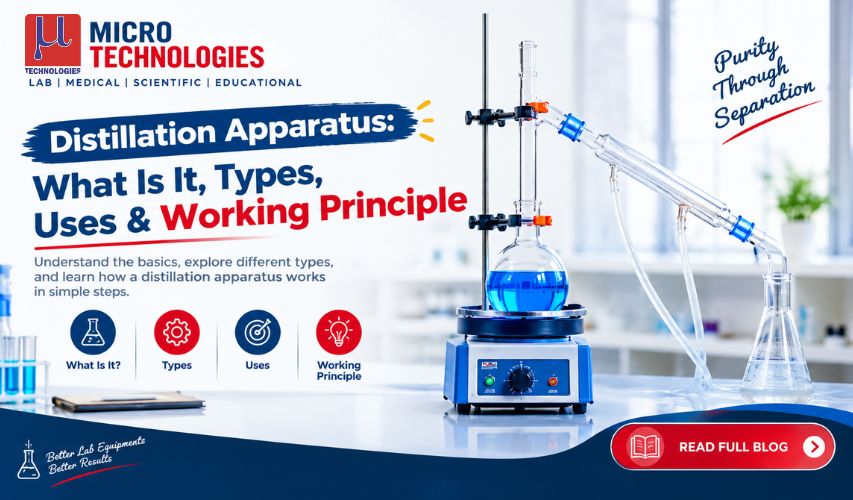
This comprehensive guide explains what a distillation apparatus is and how it works, detailing its components, operating principles, types, and common applications. Distillation apparatus (or “stills”) are specialized laboratory setups used to separate or purify liquids by exploiting differences in boiling point. These systems typically comprise a boiling flask, condenser, receiving flask and supporting equipment. Distillation works by heating a liquid mixture to vaporize the more volatile components and then condensing the vapor back to liquid. Key types include simple distillation (for mixtures with large boiling-point gaps), fractional distillation (for closer boiling points), steam distillation (for heat-sensitive compounds and essential oils), vacuum distillation (for high-boiling or decomposable substances), and specialized methods like short-path and Soxhlet setups. Each type has specific apparatus configurations and use-cases. This article discusses component functions (flasks, condensers, columns, etc.), selection criteria, safety and troubleshooting tips, and examples of laboratory and industrial uses (e.g. solvent purification, essential oil extraction, water distillation). Throughout, content is backed by educational and manufacturer sources. A comparison table and illustrative flowchart clarify differences between methods. The article concludes with a brief commercial note: Micro Technologies offers high-quality Laboratory distillation apparatus and custom lab solutions for educational, industrial and research labs (contact details for enquiries are provided).
What Is a Distillation Apparatus?
A distillation apparatus (also called a distillation setup or still) is a laboratory or industrial assembly used to separate components of a liquid mixture by heating and condensation. In simple terms, it is “a specialized device used to separate the components of a liquid blend according to their boiling points”. Historically, distillation has been practiced for thousands of years to purify alcohol, obtain essential oils and make distilled water. In modern chemistry labs, distillation is a fundamental separation and purification technique. The apparatus exploits the fact that different liquids boil (vaporize) at different temperatures; by carefully controlling heating, the more volatile (lower boiling-point) components vaporize first and can be collected separately.
In practice, a distillation setup consists of glassware and accessories that allow heating the mixture, condensing the vapor, and collecting the purified liquid. Key parts include a boiling flask (to contain and heat the liquid), a distillation head (connector), a condenser (cooling tube where vapor condenses), and a receiving flask (to collect the distillate). A thermometer is often placed near the flask to monitor temperature, and the whole assembly is supported by stands and clamps. For example, one educational source notes: “A basic distillation apparatus consists of several key components…: boiling flask (holds liquid and is heated), condenser (cools vapour), distillation head, and receiving flask”. High-quality borosilicate glass is typically used for chemical resistance and visibility.
Overall, the apparatus is essentially a still: one part vaporizes the mixture, and another cools and collects the vapor. This controlled vaporization-condensation cycle enables separation by boiling point. Figure 1 (below) is a simple flow diagram of this process.
How Distillation Works (Principle)
Distillation relies on differences in volatility of liquids. As a mixture is heated, the component with the lowest boiling point will vaporize first. The vapor pressure of each component dictates how easily it vaporizes; at a given temperature, the most volatile liquid (highest vapor pressure) will dominate the vapor. By collecting and condensing this vapor, one isolates that component.
The boiling flask is heated (via a Bunsen burner, heating mantle or electric heater) until the mixture boils. The liquid with the lowest boiling point vaporizes first, raising the pressure of its vapor above the mixture. The vapor rises through the distillation head into the condenser, where cold water flows around an inner tube. The vapour cools and condenses into liquid form, dripping into the receiving flask. If the boiling is controlled, the temperature plateau observed corresponds to the boiling point of the component that is vaporizing. Once most of that component has distilled over, the temperature will rise toward the next component’s boiling point, at which point the apparatus will collect that in turn, and so on.
ThoughtCo explains: “Distillation is a process of separating the components of a mixture based on their different boiling points. It is widely used – for example, to purify alcohol, desalinate water, or to refine petroleum”. In essence, by repeatedly vaporizing and condensing, distillation concentrates one component at a time. A conventional distillation (single cycle) provides a moderate purity; for higher purity or for multi-component separation, fractional distillation or multiple distillations may be used.
The underlying science involves Raoult’s Law and Dalton’s Law in mixtures, but at a basic level it simply exploits that “the differences in boiling points allow separation by vaporization and condensation”. As a result, distillation “provides a convenient and time-tested solution to separate a diversity of chemicals…with high purity”. It operates at pressures ranging from sub-atmospheric (vacuum distillation) to a few bars in industry, allowing flexibility for heat-sensitive or high-boiling compounds.
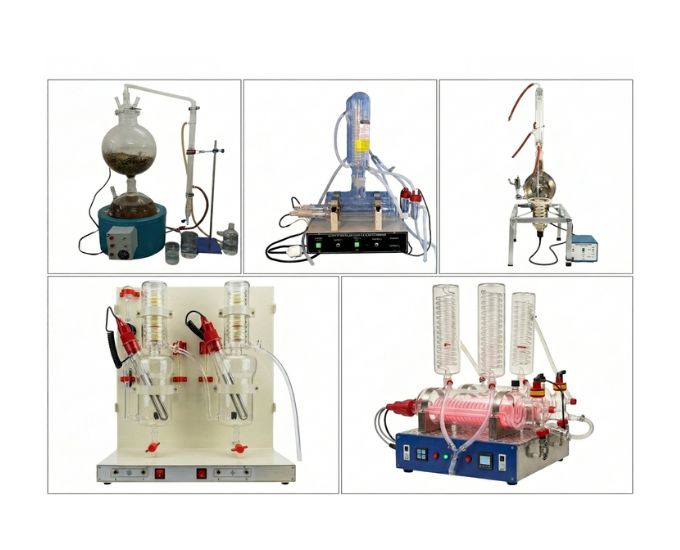
Types of Distillation Apparatus
Different distillation apparatus are designed for different needs. The main types encountered in laboratories are simple distillation, fractional distillation, steam distillation, vacuum distillation, and specialized setups like short-path, Soxhlet, or Clevenger apparatus. Each type has its own design and best-use scenario. Below we describe these key types and their typical applications:
- Simple Distillation: The most basic form, used when the boiling point difference between two liquids is large (generally >25°C). A simple setup uses just a round-bottom (boiling) flask, a distillation head, a Liebig (straight) condenser, and a receiving flask. It is ideal for separating a liquid from non-volatile impurities or from a much higher-boiling liquid. Common uses include purifying solvents (e.g. separating an organic solvent from dissolved solids) and producing distilled water. Because of its straightforward design and ease of assembly, simple distillation is ubiquitous in teaching and basic laboratory work. (Example: Distilling tap water to remove salts and produce pure water.)
- Fractional Distillation: Used when the boiling points of the mixture’s components are relatively close (for example, ethanol/water, or various petroleum fractions). This apparatus adds a fractionating column between the boiling flask and condenser. The column (often packed with glass beads or plates) provides a large surface area for repeated vaporization-condensation cycles (“theoretical plates”), improving separation of nearby boiling points. Fractional distillation is employed in laboratories and industry to separate complex mixtures like crude oil or multicomponent solvent mixtures. For instance, it is used to separate different hydrocarbons in petroleum or to obtain high-purity chemicals in organic synthesis. The trade-off is complexity: fractional setups take longer to reach equilibrium and require careful control, but yield higher-purity distillates than simple distillation.
- Steam Distillation: Ideal for heat-sensitive or non-miscible mixtures (often used with organic oils). In a steam distillation apparatus, steam or water vapor is passed through the mixture, carrying over volatile compounds that boil at lower temperatures when mixed with water. This allows extraction of essential oils and fragrances from plant materials without decomposing them. The most common version is the Clevenger apparatus for essential oils: a specialized distillation unit that separates oil and water layers after distillation. Steam distillation is widely used in botanical and pharmaceutical labs for oils, as it “prevents decomposition of delicate substances”. (Example: Extracting peppermint oil from leaves using steam.)
- Vacuum Distillation: For high-boiling or thermally sensitive substances that would decompose at atmospheric pressure. A vacuum distillation apparatus connects the system to a vacuum pump, lowering the pressure and thus the boiling points of all components. This permits distillation at lower temperatures. It is common in pharmaceutical and fine-chemical labs, where exotic or delicate compounds (such as high-boiling oils, heavy aromatics, or polymer precursors) must be purified without overheating. Vacuum distillation requires robust glassware and careful pressure control (see Safety section). (Example: Distilling glycerol or certain polymers which boil only above 300°C at 1 atm, but at 100°C under vacuum.)
- Short-Path and Path Distillation: Specialized vacuum distillations for very small volumes or extremely sensitive materials. They minimize the distance the vapor travels (short path) to reduce losses. Used in research where trace purification is needed. Some kits (e.g. “micro short-path distillation”) are popular for high-purity substances. These units might include water-jacketed heads or cold traps to maximize recovery.
- Soxhlet Apparatus: Though technically an extraction device, the Soxhlet is a form of continuous distillation/extraction for solid-liquid separations. It repeatedly washes a solid with a refluxing solvent. It’s often covered under “distillation equipment” discussions because it leverages boiling and condensation. Commonly used to extract fats from foods or bioactive compounds from plants.
- Other Specialized Apparatus: Variations exist for niche tasks: for instance, azeotropic distillation setups add a third solvent to break azeotropes, or molecular distillation apparatus for ultra-high vacuum separations. However, these are beyond typical general-lab use and not detailed here.
Key Components of a Distillation Setup
A lab distillation apparatus combines several standard pieces of glassware and accessories. Below is a summary of the main components and their functions:
1. Boiling (Reaction) Flask: Contains the liquid mixture to be distilled. It is heated to vaporise the components. Round-bottom flasks are commonly used because they provide more even heating.
2. Heat Source: Provides controlled heat to the boiling flask. Common options include heating mantles, oil baths and sand baths. Bunsen burners may be used where appropriate, but open flames should be avoided when handling flammable solvents.
3. Thermometer: Measures the temperature of the vapour near the distillation head. This helps monitor the boiling range of the component being collected.
4. Distillation Head/Adapter: Connects the boiling flask to the condenser and directs vapour towards it. It often includes an opening for the thermometer.
5. Fractionating Column: Used in fractional distillation. It allows repeated condensation and vaporisation, improving the separation of liquids with relatively close boiling points. It may contain glass beads or other packing material.
6. Condenser: Cools the vapour and converts it back into liquid. Common types include Liebig, Graham and Allihn condensers. Cooling water typically enters through the lower connection and exits through the upper connection.
7. Receiving Flask: Collects the condensed liquid, known as the distillate. It may be placed in an ice bath when cooling is needed to reduce evaporation or protect a temperature-sensitive product.
8. Clamps and Support Stands: Secure the glassware and keep the apparatus stable during operation. Proper support helps reduce the risk of joints separating, glassware breaking or hot liquid spilling.
9. Boiling Stones/Chips: Help liquid boil smoothly and reduce sudden, violent boiling known as bumping. They should be added before heating begins; never add them to a hot liquid that is already boiling.
10. Vacuum Adapter and Pump: Used in vacuum distillation to lower the pressure inside the apparatus, allowing certain liquids to boil at lower temperatures. A suitable vacuum adapter, trap and compatible pump help manage vapours and protect the equipment.
11. Distillation Shield/Enclosure: An optional protective screen or enclosure that can help shield users from splashes or glass fragments, particularly in higher-risk setups.
Each component must be chosen to fit joint sizes (commonly 19/22 or 24/40 standard taper joints) and chemical compatibility (borosilicate glass is usual). For safety and repeatability, high-quality glassware is preferred.
Applications and Uses of Distillation Apparatus
Distillation has broad applications in science and industry. In the laboratory context, apparatus are used whenever pure liquids or separation of components is needed. Key uses include:
- Chemical Purification: Widely used in organic and inorganic labs to purify solvents, reagents, and synthesized products. For example, distilled ethanol or acetone is used instead of impure commercial grades. Many organic chemistry courses include simple distillation labs to separate a salt from a solvent. As AELAB notes, distillation is essential for “purifying solvents, chemicals, and oils” and isolating pure compounds.
- Water Distillation: The standard method for producing distilled water, which is required in many experiments (titrations, buffer prep, spectroscopy). A still can remove minerals and non-volatiles from tap water. (Recall old-fashioned lab water distillers.)
- Pharmaceutical and Chemical Industry: Lab-scale distillation is crucial in pharma R&D. For instance, distilling active pharmaceutical ingredients (APIs) to remove side-products, or recovering solvents after reactions. Fractional distillation is particularly important in pharmaceuticals when purifying multi-component mixtures. In chemical analysis labs, distillation apparatus (e.g. Kjeldahl distillation units) are used to determine contents like nitrogen or alcohol levels.
- Food & Beverage Industry: Laboratory Distillation apparatus are used for testing and production of alcoholic beverages. For example, determining alcohol content (ethanol fraction) in wine or beer often involves laboratory distillation. This points out that “Distillation… is used to produce gasoline, diesel, jet fuel… and in the food industry, where it is used to extract essential oils and flavors”. Perfume and flavor labs use steam distillation to extract oils from herbs and spices. In R&D for food science, distillation can isolate food aroma compounds.
- Environmental and Petrochemical: Petroleum labs use fractional distillation at lab-scale to simulate refinery separations (e.g. separate gasoline, kerosene, etc.). Environmental labs might distill solvents or perform steam distillation to extract pollutants from samples.
- Educational Demonstrations: In teaching labs, distillation apparatus are staples for demonstrating physical separation principles. Students learn about phase changes and mixture composition by observing distillation. Virtual labs (like Labster) also include interactive distillation experiments to reinforce theory.
In summary, Lab distillation apparatus serve any case where volatile components need to be isolated or purified. Their uses range from academic teaching (chemistry demonstrations) to industrial-quality lab processes (synthesizing pure compounds, quality control, and process R&D). Micro Technologies, as a leading lab apparatus supplier, offers various distillation kits and units tailored to educational labs as well as sophisticated research applications, ensuring accurate and consistent results.
Selecting and Configuring the Apparatus
Choosing the right distillation setup involves matching the system to the substance and desired outcome. Consider:
- Composition of the Mixture: Is the mixture simple (one solvent + solute) or complex (multiple solvents)? Are components immiscible or form azeotropes? If components have a large boiling gap, simple distillation will suffice. If BPs are close, fractional distillation (long column) is necessary. For immiscible volatile liquids (like oil + water), steam distillation is best.
- Thermal Stability: If the target compound decomposes near its boiling point, consider vacuum distillation to lower the boiling point. Also, lab sources advise never to let organic solvents “boil to dryness” or overheat, which can lead to dangerous runaways.
- Required Purity and Yield: Fractional distillation yields higher purity by multiple “theoretical plates”, but takes more time. Short-path or thin-film setups can maximize recovery of precious samples with minimal loss.
- Scale: Large-scale separations (liters) require sturdier apparatus and heating mantles; tiny samples (milliliters) may use micro-distillation kits.
- Lab Resources: Ensure availability of coolant water, vacuum pumps (if needed), and safety equipment. Always plan for a cooling bath (ice or room-temperature water) for the receiver if distillate needs extra cooling.
- Quality and Material: Use good-quality borosilicate glass to resist thermal shock and chemicals. Check that joints fit properly and Keck clips secure them.
Once chosen, assemble the apparatus carefully:
- Secure each piece: clamps on the boiling flask, condenser, and receiving flask to sturdy stands.
- Arrange the condenser vertically, with water inlet at the top (far end from heat) to avoid thermal shock.
- Place a thermometer so its bulb is just below the exit of the distillation head.
- Add boiling chips to the liquid (unless using magnetic stirring) to ensure smooth boiling.
- Attach the cold-water tubing: typically, connect inlet at the upper condenser joint, outlet at the lower end so water flows counter-current to vapor (maximizing cooling).
- Pre-check for cracks and clean glassware. Do not over-fill the flask (no more than half-full) or the risk of bumping increases.
Troubleshooting and Maintenance
Even with the correct setup, distillations can encounter issues. Below are common problems and checks:
- Little or No Distillate: Ensure sufficient heat is applied and that the vapor path is clear. Check that the condenser water is flowing properly; no cooling leads to vapor loss. Confirm all joints are sealed (loose joints can lose vapor). If using vacuum, check pump vacuum level and connections.
- Overheating/Charring: If residue forms in the flask or the temperature skyrockets, reduce heat. Never let the flask go dry, especially with peroxidizable compounds – always leave some liquid. If liquid is nearly gone, stop heating immediately.
- Bumping or Sudden Boil-Overs: Bumping (violent boiling) can be fixed by adding boiling chips or using a magnetic stirrer. Heat more gently. Using round-bottom flasks and stirring helps prevent hot spots. Avoid heating too rapidly.
- Temperature Does Not Stabilize: This could mean an azeotrope or a mixture of very close boiling points. A fractional column may be needed for a more gradual separation.
- Leaks or Breakage: Glass apparatus can crack if stressed. Inspect all pieces before use. Check that ground glass joints have a drop of vacuum grease (for vacuum distillations) or are properly sealed with clips. Clamps should hold glass firmly but not overtighten. Replace any chipped glassware.
- Poor Vacuum Distillation: If attempting vacuum distillation and foam or liquid is drawn into the pump, disconnect immediately. Use a cold trap. Always vent vacuum slowly; never break vacuum at high temperature. Cornell’s safety notes stress “evacuate gradually and allow slow venting” to avoid shock to glass.
- Condenser Leaks: Tighten hose connections and clamps. Use o-rings if needed. Use a check valve in cooling line if necessary.
Maintenance Tips: After use, wash all glassware thoroughly (ideally with appropriate solvents and detergent) to remove residues. Descale any encrusted solids. Store drying upside-down. Check and replace worn rubber tubing (coolant, vacuum) regularly. Clean condenser channels if deposits appear. Proper upkeep ensures consistent performance.
A useful troubleshooting checklist:
- Are all joints sealed and clamped?
- Is the boiling flask filled to ~50% or less?
- Are boiling chips or stir bar in place?
- Is the condenser water flow adequate and correctly hooked?
- Is the heat source gentle and even (no direct flame on glass)?
- For vacuum distillations, is pressure reduced slowly and system cooled before venting?
- Is the temperature reading stable and sensible for the expected boiling component?
If problems persist, revisiting the basic setup or consulting an experienced lab manager is advised.
Safety and Best Practices
Distillation involves heat, hot vapors, and often flammable or corrosive chemicals. Follow these safety guidelines:
- Wear PPE: Always use goggles (splash protection) and heat-resistant gloves when handling hot apparatus. A lab coat and fume hood are recommended, especially for volatile or toxic substances.
- Glassware Integrity: Inspect glass components for cracks, chips or scratches before use. Never use damaged glass; it can fail under heat or pressure. Clamp everything securely to prevent tipping or falling.
- Heating Methods: Avoid direct open flames on glass. Use heating mantles, sand baths or heat/diffusion mats to spread heat evenly. Never apply flame directly to a distillation flask – this can cause sudden boiling, stress on glass, or ignition of vapors.
- Cooling Water: Always run cold water through the condenser before and during distillation. Connect the inlet hose to the upper end of the condenser (away from heat) and outlet at the lower end. This avoids “thermal shock” which can crack the glass. Check that water flow rate is moderate (not too high to cause breaks, but sufficient to condense all vapor).
- Pressure Relief: Never seal a distillation apparatus completely. For atmospheric/simple distillations, the apparatus should vent freely. For vacuum distillations, use a proper vacuum take-off adapter, maintain a cold trap, and ensure the vacuum pump is chemically compatible (or vent to scrubber). Always vent vacuum systems slowly and with the cooling bath in place.
- Temperature Control: Add boiling chips or stirring to the flask to prevent superheating and bumping. Boil at a gentle rate once the mixture reaches boiling. Monitor temperature; do not overshoot beyond the intended boiling point.
- Fire and Chemical Hazards: Know the flash point of your solvents. Organic vapors can ignite easily. Keep ignition sources (open flames, sparks) away from the distillation hood. Have a suitable fire extinguisher available. Likewise, if acidic or caustic vapors are produced, use fume hoods and neutralizing traps (e.g. acid trap in line).
- Emergency Procedures: Plan for spills or glass breakage. Place absorbent pads around the apparatus to catch drips. In case of a bump-out or boil-over, immediately turn off the heat. Keep a heat shield or fire blanket handy if dangerous material is involved.
A helpful summary from a lab safety guide says: “Distillation apparatus is generally made of glass… handle with care… secure it to a stable stand… boil chips to ensure uniform boiling… use a condenser with proper cooling”. By following these practices, most accidents can be prevented.
Micro Technologies – Quality Distillation Solutions
For educators, researchers and lab managers requiring reliable distillation apparatus, Micro Technologies offers a range of high-quality solutions. Whether you need a complete distillation kit (including flasks, columns, condensers and stands) for teaching purposes, or custom glassware assemblies for industrial R&D, MicroTech can help. Our apparatus are made from premium borosilicate glass and are compatible with standard joints, ensuring durability and ease of use.
Why choose Micro Technologies? We have over 30 years of expertise supplying laboratory equipment across Asia and beyond. Our distillation units are designed for safety and precision. We can customize configurations (e.g. multi-stage fractional distillers, vacuum-ready assemblies, or steam distillation setups) to fit your exact needs. For academic labs, we also offer economical complete sets with clamps and stands.
Get in touch: Visit microtechnologies.example to browse our distillation products, or contact our technical sales team for a quote. We provide detailed guidance on selecting the right apparatus for your process and offer after-sales support.
(Note: This section is intended for informational purposes. Specific product models and pricing are available directly from Micro Technologies.)
Frequently Asked Questions
Q1: What is the difference between simple and fractional distillation?
A: Simple distillation is used when components have a large boiling point difference (typically >25°C). It involves one vaporization-condensation cycle. Fractional distillation is used for mixtures with closer boiling points. It employs a fractionating column that provides multiple successive vaporizations and condensations, yielding higher purity.
Q2: Can I distill saltwater with this apparatus?
A: Yes. In simple distillation of saltwater, the salt remains in the boiling flask (as it is non-volatile), and pure water vaporizes and condenses. This is a common way to produce laboratory-grade distilled water.
Q3: How do I prevent my sample from bumping during distillation?
A: Always add boiling chips or use a magnetic stir bar during atmospheric distillation to ensure smooth boiling. Heat the flask gently and avoid superheating. Ensure the liquid volume is appropriate (do not fill more than half the flask).
Q4: Why is my distillate impure?
A: Impurities may result if the boiling points of components are too close or if the apparatus is not set up properly. Using a longer fractionating column, reheating after collecting part of the distillate, or performing a second distillation can improve purity. Also check that condensation is complete and no vapors escape (verify cold-water flow and seals).
Q5: How should the condenser be connected to water?
A: Connect the water inlet to the top of the condenser (furthest from the heat) and the outlet at the bottom. This counter-current flow maximizes cooling and avoids thermal shock. Always have water flowing before heating starts.
Q6: Can I use an open flame to heat the flask?
A: It’s safest to avoid direct flames. Use heating mantles, sand/oil baths, or heat-diffusion mats under the flask. Open flames can hot-spot the glass, cause cracking, or ignite flammable vapors.
Q7: What maintenance does a distillation apparatus require?
A: Clean all glassware after each use with appropriate solvents or detergents to remove residues. Rinse with distilled water and allow to dry. Inspect for cracks regularly. Lubricate ground joints lightly with vacuum grease if needed (for vacuum distillations). Replace any worn tubing or clamps. This routine care ensures the apparatus works reliably each time.
Q8: How do I handle distillation in a vacuum?
A: Use specially rated glassware (thicker walls). Ensure all joints are sealed (vacuum grease or proper glass adapters). Start by applying the vacuum gradually while the apparatus is cooled (ice bath around the receiving flask helps). Heat slowly to prevent bumping. Always vent vacuum systems to atmosphere slowly (never open to air while still hot).
Q9: What safety gear is recommended during distillation?
A: Safety goggles or face shield, lab coat and heat-resistant gloves are essential. Work in a fume hood if distilling volatile or hazardous compounds. Make sure a fire extinguisher and spill kit are accessible.
Q10: How can I extract essential oils from plants?
A: A Clevenger-type steam distillation apparatus is commonly used. It allows steam to pass through plant material and collects oil and water layers separately. Micro Technologies can supply Clevenger sets and related steam distillation equipment for botanical extraction.
Q11: Do I need to know chemistry to use a distillation apparatus?
A: Basic understanding helps, but standard educational kits come with instructions. Always follow procedural guidelines (e.g., add boiling stones, monitor temperature). If in doubt, consult a lab instructor or technician. Safety first.
Q12: Why did my vacuum distillation still become noisy or foam?
A: Bumping or foaming can occur if the mixture boils too vigorously under low pressure. Make sure to add anti-foaming agents if needed, or use trap cold, and apply vacuum slowly while cooling the flask.
For further questions or a quote on equipment, please contact Micro Technologies (general enquiries link) or email our technical team.