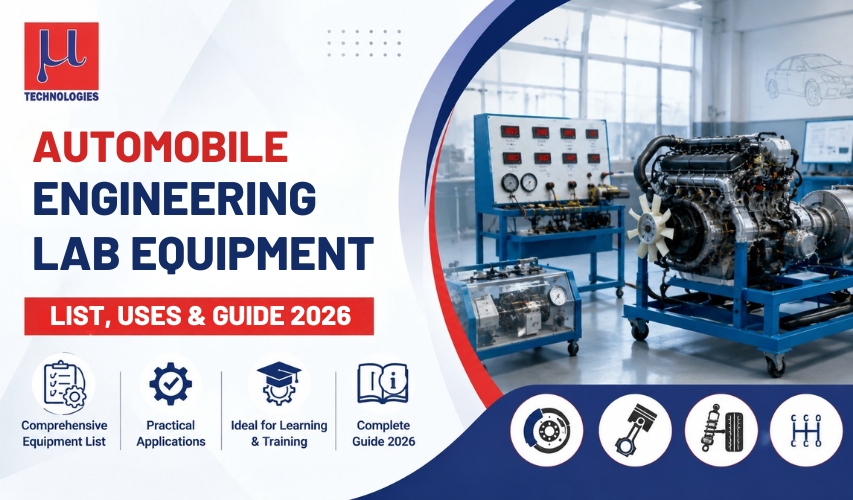
Automobile engineering lab equipment refers to the machines, test rigs, and instruments used to study and test vehicle systems — including engine test rigs, dynamometers, cut-section models, fuel injection test rigs, exhaust gas analyzers, and brake test benches. These are used in engineering colleges, polytechnics, and ITIs to teach students how real automotive components perform under working conditions. Manufacturers such as Micro Technologies supply this equipment to institutions across India and internationally.
Automobile engineering is one of the most hands-on branches of mechanical engineering. While theory explains how an engine, transmission, or braking system should work, it's the laboratory that shows students and engineers how these systems actually behave under real conditions. That's why every automobile engineering department — whether in a polytechnic, engineering college, or ITI — is built around a well-equipped lab, typically sourced from a specialized automobile engineering equipment manufacturer like Micro Technologies.
This guide walks through the essential automobile engineering lab equipment, what each machine does, and why it matters for practical learning and research. Whether you're a student preparing for lab exams, a faculty member setting up a new lab, or an institution planning equipment procurement, understanding the purpose behind each machine makes the learning process far more meaningful than simply memorizing a list of names.
Why Automobile Engineering Labs Matter
Automobile labs bridge the gap between classroom concepts and real-world vehicle systems. They let students:
Dismantle and study working models of engines, transmissions, and suspension systems
- Measure real performance parameters like power, torque, and fuel efficiency
- Understand diagnostic and testing procedures used in the automotive industry
- Get familiar with tools and instruments used by service engineers and R&D teams
With that context, here's a complete automobile engineering equipment list you'll typically find in a well-set-up lab.
Complete List of Automobile Engineering Lab Equipment
1. Engine Test Rigs
What is it? An engine test rig (or engine test bed) is the centerpiece of most automobile labs. It allows a running engine — petrol or diesel, single-cylinder or multi-cylinder — to be studied under controlled load conditions.
What it measures:
- Brake power and indicated power
- Fuel consumption rate
- Thermal efficiency
- Mechanical efficiency
- Exhaust gas temperature
These rigs are usually paired with a dynamometer to apply variable load on the engine. Micro Technologies manufactures engine test rig setups configured for both petrol and diesel engine study.
2. Dynamometers
What is it? A dynamometer measures torque, speed, and power output of an engine or vehicle. Two common types found in automobile labs are:
- Chassis dynamometer – tests the complete vehicle by simulating road load conditions on rollers, useful for measuring wheel horsepower and emissions.
- Engine (brake) dynamometer – connects directly to the engine's output shaft to measure brake power under load, using hydraulic, eddy current, or rope-brake mechanisms.
3. Cut-Section Models
What is it? Cut-section (sectioned) models are physical, non-working replicas of engines, gearboxes, differentials, clutches, and steering systems with sections cut away to reveal internal components. They are essential teaching tools for visualizing:
- Piston and cylinder arrangement
- Valve train mechanisms
- Gear meshing in manual transmissions
- Differential gear action
- Clutch plate assembly
4. Fuel Injection Test Rig
What is it? This equipment tests and calibrates diesel fuel injection pumps and injectors. It helps students understand:
- Injection timing and pressure
- Spray pattern quality
- Nozzle opening pressure
- Fuel delivery per stroke
5. Exhaust Gas Analyzer
What is it? Used to measure the composition of vehicle exhaust emissions — including CO, CO2, HC, NOx, and O2 levels. This equipment is critical for:
- Emission testing and compliance studies
- Understanding combustion efficiency
- Environmental engineering coursework tied to automotive systems
6. Compression Ratio and Ignition Test Equipment
- Compression testers measure cylinder compression pressure, helping diagnose engine health.
- Spark plug and ignition testing units evaluate ignition timing, spark intensity, and coil performance in petrol engines.
7. Battery and Electrical System Test Bench
Modern automobile labs include equipment to test:
- Battery capacity and charging/discharging behavior
- Starter motor performance
- Alternator output
- Wiring and lighting circuits
This ties into the growing focus on vehicle electrical and electronic systems, including hybrid and EV components in updated curricula.
8. Transmission and Power Train Models
Working or semi-working models of:
- Manual and automatic gearboxes
- Clutch assemblies
- Propeller shafts and universal joints
- Differential units
These help students understand torque transfer and power flow from engine to wheels.
9. Suspension and Steering System Test Rigs
Equipment used to study:
- Independent and dependent suspension systems
- Steering geometry (camber, caster, toe, king-pin inclination)
- Shock absorber performance
10. Brake Testing Equipment
- Brake test rigs simulate braking force and evaluate stopping distance, brake fade, and pedal effort.
- Brake fluid and hydraulic system test kits check fluid pressure and leak points in hydraulic braking systems.
11. Wheel Alignment and Balancing Machines
Used to demonstrate and practice:
- Wheel alignment (camber, caster, toe adjustments)
- Dynamic and static wheel balancing
- Tire wear analysis
12. Automotive Diagnostic Scanners (OBD Tools)
With increasing vehicle electronics, labs now include OBD-II scanners and diagnostic tools that read engine control unit (ECU) data, error codes, and sensor outputs — bridging traditional mechanical study with modern automotive electronics.
13. Lubrication and Fluid Testing Equipment
Engine and gear oils play a direct role in vehicle performance and longevity, so many labs include equipment to test:
- Viscosity of lubricating oils at different temperatures
- Flash and fire point of fuels and lubricants
- Coolant quality and boiling point behavior
14. Noise, Vibration, and Harshness (NVH) Equipment
Basic lab setups may include:
- Sound level meters to measure cabin and exhaust noise
- Vibration sensors to study engine mounting and chassis vibration
- Simple accelerometer-based data acquisition systems
15. Automobile Workshop Tools and Hand Instruments
Alongside heavier machines, every lab also relies on a set of standard workshop tools:
- Micrometers, vernier calipers, and dial gauges for precision measurement
- Torque wrenches for accurate fastening
- Feeler gauges for checking valve clearances
- Compression gauges and tachometers
How to Choose an Automobile Engineering Lab Equipment Manufacturer
When selecting a supplier for your institution, evaluate them on:
- Curriculum alignment – equipment mapped to AICTE/university syllabus requirements
- Build quality and safety compliance – especially for running engine rigs and electrical benches
- After-sales support – calibration, spare parts, and installation training
- Range coverage – ability to supply everything from cut-section models to EV trainers under one roof
Micro Technologies, based in Ambala, Haryana, is one such manufacturer supplying automobile and mechanical engineering lab equipment to educational institutions across India and to export markets including Kenya, Europe, and the USA. Their range spans engine models, test rigs, and allied laboratory instruments built for classroom and workshop use.
Emerging Additions: EV and Hybrid Lab Equipment
As curricula evolve, many automobile engineering labs are adding:
- Battery management system (BMS) trainers
- Electric motor and controller test setups
- Regenerative braking demonstration kits
- Hybrid powertrain simulators
This reflects the industry's shift toward electric mobility and the need for engineers trained on both conventional and electric vehicle systems.
Conclusion
Automobile engineering labs combine mechanical, electrical, and diagnostic equipment to give students a complete, practical understanding of how vehicles work. From engine test rigs and dynamometers to cut-section models and emission analyzers, each piece of equipment plays a specific role in connecting theory to real automotive systems. Choosing the right automobile engineering lab equipment manufacturer — one that offers curriculum-aligned, durable, and well-supported equipment — makes a measurable difference to learning outcomes.
Frequently Asked Questions
What is automobile engineering lab equipment?
It refers to the test rigs, models, and instruments — such as engine test rigs, dynamometers, and cut-section models — used to teach and test automotive systems in a laboratory setting.
What is the most important equipment in an automobile engineering lab?
Engine test rigs and dynamometers are generally considered the core equipment, since they allow direct measurement of engine performance parameters like power, torque, and efficiency.
What is a cut-section model used for?
It's a static, sectioned replica of an automotive component (engine, gearbox, differential, etc.) used purely for visual and conceptual learning, not for performance testing.
Which equipment is used to test engine performance?
Engine test rigs combined with brake or chassis dynamometers are used to measure brake power, thermal efficiency, and fuel consumption.
Do automobile labs include EV-related equipment?
Increasingly, yes. Many updated labs now include battery management system trainers, electric motor test setups, and hybrid powertrain simulators alongside traditional IC engine equipment.
Who manufactures automobile engineering lab equipment in India?
Several Indian manufacturers supply this equipment, including Micro Technologies (Ambala, Haryana), which offers engine models, test rigs, and related laboratory instruments for engineering institutions.