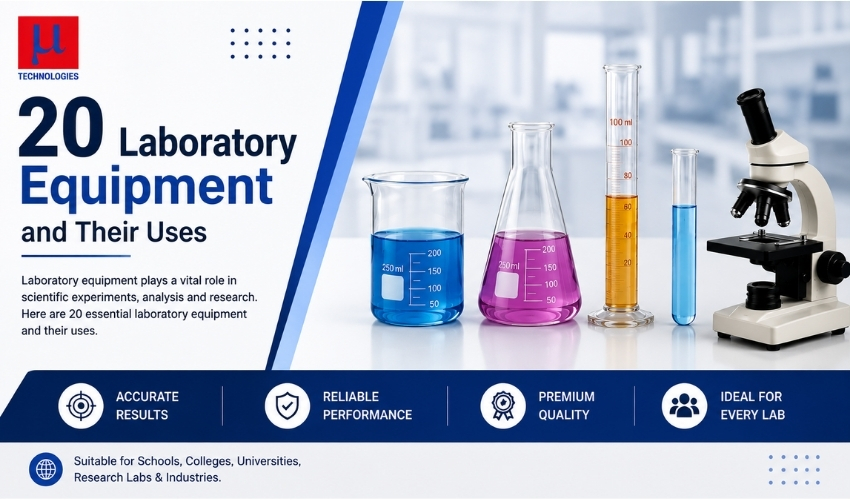
The 20 most common laboratory equipment items are the microscope, Bunsen burner, autoclave, incubator, centrifuge, pH meter, analytical balance, spectrophotometer, laminar air flow cabinet, hot air oven, water bath, magnetic stirrer, vortex mixer, colony counter, refrigerator/deep freezer, fume hood, beaker, pipette, test tube, and Petri dish. Together, they cover measuring, heating, cooling, sterilizing, separating, and observing — the core jobs every lab needs done.
Measuring and Weighing Equipment
1. Analytical Balance
An analytical balance measures mass down to the sub-milligram range, and it does so inside an enclosed glass chamber that shields the pan from stray air currents and dust—because even a light breeze can throw off a measurement this fine. Labs rely on it for weighing test samples, formulation work, and purity checks where a rounding error simply isn't an option.
2. pH Meter
The modern pH meter traces back to a very specific problem: in 1934, a California citrus chemist needed a faster, sturdier way to measure the acidity of lemon juice than fragile glass electrodes allowed. Arnold Beckman, then a chemistry professor, built him an electronic solution — and the instrument he created became the ancestor of every glass-electrode pH meter used in labs today. It reads acidity or alkalinity by measuring a tiny voltage generated at the electrode's glass membrane.
3. Spectrophotometer
A spectrophotometer measures how much light a solution absorbs at a specific wavelength, which tells you how concentrated a substance is. Fittingly, the same Arnold Beckman who built the pH meter also developed the DU spectrophotometer — an instrument later described as one of the most important tools ever built for advancing bioscience.
Heating, Cooling, and Sterilization Equipment
4. Bunsen Burner
Every chemistry lab's open flame has a surprisingly specific birthday: 1855, at the University of Heidelberg. Robert Bunsen wanted a hotter, cleaner-burning flame for his research, so he worked with lab mechanic Peter Desaga to build a burner that mixed gas and air before ignition, rather than at the flame itself. The result burns hot enough to reach roughly 1,500°C at its tip, and the basic design hasn't changed much since.
5. Autoclave
An autoclave sterilizes equipment using pressurized steam, and the numbers behind it are oddly precise: 121°C at 15 psi for 15 to 20 minutes is the internationally recognized standard cycle. That specific combination exists because raising the pressure raises the boiling point of water — pushing steam hot enough to destroy even bacterial spores, which plain boiling water can't touch.
6. Hot Air Oven
Where an autoclave uses moist heat, a hot air oven sterilizes with dry heat, using electric heating elements to bake glassware, metal tools, and other heat-stable items free of microorganisms. It's the go-to choice for anything that shouldn't get wet during sterilization.
7. Incubator
An incubator holds a steady, controlled temperature so microbial or cell cultures can grow under consistent conditions. Some versions add CO2 control for cell culture work or shaking for uniform mixing — but the core job is always the same: hold the environment steady so the biology inside behaves predictably.
8. Water Bath
A water bath heats samples gently and evenly by surrounding containers with temperature-controlled water, which avoids the scorching or uneven heating a direct flame can cause. It's a quiet workhorse for incubating reagents, melting substances, and warming samples to body temperature.
9. Refrigerator and Deep Freezer
Lab refrigerators and freezers store reagents and samples at low temperatures, but the range matters: a general-purpose lab freezer typically holds items down to about -25°C, while an ultra-low-temperature freezer can reach nearly -80°C for long-term biological sample storage.
Separation and Sample Prep Equipment
10. Centrifuge
A centrifuge spins samples at high speed to separate components by density — denser particles get pushed to the bottom of the tube while lighter ones stay near the top. This makes it essential for isolating DNA and RNA, concentrating microbial cells, and separating blood serum or plasma for testing.
11. Magnetic Stirrer
A magnetic stirrer uses a rotating magnetic field to spin a small stir bar inside a container, mixing a solution without ever touching it directly. Many models pair this with a built-in hot plate, letting a lab stir and heat a solution at the same time.
12. Vortex Mixer
A vortex mixer rapidly agitates small tubes to mix their contents in seconds — the quick, noisy cousin of the magnetic stirrer, built for small volumes that need fast, thorough mixing rather than slow, continuous stirring.
Safety and Containment Equipment
13. Laminar Air Flow Cabinet
A laminar airflow cabinet pushes filtered air across a workspace in a single, steady direction, using a HEPA filter to strip out airborne particles and microorganisms before they ever reach the sample. It's designed for work where contamination risk is low but still needs preventing — think sterile media prep.
14. Biosafety Cabinet
Don't confuse this with a laminar flow hood — a biosafety cabinet is built specifically to protect the person working at it, using HEPA-filtered, controlled airflow to contain infectious samples rather than just keep them clean. It's the equipment of choice whenever the material being handled poses a real risk to whoever's handling it.
15. Fume Hood
A fume hood pulls hazardous fumes and vapors away from the researcher during chemical work, venting them safely out of the breathing zone. Where a biosafety cabinet protects against biological risk, a fume hood protects against chemical risk — different job, same underlying goal of keeping the person at the bench safe.
Observation and Counting Equipment
16. Microscope
A microscope magnifies objects too small to see with the naked eye by focusing light (or, in electron microscopes, electrons) through a series of lenses. It's the single most indispensable tool for observing microorganisms, cells, and tissue structures in any biology or microbiology lab.
17. Colony Counter
After a Petri dish full of bacteria has grown overnight, someone still has to count the colonies — and a colony counter makes that job faster and less error-prone, typically using a lit, gridded surface and a magnifying lens (the classic version is known as a Quebec colony counter) to make individual colonies easier to spot and tally.
Basic Glassware Essentials
18. Beaker
The beaker is the simplest, most universal container in the lab — a flat-bottomed cylinder used for mixing, stirring, and general-purpose heating, with volume markings that are approximate rather than precise.
19. Pipette
A pipette transfers or measures small liquid volumes with far more accuracy than a beaker ever could, making it essential wherever a lab needs an exact number of milliliters or microliters moved from one container to another.
20. Petri Dish and Test Tube
Rounding out the list are two of biology's most recognizable containers. The Petri dish, developed in 1887 by Julius Richard Petri while working in Robert Koch's Berlin laboratory, is the standard surface for growing bacterial colonies on solid media. The test tube, meanwhile, holds small quantities of liquid for observation, heating, or simple reactions — unglamorous, but constantly in use.
Quick Recap: All 20 at a Glance
Here's the full list in one place, organized the same way the article walks through it:
Measuring and weighing: Analytical Balance, pH Meter, Spectrophotometer
Heating, cooling, and sterilization: Bunsen Burner, Autoclave, Hot Air Oven, Incubator, Water Bath, Refrigerator/Deep Freezer
Separation and sample prep: Centrifuge, Magnetic Stirrer, Vortex Mixer
Safety and containment: Laminar Air Flow Cabinet, Biosafety Cabinet, Fume Hood
Observation and counting: Microscope, Colony Counter
Basic glassware essentials: Beaker, Pipette, Petri Dish, Test Tube
Twenty items, six jobs. That's really the whole story of a working lab in one glance.
Why Grouping Equipment by Function Actually Helps
Most "laboratory equipment" lists just dump 20 names in a row with a one-liner each, and that's exactly why they're hard to remember. Grouping by function — measuring, heating, separating, protecting, observing — mirrors how a lab actually thinks about its own workflow.
It also makes troubleshooting easier. If a result looks off, you can ask: was this a measuring problem, a contamination problem, or a separation problem? That question narrows down which piece of equipment to check first.
Conclusion
These 20 pieces of laboratory equipment cover nearly everything a working lab touches on a daily basis — from the precision of an analytical balance, to the controlled violence of a centrifuge, to the quiet reliability of a Petri dish sitting in an incubator overnight. None of them do their job in isolation; a single experiment often leans on five or six of these tools in sequence.
Knowing what each one actually does — not just its name — is what turns a list of equipment into a lab that runs smoothly.
Frequently Asked Questions
What are the 20 most common laboratory equipment items?
The microscope, Bunsen burner, autoclave, incubator, centrifuge, pH meter, analytical balance, spectrophotometer, laminar air flow cabinet, hot air oven, water bath, magnetic stirrer, vortex mixer, colony counter, refrigerator/freezer, fume hood, beaker, pipette, test tube, and Petri dish.
What is the difference between an autoclave and a hot air oven?
An autoclave sterilizes using pressurized steam at 121°C, while a hot air oven uses dry heat instead of moisture — making it better suited for items that shouldn't get wet during sterilization.
What is the difference between a laminar flow cabinet and a biosafety cabinet?
A laminar flow cabinet protects the sample from contamination using filtered, unidirectional airflow, while a biosafety cabinet protects the person working with it by containing infectious material.
Why is a centrifuge important in a laboratory?
It separates components of a sample by density at high spin speeds, which is essential for isolating DNA and RNA, concentrating cells, and separating blood serum or plasma.
Who invented the pH meter used in laboratories today?
Arnold Beckman invented the first commercially successful electronic pH meter in 1934, originally to help a California citrus chemist measure the acidity of lemon juice more reliably.