
Laboratory Rod Mill
Product Specification Sheet
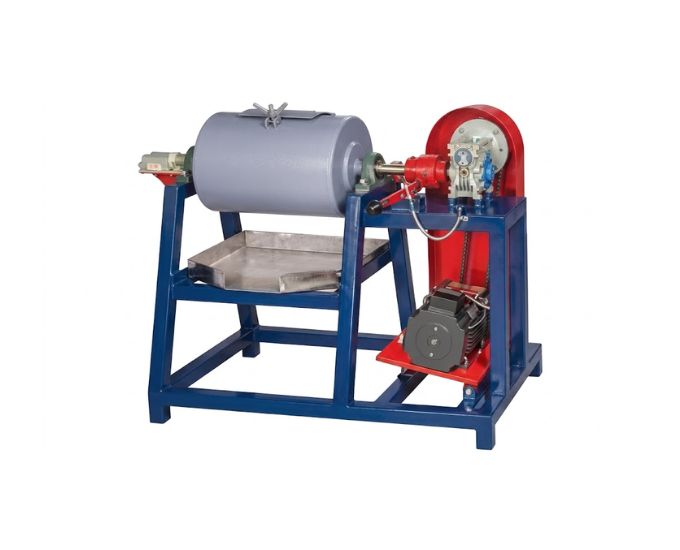
Laboratory Rod Mill
Model Number: MTMO-104
The Laboratory Rod Mill is a laboratory-scale grinding system designed for practical investigation of size reduction, grinding efficiency and power consumption. It enables students to study the effect of rotational speed on mill power requirements and determine the grinding efficiency of a known material using its work index.
Product Specification
The Laboratory Rod Mill is an educational grinding system developed for studying the size reduction and comminution of solid materials under controlled laboratory conditions.
Rod milling is an important grinding operation used in mineral processing, chemical engineering, materials processing and related industries. The equipment provides students with practical exposure to the behaviour of a rotating grinding mill and the influence of operating parameters on grinding performance.
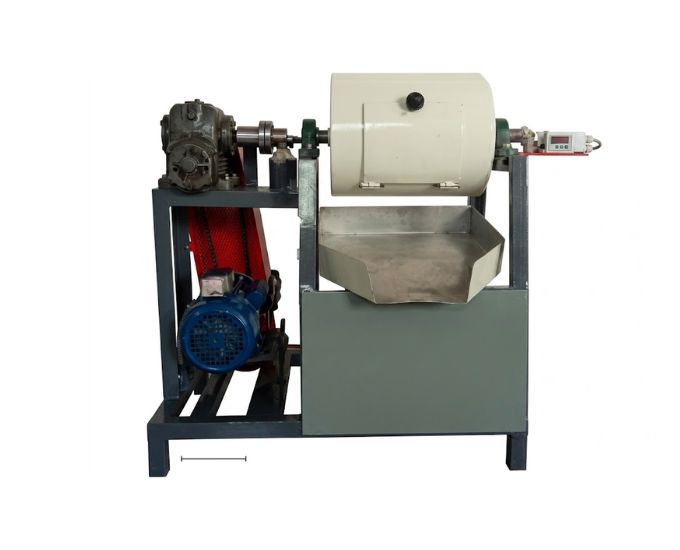
The grinding chamber contains rod-shaped grinding media rather than spherical media. As the cylindrical chamber rotates, the rods move within the mill and interact with the feed material.
The material is progressively reduced in size through the mechanical action generated between the rods, feed particles and internal surface of the mill.
The rod-shaped media provide a different grinding action compared with a conventional ball mill, making the apparatus useful for comparative studies of comminution equipment.
One of the principal experiments is to investigate the effect of RPM on the power consumption of the Rod Mill.
Students can operate the equipment at selected rotational speeds and record the corresponding power requirements.
The resulting data can be used to establish the relationship between mill speed and power consumption, helping students understand how operating speed influences energy requirements.
Another important experiment involves determining the efficiency of the Rod Mill for grinding a material of known work index.
The work index provides an indication of the energy required to reduce a material from one particle size to another under defined conditions.
By using a material with a known work index and analyzing the feed and ground product, students can evaluate the grinding performance and energy efficiency of the laboratory mill.
Particle-size measurements before and after milling can also be used to investigate the degree of size reduction achieved during the experiment.
The equipment therefore provides practical understanding of grinding, comminution, rotational speed, power consumption, work index, particle-size reduction and grinding efficiency.
Experimental data can be compared with theoretical relationships used in Mechanical Operations and particle technology.
Micro Technologies supplies Laboratory Rod Mills and other Mechanical Operations Equipment for engineering colleges, universities, research laboratories, polytechnic institutes and technical training centres.
Features
- Laboratory-scale rod mill
- Rod-type grinding media
- Controlled grinding operation
- RPM effect investigation
- Power consumption studies
- Grinding efficiency determination
- Work index based experiments
- Particle-size reduction studies
- Feed and product comparison
- Comminution experiments
- Rotational speed studies
- Motor-driven configuration
- Suitable for laboratory teaching
- Robust supporting structure
- Suitable for repeated experiments
Benefits
- Provides practical understanding of rod milling
- Demonstrates mechanical grinding and size reduction
- Enables RPM versus power consumption studies
- Supports grinding efficiency determination
- Enables experiments using materials of known work index
- Demonstrates particle-size reduction
- Provides practical understanding of comminution
- Enables feed and product particle-size comparison
- Helps students analyze mill energy requirements
- Provides hands-on Mechanical Operations training
- Connects theoretical grinding concepts with experiments
Product Specifications
| Specification | Details |
|---|---|
| Product Name | Laboratory Rod Mill |
| Equipment Type | Laboratory Grinding Equipment |
| Mill Type | Rod Mill |
| Grinding Media | Rod-Type Media |
| Primary Operation | Grinding / Size Reduction |
| RPM Study | Supported |
| Power Consumption Study | Supported |
| Grinding Efficiency | Determination Supported |
| Work Index Study | Supported |
| Particle Size Reduction | Supported |
| Feed/Product Analysis | Supported |
| Comminution Study | Supported |
| Drive System | Electric Motor Driven |
| Installation | Laboratory Setup |
| Application | Mechanical Operations / Particle Technology |
Experiments Performed
- Study of Laboratory Rod Mill operation
- Grinding of suitable solid materials
- Investigation of mechanical size reduction
- Study of the effect of RPM on Rod Mill performance
- Determination of power consumption at different RPM
- Plotting of RPM versus power consumption
- Determination of Rod Mill grinding efficiency
- Grinding of a material with known work index
- Investigation of work index and energy requirements
- Study of feed particle size
- Study of ground-product particle size
- Comparison of feed and product sizes
- Evaluation of grinding performance
- Investigation of comminution behaviour
- Study of energy consumption during grinding
- Practical study of particle-size reduction
Applications
- Mechanical Operations Laboratories
- Chemical Engineering Laboratories
- Mineral Processing Laboratories
- Mining Engineering Laboratories
- Metallurgical Engineering Laboratories
- Particle Technology Laboratories
- Materials Engineering Laboratories
- Size Reduction Laboratories
- Engineering Colleges
- Universities
- Polytechnic Institutes
- Technical Training Centres
- Research Laboratories
FAQs
What is a Laboratory Rod Mill used for?
A Laboratory Rod Mill is used for grinding solid materials and studying particle-size reduction, power consumption, grinding efficiency and comminution behaviour.
What type of grinding media does a Rod Mill use?
A Rod Mill uses elongated rod-shaped grinding media inside a rotating cylindrical chamber.
Can the effect of RPM on power consumption be studied?
Yes. One of the main experiments involves operating the mill at different rotational speeds and analyzing the corresponding power consumption.
Can grinding efficiency be determined?
Yes. Grinding performance can be evaluated using experimental operating data and suitable particle-size and energy measurements.
Can a material with a known work index be tested?
Yes. The apparatus is suitable for experiments involving grinding efficiency using a material with a known work index.
What is work index in size reduction?
Work index is a material-related parameter used in comminution calculations to represent the energy required for a specified degree of particle-size reduction.
Can feed and product particle sizes be compared?
Yes. Particle-size analysis before and after grinding can be used to evaluate the degree of size reduction achieved by the mill.
What is the difference between a Rod Mill and a Ball Mill?
The main difference is the grinding media. A Rod Mill uses elongated rods, while a Ball Mill uses spherical grinding media. This difference influences particle contact and grinding behaviour.
Is a Rod Mill suitable for Mechanical Operations laboratories?
Yes. It is suitable for Mechanical Operations Equipment laboratories for practical study of grinding, comminution and energy requirements.
Is it suitable for Chemical Engineering education?
Yes. It is particularly relevant to Mechanical Operations, particle technology and size-reduction experiments in Chemical Engineering courses.
Why Choose Our Products
- Laboratory-scale rod grinding
- RPM-based performance experiments
- Power consumption analysis
- Grinding efficiency determination
- Work index based studies
- Particle-size reduction experiments
- Practical comminution analysis
- Feed and product comparison
- Educational and research applications
- Durable laboratory configuration
- Customized configurations available
- Institutional and bulk supply support
Call to Action
Equip your Mechanical Operations Laboratory with a Laboratory Rod Mill from Micro Technologies for practical studies of grinding efficiency, power consumption, work index and particle-size reduction. Contact us for technical specifications, customized laboratory configurations, institutional quotations, bulk requirements or tender supply.