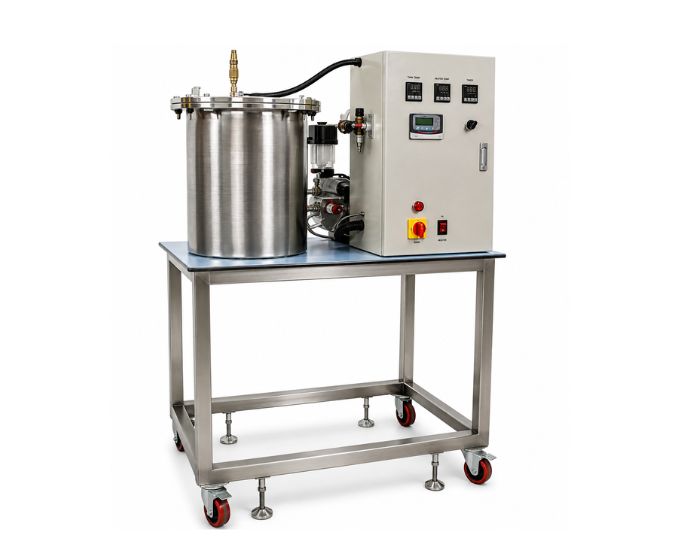

Free and Forced Convection ApparatusV
Product Specification Sheet
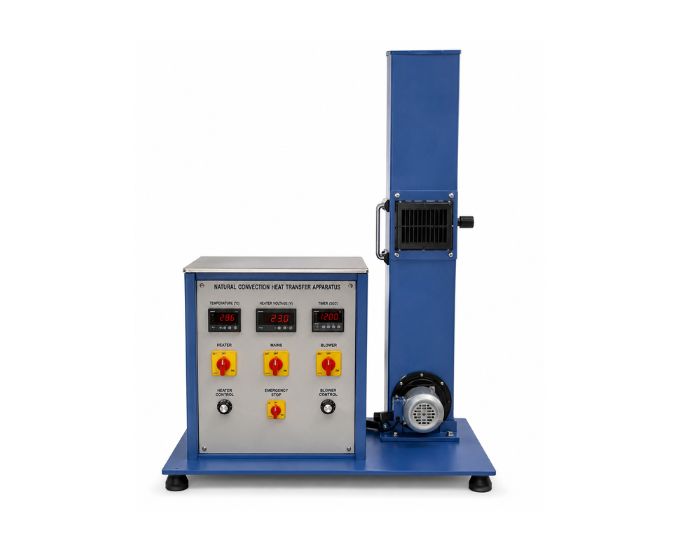
Free and Forced Convection ApparatusV
Model Number: MTCA-101
The Free and Forced Convection Apparatus from Micro Technologies is an engineering laboratory system designed for the experimental study of natural/free convection and forced convection heat transfer. The apparatus allows students to investigate convective heat transfer from different geometries, including a flat plate, cylinder, and tube bundle, determine the Nusselt number, and calculate typical heat-transfer characteristics. Its integrated air duct, airflow arrangement, heated test sections, instrumentation, and control panel make it suitable for heat transfer and thermal engineering laboratories.
Product Specification
The Free and Forced Convection Apparatus is a comprehensive laboratory experimental setup designed to demonstrate the principles governing convective heat transfer between heated surfaces and surrounding air.
Manufactured by Micro Technologies, the apparatus enables students to experimentally investigate both free convection (natural convection) and forced convection, providing practical understanding of two fundamental heat-transfer mechanisms extensively encountered in thermal and mechanical engineering.
In free convection, fluid motion is produced naturally due to density differences caused by temperature variations. In forced convection, airflow is generated mechanically to increase the rate of heat transfer between the heated surface and surrounding fluid.
The apparatus incorporates a vertical experimental section with an airflow system that enables controlled investigation of heat transfer under different operating conditions. Suitable electrical heaters and temperature measurement arrangements allow students to observe temperature distribution and determine the heat transferred from the test surface.
One of the major advantages of the apparatus is its ability to study convection from different geometrical surfaces, including a flat plate, cylinder, and tube bundle. This enables students to compare the effect of geometry on convective heat-transfer behaviour.
Experimental measurements can be used to determine the convective heat-transfer coefficient and calculate the Nusselt number, an important dimensionless parameter used extensively in heat-transfer analysis.
Students can also investigate relationships between airflow, surface temperature, ambient temperature, geometry, and heat-transfer rate. These practical observations reinforce theoretical concepts taught in heat transfer and thermal engineering courses.
The integrated instrumentation and control panel provides convenient operation and monitoring of experimental parameters. Its floor-mounted design and accessible experimental section make the system suitable for routine laboratory experiments, classroom demonstrations, engineering projects, and technical training.
Scope of Learning
The apparatus supports practical study of:
- Free or natural convection
- Forced convection
- Convective heat transfer
- Heat transfer from different geometries
- Heat transfer from a flat plate
- Heat transfer from a cylinder
- Heat transfer from a tube bundle
- Effect of airflow on heat-transfer rate
- Determination of convective heat-transfer coefficient
- Experimental determination of Nusselt number
- Temperature distribution
- Effect of surface geometry on convection
- Comparison between free and forced convection
- Typical characteristics of heat transfer
Working Principle
Free Convection
During free convection, air adjacent to a heated surface becomes warmer and less dense. The heated air rises naturally while relatively cooler air moves toward the surface. This density-driven circulation transfers thermal energy without requiring a mechanical airflow source.
The experiment allows students to observe the relationship between surface temperature, ambient temperature, geometry, and natural convective heat transfer.
Forced Convection
During forced convection, air is mechanically passed over the heated test surface. The increased fluid velocity enhances energy transfer between the surface and air.
By controlling and measuring the operating conditions, students can compare forced convection with natural convection and analyze how airflow influences heat-transfer performance.
Test Geometries
The apparatus is designed for convection studies using different geometries, including:
Flat Plate
Allows experimental investigation of convection from a heated flat surface.
Cylinder
Enables students to study convective heat transfer around a cylindrical surface.
Tube Bundle
Provides a practical representation of heat transfer from multiple tubes, relevant to heat exchangers and other industrial thermal systems.
These interchangeable or application-specific geometries allow meaningful comparison of convection characteristics.
Nusselt Number Determination
The apparatus allows experimental determination of the Nusselt number (Nu), an important dimensionless parameter in convective heat-transfer analysis.
It is generally expressed as:
Nu = hL / k
Where:
- Nu = Nusselt number
- h = Convective heat-transfer coefficient
- L = Characteristic length
- k = Thermal conductivity of fluid
The Nusselt number helps describe the relative importance of convective heat transfer compared with conductive heat transfer through the fluid.
Main Components
- Vertical convection test duct
- Airflow section
- Forced-air arrangement
- Heated test section
- Flat plate test geometry
- Cylindrical test geometry
- Tube bundle test geometry
- Temperature sensors
- Digital temperature indication
- Electrical measurement instruments
- Heater control
- Airflow control arrangement
- Electrical control panel
- Rigid supporting structure
Key Features
- Study of both free and forced convection
- Experimental convective heat-transfer analysis
- Different test geometries
- Flat plate heat-transfer study
- Cylinder heat-transfer study
- Tube bundle heat-transfer study
- Experimental determination of Nusselt number
- Calculation of convective heat-transfer coefficient
- Controlled electrical heating
- Forced airflow arrangement
- Integrated temperature measurement
- Digital instrumentation
- Convenient control panel
- Vertical experimental duct
- Accessible test section
- Robust laboratory construction
- Suitable for repeated engineering experiments
Technical Specifications
| Parameter | Details |
|---|---|
| Product Name | Free and Forced Convection Apparatus |
| Product Type | Heat Transfer Laboratory Apparatus |
| Heat Transfer Mode | Free & Forced Convection |
| Test Medium | Air |
| Test Geometries | Flat Plate, Cylinder & Tube Bundle |
| Heating | Electrical |
| Temperature Measurement | Integrated Sensors |
| Temperature Indication | Digital |
| Airflow | Forced Air Arrangement |
| Experimental Parameter | Convective Heat Transfer |
| Nusselt Number Study | Yes |
| Heat Transfer Coefficient | Determination Possible |
| Control | Integrated Control Panel |
| Installation | Floor Mounted |
| Application | Heat Transfer / Thermal Engineering Laboratory |
| Customization | Available |
Detailed heater rating, temperature range, airflow range, electrical supply, sensor quantity, and instrument ranges can be configured according to laboratory requirements.
Experiments / Studies
- To study free convection heat transfer
- To study forced convection heat transfer
- To compare free and forced convection
- To calculate convective heat transfer for different geometries
- To study convection from a flat plate
- To study convection from a cylinder
- To study convection from a tube bundle
- To experimentally determine the Nusselt number
- To determine convective heat-transfer coefficient
- To study the effect of airflow on heat transfer
- To analyze temperature variation
- To study typical characteristics of convective heat transfer
Educational Benefits
- Demonstrates convection principles practically
- Provides hands-on heat-transfer experiments
- Helps differentiate natural and forced convection
- Demonstrates the influence of surface geometry
- Enables experimental Nusselt number calculation
- Improves understanding of heat-transfer coefficients
- Connects theoretical equations with actual measurements
- Helps students understand industrial convection applications
- Suitable for individual and group practicals
- Useful for laboratory examinations
- Supports mechanical and thermal engineering curricula
- Suitable for undergraduate engineering experiments
Applications
- Heat Transfer Laboratories
- Thermal Engineering Laboratories
- Mechanical Engineering Laboratories
- Energy Engineering Laboratories
- Chemical Engineering Laboratories
- Engineering Colleges
- Polytechnic Institutes
- Universities
- Technical Training Institutes
- Research Laboratories
- Vocational Training Centers
- Engineering Research & Development
Optional Accessories
- Additional Temperature Sensors
- Digital Temperature Indicator
- Digital Voltmeter
- Digital Ammeter
- Digital Wattmeter
- Air Velocity Measurement Instrument
- Anemometer
- Additional Test Sections
- Data Acquisition System
- Computer Interface
- Digital Control System
- Experimental Manual
Customization Options
The Free and Forced Convection Apparatus can be customized with:
- Different test geometries
- Different heater capacities
- Additional temperature sensors
- Additional temperature measurement points
- Digital airflow measurement
- Variable airflow control
- Additional electrical instrumentation
- Digital wattmeter
- Data acquisition system
- Computerized data logging
- Customized control panel
- Application-specific experimental sections
SKU System
MT-FHT-104
FAQs
What is the Free and Forced Convection Apparatus used for?
It is used to experimentally study natural/free convection and forced convection heat transfer, determine heat-transfer characteristics, and calculate parameters such as the convective heat-transfer coefficient and Nusselt number.
Which geometries can be studied?
The apparatus supports convection studies involving flat plate, cylinder, and tube bundle geometries.
What is the difference between free and forced convection?
In free convection, fluid movement occurs naturally because of density differences caused by temperature changes. In forced convection, a fan or another mechanical arrangement produces airflow over the heated surface.
Can the Nusselt number be determined experimentally?
Yes. One of the main objectives of the apparatus is the experimental determination of the Nusselt number under different convection conditions.
Can the heat-transfer coefficient be calculated?
Yes. Experimental measurements can be used to calculate the convective heat-transfer coefficient and study how it varies with operating conditions.
Why are different geometries provided?
Different surface geometries produce different flow and heat-transfer characteristics. Studying flat plates, cylinders, and tube bundles helps students understand the influence of geometry on convection.
Where can this apparatus be used?
It is suitable for heat transfer, mechanical engineering, thermal engineering, chemical engineering, and energy engineering laboratories in colleges, universities, polytechnics, and research institutes.
Can the apparatus be customized?
Yes. Micro Technologies can customize test sections, instrumentation, heater capacity, airflow measurement, temperature sensors, controls, and data acquisition according to laboratory requirements.
Why Choose Our Products
- Comprehensive convection laboratory equipment
- Free and forced convection in one experimental system
- Multiple test geometries
- Nusselt number determination
- Practical heat-transfer coefficient calculations
- Integrated measurement and control
- Robust engineering laboratory construction
- Suitable for academic curricula
- Customized configurations available
- Institutional and project supply
- OEM requirements supported
- Quality-controlled manufacturing
- Technical assistance and after-sales support
Call to Action
Enhance practical heat-transfer learning with the Free and Forced Convection Apparatus from Micro Technologies. Contact us for technical specifications, customized configurations, engineering laboratory projects, institutional quotations, government tenders, OEM requirements, distributor inquiries, and bulk supply.