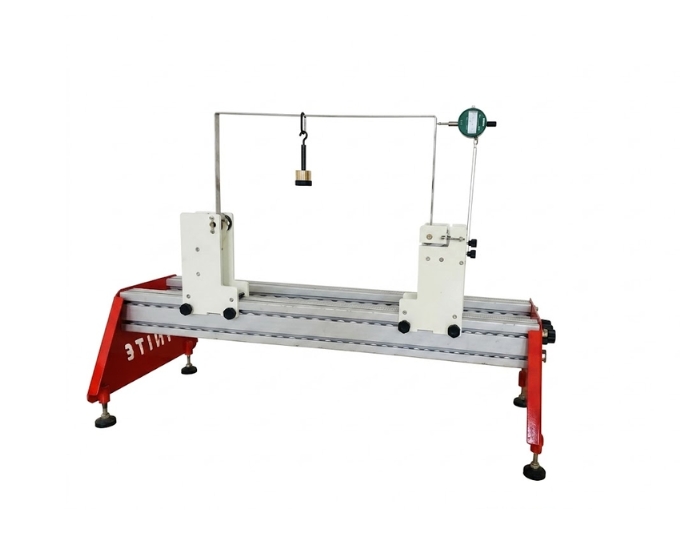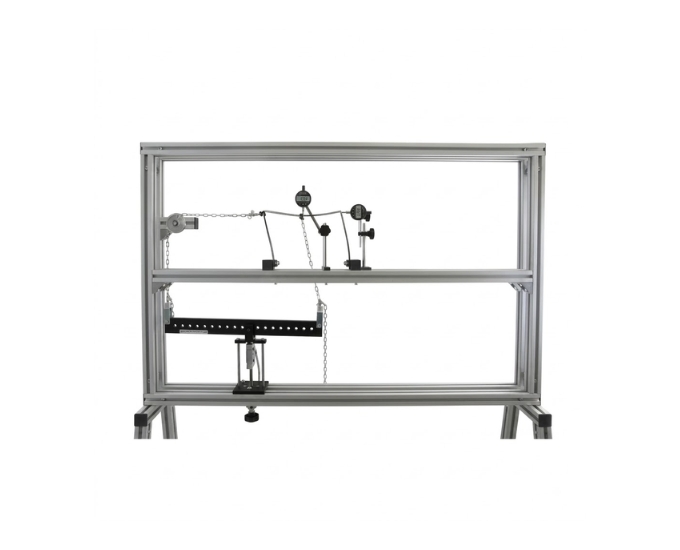

Buckling Behaviour of Frames Apparatus
Product Specification Sheet
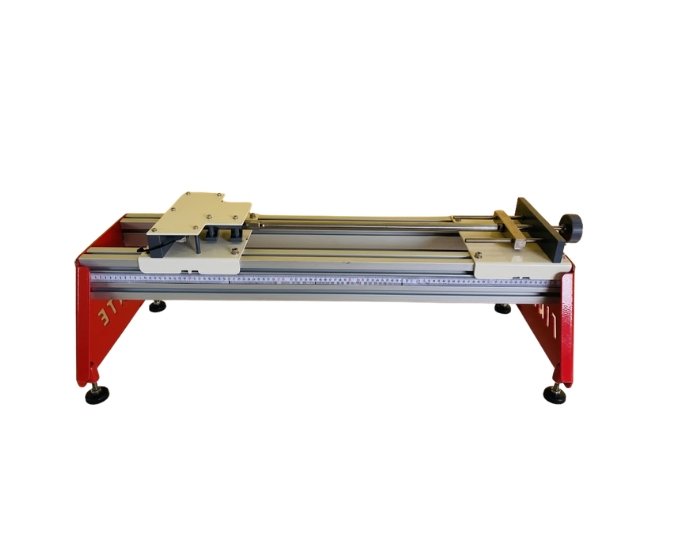
Buckling Behaviour of Frames Apparatus
Model Number: MTFE-124
The Buckling Behaviour of Frames Apparatus is an educational engineering laboratory system designed for practical investigation of elastic buckling and structural stability. It enables students to examine how support conditions, bar length, cross-sectional geometry, material properties, lateral loads and eccentric loading influence critical buckling behaviour and deformation.
Product Specification
The Buckling Behaviour of Frames Apparatus is a structural mechanics laboratory system developed for experimental investigation of instability and buckling in slender elastic members.
Buckling is an important structural phenomenon that can occur when a slender member subjected to compression becomes unstable and develops significant lateral deformation.
Unlike failure caused directly by excessive material stress, buckling can occur because of structural instability, making member geometry, effective length and support conditions particularly important.
The apparatus enables students to investigate buckling behaviour under the influence of different supports and clamps.
Changing the end restraints alters the effective buckling length of the member and therefore changes its critical buckling load.
Students can also investigate specimens having different bar lengths and cross-sections.
These experiments demonstrate the strong relationship between member geometry and resistance to buckling.
Different materials can also be investigated, allowing students to observe how the elastic modulus influences structural stability.
The system supports experiments involving an additional lateral load, helping demonstrate the interaction between axial compression and transverse loading.
Students can experimentally test Euler's theory of elastic buckling using suitable slender bars.
For an ideal slender member, the Euler critical buckling force can be represented as:
Pcr = π²EI / (KL)²
where:
Pcr = Critical buckling load
E = Elastic modulus
I = Second moment of area
L = Actual member length
K = Effective length factor determined by support conditions
The apparatus enables the experimentally observed buckling load to be compared with the value calculated using Euler's formula.
Students can perform a graphical analysis of deflection and applied force, helping them identify the relationship between increasing compressive load and lateral displacement.
The system can also be used to determine the elastic modulus of an unknown material when the required specimen geometry and buckling data are available.
Further experiments enable students to investigate how different cross-sectional shapes influence buckling resistance through changes in the second moment of area.
The apparatus also demonstrates the effect of eccentric application of force. When the compressive load does not pass directly through the centroidal axis, bending effects are introduced and the member's deformation behaviour changes.
The system therefore provides practical understanding of critical loads, elastic instability, Euler buckling, effective length, slenderness, lateral deflection, eccentric loading and structural stability.
Micro Technologies supplies Buckling Behaviour of Frames Apparatus and other Structural Mechanics and Strength of Materials laboratory systems for engineering colleges, universities, polytechnic institutes and technical training centres.
Features
- Elastic buckling experiments
- Euler buckling theory investigation
- Critical buckling load determination
- Different support-condition studies
- Interchangeable support and clamp arrangements
- Different bar-length experiments
- Different cross-sectional specimen studies
- Different material investigations
- Additional lateral loading
- Force versus deflection analysis
- Elastic modulus determination
- Cross-sectional shape comparison
- Eccentric loading experiments
- Structural stability investigation
- Experimental and theoretical comparison
- Educational laboratory construction
Benefits
- Demonstrates structural instability practically
- Enables verification of Euler's buckling theory
- Shows how support conditions influence buckling
- Demonstrates the effect of effective member length
- Enables comparison of different bar lengths
- Shows the influence of cross-sectional geometry
- Demonstrates the effect of material stiffness
- Enables critical buckling load determination
- Provides force-deflection analysis
- Supports elastic modulus determination
- Demonstrates eccentric loading effects
- Connects structural stability theory with experiments
Product Specifications
| Specification | Details |
|---|---|
| Product Name | Buckling Behaviour of Frames Apparatus |
| Product Type | Structural Mechanics Laboratory Apparatus |
| Primary Study | Elastic Buckling & Stability |
| Test Members | Slender Elastic Bars |
| Loading Type | Compressive |
| Euler Buckling | Study Supported |
| Critical Buckling Load | Determination Supported |
| Support Conditions | Variable |
| Bar Length | Multiple Length Studies |
| Cross-Sections | Different Sections Supported |
| Materials | Different Materials Supported |
| Lateral Load | Study Supported |
| Force vs. Deflection | Analysis Supported |
| Elastic Modulus | Determination Supported |
| Eccentric Loading | Study Supported |
| Theoretical Comparison | Supported |
| Application | Structural Mechanics / Strength of Materials |
Experiments Performed
- Investigation of elastic buckling behaviour
- Study of different supports and clamps
- Investigation of different bar lengths
- Investigation of different bar cross-sections
- Comparison of different specimen materials
- Investigation of additional lateral loading
- Experimental verification of Euler's buckling theory
- Calculation of critical buckling force using Euler's formula
- Measurement of experimental buckling load
- Comparison of theoretical and experimental critical loads
- Graphical analysis of deflection versus force
- Investigation of lateral deformation
- Determination of elastic modulus of an unknown material
- Measurement of force and deflection
- Comparison of different cross-sectional shapes
- Investigation of eccentric application of compressive force
- Study of structural stability and instability
Applications
- Structural Mechanics Laboratories
- Strength of Materials Laboratories
- Structural Analysis Laboratories
- Mechanics of Materials Laboratories
- Civil Engineering Laboratories
- Mechanical Engineering Laboratories
- Applied Mechanics Laboratories
- Engineering Mechanics Laboratories
- Structural Stability Laboratories
- Engineering Colleges
- Universities
- Polytechnic Institutes
- Technical Training Centres
- Educational & Research Laboratories
FAQs
What is the Buckling Behaviour of Frames Apparatus used for?
The apparatus is used to investigate elastic buckling, critical loads, lateral deformation and the effects of support conditions, geometry, material properties and eccentric loading.
What is structural buckling?
Buckling is an instability phenomenon in which a slender member subjected to compression develops significant lateral deformation after reaching a critical loading condition.
Can Euler's buckling theory be verified?
Yes. Experimental critical loads can be compared with theoretical values calculated using Euler's buckling equation.
Can different support conditions be investigated?
Yes. Different supports and clamps can be used to demonstrate how end restraints affect effective length and critical buckling load.
Can different bar lengths be compared?
Yes. Different specimen lengths can be investigated to demonstrate the strong relationship between effective length and buckling resistance.
Can different cross-sections be studied?
Yes. Different cross-sectional geometries can be compared to investigate the influence of second moment of area on buckling behaviour.
Can different materials be tested?
Yes. Suitable specimens of different materials can be compared to investigate the influence of elastic modulus on buckling resistance.
Can elastic modulus be determined experimentally?
Yes. With known specimen geometry and appropriate buckling measurements, the elastic modulus of a test material can be evaluated.
Can force and deflection be plotted graphically?
Yes. Experimental measurements can be used to develop force-versus-deflection relationships and analyze the progression of buckling.
What is eccentric loading?
Eccentric loading occurs when a compressive force acts away from the centroidal axis of a member, introducing bending in addition to axial compression.
Does cross-sectional shape affect buckling resistance?
Yes. Cross-sectional geometry affects the second moment of area and therefore significantly influences resistance to elastic buckling.
Is this apparatus suitable for Civil and Mechanical Engineering laboratories?
Yes. It is suitable for Civil Engineering, Mechanical Engineering, Structural Mechanics, Strength of Materials and Structural Analysis laboratories.
Why Choose Our Products
- Euler buckling verification
- Multiple support-condition studies
- Different bar-length experiments
- Cross-sectional geometry comparison
- Different material investigations
- Critical buckling load determination
- Force-deflection analysis
- Elastic modulus determination
- Lateral loading studies
- Eccentric load investigation
- Experimental and theoretical comparison
- Institutional and bulk supply support
Call to Action
Equip your Structural Mechanics and Strength of Materials Laboratory with the Buckling Behaviour of Frames Apparatus from Micro Technologies. The system provides hands-on investigation of Euler buckling, critical loads, structural stability and the effects of geometry, material and support conditions. Contact us for technical specifications, customized laboratory configurations, institutional quotations, bulk requirements or tender supply.