
Acrylic Refraction Cube
Product Specification Sheet
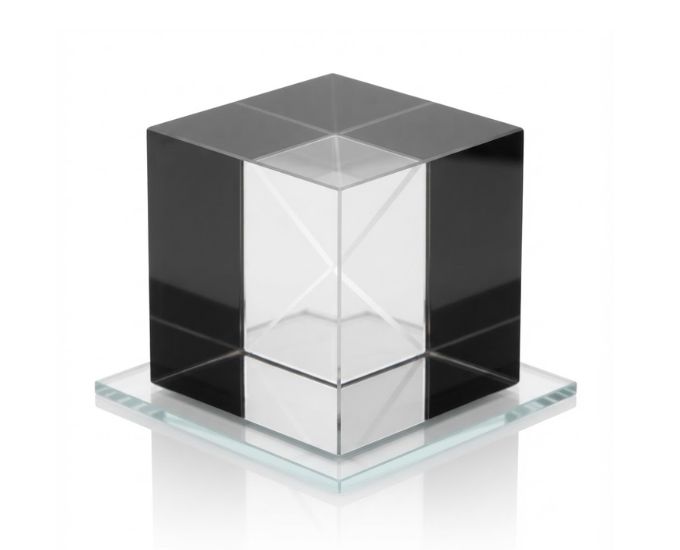
Acrylic Refraction Cube
Model Number: MTO-15
The Acrylic Refraction Cube is a transparent optical component used for practical experiments involving refraction, light transmission, ray tracing, and refractive properties of acrylic. Micro Technologies supplies the cube with approximately 50 mm faces, providing a compact and symmetrical geometry for a variety of optics setups. Its surfaces are highly polished to maintain clarity and allow light paths to be observed conveniently as rays enter, travel through, and emerge from the acrylic medium. The uniform cubic shape provides multiple flat optical faces, making the component easy to reposition for different experimental arrangements. Its clear, reusable construction is suitable for physics laboratories, optics laboratories, universities, colleges, research facilities, laboratory kits, and institutional procurement.
Product Specification
The Acrylic Refraction Cube is a clear, solid optical component used for studying how light behaves when it travels from air into acrylic and back into air. Its regular cubic geometry provides multiple flat and parallel surfaces, making it useful for experiments involving refraction, transmission, ray tracing, and optical path observation.
Each face measures approximately 50 mm, creating a compact cube that can be conveniently positioned on an optical board or laboratory bench. The transparent surfaces are highly polished to provide good optical clarity and allow incident, refracted, and emerging rays to be observed with minimal visual obstruction.
Micro Technologies supplies the Acrylic Refraction Cube for use with suitable ray boxes, narrow light sources, optical boards, angular scales, and other compatible optics accessories. When a light ray enters one face at an angle, its direction changes because acrylic has a different refractive index from air. A further change occurs as the ray emerges through another acrylic-air boundary.
The parallel opposite faces also make the cube useful for examining lateral displacement and comparing the incident and emergent ray directions. By changing the angle of incidence or orientation of the cube, different ray paths can be investigated without changing the optical component.
Its symmetrical 50 mm form provides a stable footprint and allows several faces to be used interchangeably during practical work. Acrylic construction offers useful transparency while remaining comparatively lightweight and convenient to handle.
With highly polished faces, clear construction, regular geometry, and no moving components, the Acrylic Refraction Cube requires minimal maintenance and provides dependable long-term value for optics experiments, laboratory kits, and bulk procurement.
Features
- Clear acrylic optical construction
- Approximately 50 mm face dimensions
- Regular cubic geometry
- Highly polished transparent faces
- Multiple flat optical surfaces
- Suitable for refraction investigations
- Supports ray-tracing experiments
- Useful for light transmission and lateral displacement studies
- Lightweight and convenient to position
- Reusable construction with no moving components
Benefits
- Clear polished faces improve observation of light paths
- Cubic geometry provides multiple usable optical surfaces
- Supports several refraction experiments with one component
- Stable 50 mm form simplifies bench-top positioning
- Lightweight acrylic construction improves routine handling
- Minimal maintenance helps reduce long-term operating costs
- Suitable for optics kits and institutional bulk procurement
Product Specifications
| Specification | Details |
|---|---|
| Product Name | Acrylic Refraction Cube |
| Internal Model No. | MT-30310 |
| Product Type | Optical Refraction Cube |
| Material | Clear acrylic |
| Shape | Cube |
| Face Size | Approx. 50 × 50 mm |
| Approx. Cube Size | 50 × 50 × 50 mm |
| Surface Finish | Highly polished |
| Transparency | Clear / transparent |
| Optical Faces | Flat and parallel |
| Optical Behaviour | Refraction and light transmission |
| Accuracy / Tolerance | Laboratory-grade dimensional consistency |
| Calibration Standard | Not normally required |
| Stopper Type | Not applicable |
| Color | Clear |
| Usage / Application | Refraction, ray tracing and optics experiments |
| Compliance Standard | Laboratory-grade optical and manufacturing quality |
Available Variants
- MT-30310 – Acrylic Refraction Cube, approx. 50 × 50 × 50 mm
- Acrylic Refraction Cube with optics accessory set
- Refraction Cube set for laboratory kits
- Custom dimensional configuration for bulk requirements
SKU System
- MT-ARC-50 – 50 mm Acrylic Refraction Cube
- MT-ARC-505050 – 50 × 50 × 50 mm Cube
- MT-ARC-OPT – Optics Experiment Configuration
- MT-ARC-SET – Acrylic Refraction Cube Set
- MT-ARC-CUS – Customized Refraction Cube
FAQs
What is an Acrylic Refraction Cube used for?
An acrylic refraction cube is used for optics experiments involving refraction, light transmission, ray tracing, and related optical behaviour. Its clear surfaces allow the path of light through acrylic to be investigated.
What is the size of the cube?
Each face is approximately 5 cm, giving the standard cube approximate overall dimensions of 50 × 50 × 50 mm.
Are the faces polished?
Yes. The transparent faces are highly polished to provide good optical clarity and smooth surfaces for refraction and ray-tracing investigations.
Can it be used for refraction experiments?
Yes. A suitable light ray passing from air into acrylic changes direction at the interface, allowing incident and refracted rays to be examined using an appropriate experimental setup.
Can the cube demonstrate lateral displacement?
Yes. Its parallel opposite faces allow suitable oblique rays to be used for investigating lateral displacement through a parallel-sided transparent medium.
Can it be used to investigate refractive index?
Yes. With an appropriate ray source and angular measuring arrangement, observations can be used to investigate the refractive properties of acrylic.
Can the Acrylic Refraction Cube be used with a ray box?
Yes. It can be combined with a suitable ray box or narrow-beam light source for observing incident, refracted, and emergent ray paths.
Does the cube require calibration?
The cube itself does not normally require calibration. Any angular or dimensional measuring instruments used for quantitative experiments should be appropriately checked.
How should the polished acrylic surfaces be maintained?
Use a soft, non-abrasive cloth and an acrylic-compatible cleaner. Avoid abrasive materials and aggressive solvents that may scratch, haze, or otherwise damage the polished surfaces.
Can Acrylic Refraction Cubes be ordered in bulk?
Yes. Bulk quantities can be supplied for physics laboratories, optics laboratories, universities, colleges, research facilities, laboratory kits, and scientific equipment distributors.
Can custom cube dimensions be supplied?
Custom dimensions may be considered depending on the required size, quantity, optical requirements, and manufacturing feasibility.
How is the cube packed for transportation?
The polished faces, corners, and edges are protected against scratching and impact during transportation. Suitable bulk and export packaging can also be arranged.
Why Choose Our Products
- Highly polished transparent acrylic surfaces
- Practical 50 × 50 × 50 mm cubic configuration
- Quality-checked dimensional and optical finish
- Reusable construction for dependable long-term use
- Bulk supply capability for laboratories, institutions, and distributors
Call to Action
Looking for Acrylic Refraction Cubes for optics experiments, laboratory kits, or institutional procurement? Contact Micro Technologies for competitive quotations, bulk orders, distributor inquiries, quantity supply, and customized optical requirements. Share your required quantity and specifications to receive suitable pricing and delivery details.