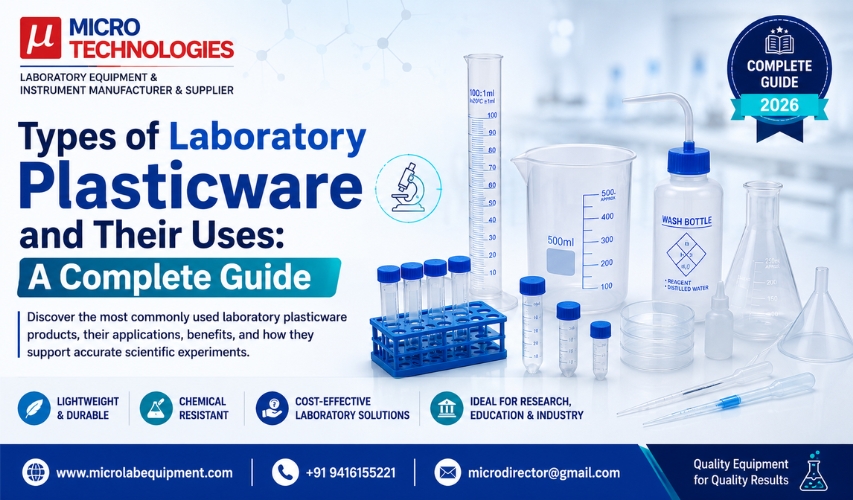
If you work in a diagnostic lab, a pharmaceutical company, a research institute, or a hospital, you already know that laboratory plasticware is everywhere. It lines your benches, fills your sample storage racks, and moves through your workflows dozens of times a day.
But here's what most procurement guides miss: not all plasticware is the same. The material, the intended use, and the quality standard all affect your results. These details can make your experiment succeed or fail. They can keep your sample sterile or cause contamination. They can protect your lab budget or force repeated replacements.
This guide covers the main types of laboratory plasticware. It explains what each one is used for. It also explains which plastic works best for each task. It shows what to check when sourcing from a manufacturer or supplier. Every claim here is backed by a published source — no filler, no fluff.
What Is Laboratory Plasticware?
Laboratory plasticware includes many plastic tools and supplies. Scientists use them in labs to store, move, mix, grow, filter, and test samples. These items may be disposable or reusable, depending on the material and the application.
The shift from glass to plastic in labs has been one of the most significant operational changes in modern science. Plastic is shatterproof, lightweight, chemically resistant across many polymer types, and — critically for pharmaceutical and diagnostic labs — available in pre-sterilised, single-use formats that eliminate cross-contamination risk entirely.
Globally, the laboratory plasticware market was valued at USD 2.27 billion in 2024 and is projected to reach USD 3.24 billion by 2032, growing at a CAGR of 4.55%. The demand is driven by expanding pharmaceutical pipelines, diagnostic lab growth, and increasing laboratory automation.
In India specifically, the diagnostic laboratories market was valued at INR 1.54 trillion in FY2024 and is expected to nearly double to INR 2.98 trillion by FY2030 — growing at approximately 11.7% annually. That translates directly into surging, sustained demand for every type of plasticware listed in this guide.
The 5 Most Common Plastics Used in Lab Plasticware (And Why It Matters)
Before diving into individual products, understand the materials — because choosing the wrong plastic for the wrong application is one of the most common and costly mistakes in lab procurement.
Polypropylene (PP): The most widely used lab plastic. Resistant to diluted acids, bases, and chemical solvents. Can be autoclaved at 121°C for sterilization. Used in beakers, centrifuge tubes, bottles, test tubes, and pipettes.
Polyethylene — LDPE and HDPE: LDPE (low-density) is soft, flexible, and ideal for squeeze bottles. HDPE (high-density) is rigid, tough, and used for storage bottles requiring durability. Neither can be autoclaved. LDPE dominated the global lab plasticware market with a 28.65% revenue share in 2023.
Polystyrene (PS): Transparent and cost-effective. Commonly used for petri dishes, pipettes, and single-use items where visual observation is needed. Fragile compared to PP — typically single-use. Accounted for 41.2% of the laboratory plasticware market in 2025.
Polycarbonate (PC): Extremely strong, impact-resistant, and autoclavable. Used for safety shields, desiccators, and high-stress centrifugation applications. Tolerates high temperatures and organic solvents.
PTFE (Polytetrafluoroethylene / Teflon): The gold standard for chemical inertness. Non-stick and resistant to almost all chemicals. Used in specialist applications where no other plastic will hold up.
The Complete List: Types of Laboratory Plasticware and Their Uses
1. Beakers
What they are: Wide-mouthed cylindrical containers available in a range of sizes, typically graduated for approximate volume measurement.
What they're used for: Mixing, stirring, and short-term storage of liquids. Used across general chemistry, biological sample preparation, and reagent mixing. Plastic beakers made from polypropylene are ideal for most applications; those made from polyethylene work well at higher temperatures.
Why plastic over glass: Plastic beakers are lightweight, shatterproof, and significantly cheaper to replace. In busy labs where beakers are handled dozens of times per shift, this matters.
Buyer note: Look for PP beakers with clear graduated markings and leak-resistant construction. For mixing highly concentrated acids, glassware remains the safer choice.
2. Centrifuge Tubes
What they are: Precision-made tubes designed to withstand the mechanical forces inside a centrifuge. Available in sizes from 0.2 mL microtubes up to 50 mL standard centrifuge tubes.
What they're used for: Separating biological components by density. Common applications include DNA isolation, protein separation, blood component separation, and biochemical assays. In molecular biology labs, microcentrifuge tubes (1.5 mL to 2.0 mL) are used in virtually every workflow.
Material: Made from polypropylene for chemical resistance and autoclavability. For very high-speed centrifugation, polycarbonate tubes offer greater structural integrity.
Buyer note: Always verify the maximum centrifugal force (g-force) the tube is rated for. A centrifuge tube that fails mid-spin doesn't just waste a sample — it can damage your centrifuge rotor.
3. Pipettes and Pipette Tips
What they are: Pipettes are instruments for measuring and transferring precise volumes of liquid. Pipette tips are the disposable plastic attachments that contact the sample directly.
What they're used for: Accurate liquid handling in every type of laboratory. Types include single-channel pipettes, multi-channel pipettes, electronic pipettes, serological pipettes, and transfer pipettes for basic non-precise work.
Why this product category matters so much: Pipettes and pipette tips are the single highest-demand products in the global lab plasticware market, driven by their essential role in accurately measuring and transferring small volumes of liquids — critical for experiments in research, diagnostics, and pharmaceutical applications.
Material: PE and PP. Low-quality polypropylene in pipette tips can leach compounds that inhibit enzymes or interfere with spectrophotometric analysis — which is why material purity is non-negotiable.
Buyer note: Always buy DNase/RNase-free certified tips for molecular biology applications. Verify lot-level certification from your supplier before standardizing on a product.
4. Petri Dishes
What they are: Shallow, transparent, lidded circular dishes — typically 90–100 mm in diameter and about 15 mm deep. Invented by German bacteriologist Julius Richard Petri in 1887. Now made predominantly from polystyrene plastic for single-use applications.
What they're used for: Culturing bacteria, fungi, and other microorganisms on nutrient agar. Used in antibiotic susceptibility testing (Kirby-Bauer disc diffusion testing), environmental sampling, food microbiology, and cell biology research. Medical laboratories use them to identify disease-causing bacteria from patient samples.
Why plastic is dominant here: Plastic petri dishes are light and pre-sterilized. They are disposable and save time. They also remove the need to wash and re-sterilize glass dishes. For high-throughput diagnostic labs processing hundreds of cultures per day, this is a decisive operational advantage.
Buyer note: For routine microbiology, standard PS petri dishes work well. For mammalian cell culture, you need treated culture dishes with surface coatings that promote cell adhesion — these are a different product.
5. Storage Bottles and Reagent Bottles
What they are: Sealed containers for the long-term storage of chemicals, reagents, and biological samples. Available with screw caps, dropper caps, and wide-mouth variants.
What they're used for: Storing reagents, media, buffers, and biological specimens. Sample storage held the largest application share of approximately 32% in 2024 in the global lab plasticware market.
Material: HDPE (high-density polyethylene) is the dominant material for storage bottles — resistant to chemicals, rigid in structure, and durable. PP is also widely used where autoclaving is required.
Buyer note: Match the bottle material to the chemical being stored. HDPE bottles are not compatible with certain solvents. Always check chemical compatibility charts from your manufacturer before procurement.
6. Test Tubes and Test Tube Racks
What they are: Cylindrical tubes open at the top, used for holding and mixing small sample volumes. Test tube racks provide organized, upright storage for multiple tubes simultaneously.
What they're used for: Holding and mixing small samples, centrifugation at lower speeds, and short-term sample storage. A staple of clinical pathology, chemistry education, and general research workflows.
Material: PP and PS. PP tubes can be autoclaved; PS tubes are typically single-use.
7. Volumetric Flasks and Erlenmeyer Flasks
What they are: Volumetric flasks have a precise fill line for exact volume measurement. Erlenmeyer (conical) flasks have a wide base and narrow neck and are used for mixing and temporary storage. Both are available in plastic.
What they're used for: Volumetric flasks for preparing solutions at exact concentrations. Erlenmeyer flasks for mixing reagents, culturing microorganisms in liquid media, and heating solutions safely.
Material: Polymethylpentene (PMP) is preferred for volumetric flasks — it's transparent, lightweight, and offers excellent chemical resistance. PP is used for Erlenmeyer flasks.
Buyer note: Plastic volumetric flasks are not as precise as glass for the most demanding volumetric work. For ISO-grade accuracy, glass is still preferred. For routine applications, PP or PMP is perfectly sufficient.
8. Microplates (Multiwell Plates)
What they are: Flat plates with multiple small wells arranged in a standardized grid—available in 6, 12, 24, 48, 96, and 384-well formats.
What they're used for: High-throughput screening in pharmaceutical drug discovery, ELISA assays, PCR reactions, cell viability testing, and diagnostic applications. The demand for advanced plasticware, including microplates, has risen by 35% due to rapid drug discovery initiatives.
Material: PS for most applications. PP for PCR plates requiring high thermal stability. Treated polystyrene with surface coatings for cell culture plates requiring cell adhesion.
Buyer note: This is one product category where cheap is very costly. Low-quality multiwell plates introduce optical interference, well-to-well variation, and binding inconsistencies that compromise assay results. Always verify plate uniformity specifications.
9. Wash Bottles
What they are: Squeezable bottles with a curved nozzle for dispensing small, directed streams of water or solvent.
What they're used for: Rinsing glassware, adding small, precise volumes of liquid to reactions, and cleaning lab surfaces. A basic but essential consumable in every lab.
Material: LDPE — flexible, squeezable, and chemical-resistant for general solvents.
10. Plastic Funnels and Filter Units
What they are: Funnels direct liquid from one container to another. Filter units combine a funnel and a membrane. They provide sterile filtration.
What they're used for: Sample filtration, sterile media preparation, and liquid transfer. Vacuum filtration units are critical in pharmaceutical manufacturing and microbiological quality testing.
Material: PP for funnels; various membrane types (nylon, PTFE, PES) for filter units depending on chemical compatibility requirements.
How to Choose a Reliable Laboratory Plasticware Manufacturer or Supplier
Understanding the products is one thing. Choosing the right source for them is another — and in a lab environment, the supplier decision directly affects the quality of your science.
Procurement teams and lab managers consistently look for these benchmarks:
ISO Certifications: ISO 9001 guarantees a documented, regularly audited quality management system. ISO 13485 is specifically designed for medical devices and laboratory consumables requiring regulatory oversight. These two certifications together are the minimum standard for any serious laboratory plasticware manufacturer.
Material Purity: Virgin-grade polymers matter. As confirmed by Thermo Fisher Scientific, low-quality polypropylene can leach compounds that inhibit enzymes or interfere with spectrophotometric analysis — directly sabotaging experiment results.
Lot-Level Consistency: Certified manufacturers verify every production lot for DNase/RNase-free status, sterility, and performance compliance. This is non-negotiable for molecular biology and pharmaceutical labs.
Bulk Availability and Delivery Reliability: Labs running high-throughput workflows cannot afford supply chain gaps. Your plasticware supplier needs consistent stock availability and reliable dispatch timelines.
Customer Support: Responsive, knowledgeable support is critical when troubleshooting product issues or specifying new requirements.
Why India's Labs Are Buying More Laboratory Plasticware Than Ever
If you're procuring for a lab in India, the market context is important. India's diagnostic laboratory market is growing at ~11.7% CAGR, set to nearly double by FY2030. The government’s Production Linked Incentive (PLI) scheme supports growth. Expanding pharma R&D also helps. Rapid growth of diagnostic chains in Tier 2 and Tier 3 cities drives demand. These factors increase domestic demand for high-quality lab consumables.
Asia-Pacific is the fastest-growing region globally for lab plasticware, with a projected CAGR exceeding 5.5% through 2035.
This means domestic manufacturers with the capacity, certifications, and product range to serve this growth are positioned to become critical partners for labs across the country.
A Note on Sustainability
One trend every lab procurement team should be watching: sustainable plasticware is no longer a niche conversation. Biomedical and scientific labs globally generate approximately 5.5 million tons of plastic waste annually. The sustainable laboratory plasticware market is growing at a 19% CAGR — from $0.47 billion in 2025 to a projected $2.69 billion by 2035. (Source: Roots Analysis, 2025)
At Micro Technologies, we are actively tracking these developments and expanding our product range to meet evolving sustainability requirements.
Source Your Laboratory Plasticware from Micro Technologies
At Micro Technologies, we manufacture and supply a full range of laboratory plasticware in this guide. We offer polypropylene beakers and centrifuge tubes. We also provide pre-sterilized petri dishes, reagent bottles, pipette tips, and multiwell plates.
We serve pharmaceutical companies, diagnostic laboratories, research institutes, hospitals, and educational institutions across India and global export markets — with consistent quality, competitive bulk pricing, and reliable supply.
What makes Micro Technologies the right laboratory plasticware supplier for your lab?
- Consistent material quality with documented specifications
- Full product range from a single, reliable source
- Bulk pricing with flexible order quantities
- Fast dispatch and reliable delivery timelines
- Dedicated support from a team that understands lab workflows
Ready to Place an Inquiry?
Whether you need a single product line or a complete lab consumables supply partnership, our team is ready to help.
📩 Microdirector@gmail.com — Request a quote, product catalogue, or technical specifications
📞 +91 98960 55098 — Speak directly with a product specialist.
🌐 Lab Plasticware Range — Explore the complete catalogue online
Micro Technologies — Precision Laboratory Plasticware for Labs That Cannot Afford Compromises.
Frequently Asked Questions
Q: What is the most commonly used type of laboratory plasticware?
Pipettes and pipette tips are the most widely used, followed by centrifuge tubes, petri dishes, and storage bottles. Their demand spans every type of laboratory — diagnostic, pharmaceutical, research, and educational.
Q: Can laboratory plasticware be reused?
Some can — polypropylene items such as beakers, bottles, and centrifuge tubes can be washed, autoclaved, and reused. However, many items such as pipette tips, petri dishes, and microplates are single-use to prevent cross-contamination.
Q: What plastic material is best for autoclaving?
Polypropylene (PP) and polycarbonate (PC) can withstand autoclave sterilization at 121°C. LDPE and HDPE items generally cannot and should not be autoclaved.
Q: How do I know if a laboratory plasticware supplier is reliable?
Check for ISO 9001 and ISO 13485 certifications, ask for material specification sheets, request lot-level quality documentation, and verify their track record with labs in your sector.
Q: What laboratory plasticware is used for cell culture?
Cell culture applications require treated polystyrene culture dishes or flasks (T-flasks), multiwell plates with surface treatment for cell adhesion, and pre-sterilized reagent bottles. Standard petri dishes are used for microbial culture, not mammalian cell culture.