
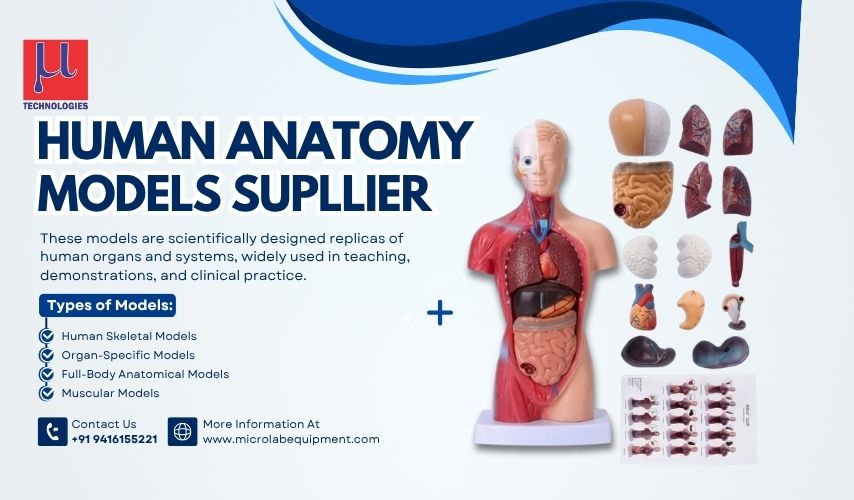
In modern healthcare and education, human anatomy models are essential. They make complex body structures easier to understand and study. A professional human anatomical model manufacturer like Micro Technologies helps institutions and healthcare professionals access accurate, durable, and easy-to-understand models.
These models are scientifically designed replicas of human organs and systems, widely used in teaching, demonstrations, and clinical practice. They provide a practical and safe alternative to traditional anatomy teaching methods.
What Are Human Anatomy 3D Models?
Human anatomy models are 3D physical representations of body parts such as organs, systems, and complete body structures. They are intended to help students and professionals comprehend anatomy visually and practically.
Unlike textbooks, these models offer depth and clarity, allowing users to examine structures from various perspectives. This improves comprehension and retention significantly.
Types of Human Anatomy Models
1. Human Skeletal Models
Human skeletal models represent the framework of the human body, including bones, joints, and the spine. These models help students understand posture, bone structure, and movement mechanisms.
They are widely used in schools and physiotherapy training, as they clearly demonstrate how bones connect and function together.
2. Muscular Models
Muscular models display different muscle groups along with their positioning and layering. They are often color-coded to make identification easier for learners.
These models are highly useful for understanding muscle movement, flexibility, and body mechanics in sports and medical training.
3. Organ-Specific Models
Organ-based models focus on individual organs like the human brain anatomical model, heart, lungs, or kidneys. They often include internal structures for detailed study.
Such models are essential for advanced learning, as they help in understanding organ functions, diseases, and medical procedures.
4. Human Torso Anatomical Model
A human torso anatomical model provides a detailed view of multiple organs within the upper body. Most models come with removable parts for interactive learning.
This model is highly preferred in classrooms because it gives a complete understanding of organ placement and internal relationships.
5. Full-Body Anatomical Models
Full-body models represent the entire human system, combining skeletal, muscular, and organ structures. They provide a comprehensive overview of the human body.
These models are ideal for beginners who need a general understanding before moving into specialized study areas.
6. 3D Printed Anatomy Models
Modern human anatomical models are now created using 3D printing technology for higher precision. These models are often based on real medical imaging data.
They offer better accuracy and customization options and are becoming increasingly popular in advanced medical training.
Materials Used in Human Anatomical Models
A reliable human anatomical model manufacturer uses high-quality materials to ensure durability and realism. Common materials include PVC, silicone, and advanced polymers.
These materials were chosen based on their strength, flexibility, and ability to mimic real human textures. High-quality construction ensures long-term usability.
Benefits of Human Anatomical Models
1. Better Understanding
These models provide a clear 3D view of the human body, making complex structures easier to understand. Students can visualize how different parts are connected.
This improves learning speed and helps in building a strong foundation in anatomy.
2. Safe Learning Option
Unlike cadavers, anatomical models are safe, hygienic, and easy to handle. They remove ethical concerns related to human body dissection.
This makes them appropriate for a variety of institutions, including schools and training centers.
3. Hands-On Experience
Students can physically interact with the models, which improves practical knowledge. Touch-based learning improves memory retention.
This interactive approach improves learning engagement and effectiveness.
4. Cost-Effective Solution
Human anatomy models are more affordable compared to maintaining cadaver labs. They also require minimal maintenance over time.
This makes them an excellent investment for educational facilities and laboratories.
5. Useful for Patient Education
Doctors use human anatomy models to explain medical conditions and treatments to patients. Visual explanation improves patient understanding.
This helps in building trust and ensures better communication in healthcare settings.
6. High Accuracy and Detail
Modern models are designed using advanced technologies to ensure precise detailing. They closely match real human anatomy.
This accuracy is important for medical students and professionals during training and practice.
How to Choose the Right Human Anatomy Model
Check Accuracy: Always choose models that are anatomically correct and proportionate. Accurate models provide better learning and reduce confusion. High precision is especially important for medical training purposes.
Identify Your Purpose: Different models serve different needs, such as basic education or advanced medical training. Choose according to your requirement. Selecting the right type ensures effective use and better results.
Material Quality: Sturdy materials help the model last longer and keep its shape. Good quality models don't wear out quickly. This helps in long-term usage without frequent replacement.
Level of Detail: Some models are simple, while others are extremely detailed, with removable parts. Choose based on your learning level. Advanced users should prefer models with more detailed features.
Why Choose Micro Technologies?
Micro Technologies is a trusted human anatomical model manufacturer known for delivering quality and precision. The company provides a diverse selection of human anatomical models for educational and medical applications.
Their products are designed with accuracy, durability, and affordability in mind. From human torso anatomical models to human brain anatomical models, they provide complete solutions for modern learning needs.
Future of Human Anatomy Models
The future of human anatomy models is evolving with technology like 3D printing, AI, and virtual reality. These advancements are making learning more interactive and precise.
Anatomical models will become more realistic and accessible in the coming years as technology advances.
Bulk Orders & Custom Solutions Available
We specialize in bulk supply and B2B orders. If you need customized human anatomical models, our team can design products based on your exact requirements.
Conclusion
Choosing the right human anatomical model manufacturer is essential for effective learning and training. High-quality human anatomy models not only improve understanding but also enhance practical knowledge.
With reliable products and modern designs, Micro Technologies is a great option. It works well for institutions and professionals. They can rely on it for high-quality anatomical solutions.
Frequently Asked Questions
1. What are human anatomical models used for?
Human anatomical models are used for teaching, training, and demonstration in medical and educational fields. They provide a 3D view of body structures, making complex concepts easier to understand. These models are widely used in colleges, hospitals, and labs. They also help doctors explain conditions to patients clearly.
2. Why are human anatomy models better than cadavers?
Human anatomy models are safer, reusable, and easy to maintain compared to cadavers. They eliminate ethical and legal concerns related to human dissection. Models also allow repeated practice without damage. This makes them a cost-effective and practical learning solution.
3. What types of human anatomical models are available?
There are different types of human anatomical models, including skeletal, muscular, organ-specific, and full-body models. Popular options include the human torso anatomical model and the human brain anatomical 3D model. Each model is designed for specific learning needs. Advanced models often include removable parts for detailed study.
4. How accurate are human anatomical models?
High-quality models from a professional human anatomical model manufacturer are highly accurate. Many are designed using real medical imaging data like CT and MRI scans. This ensures precise anatomical representation. Accuracy is essential for effective medical education and training.
5. Who should buy human anatomical models?
Human anatomy models are ideal for medical colleges, nursing institutes, schools, hospitals, and research labs. They are also useful for clinics to educate patients. Distributors and bulk buyers can purchase them for resale. These models serve both educational and professional purposes.
6. How to choose the best human anatomical model manufacturer?
Choose a human anatomical model manufacturer that offers high accuracy, durable materials, and a wide product range. Check for customization options and pricing. Reliable manufacturers ensure consistent quality and timely delivery. Always select models based on your specific use and requirement.