
Variable Inertia Bar Apparatus
Product Specification Sheet
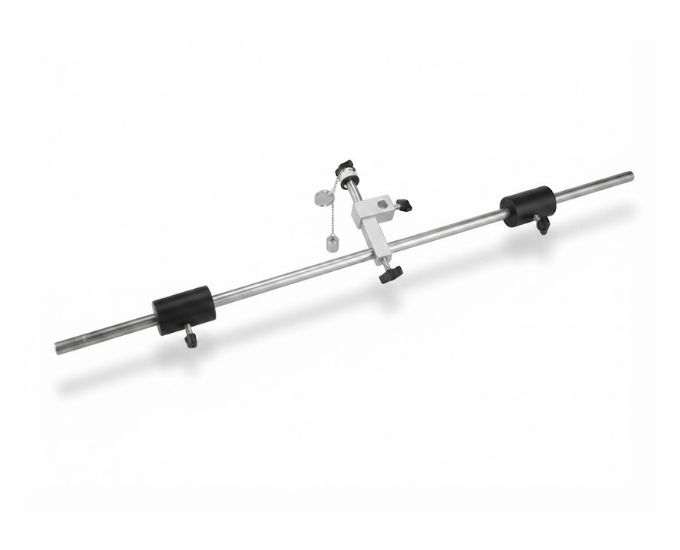
Variable Inertia Bar Apparatus
Model Number: MTM-92
The Variable Inertia Bar Apparatus from Micro Technologies is designed to demonstrate how the torque required to accelerate a rotating system depends on its moment of inertia rather than simply its total mass. The MT-10565B features a 790 × 12 mm steel bar, centrally mounted on a sleeved spindle, with two heavy adjustable masses that can be repositioned to vary the system's rotational inertia.
Product Specification
The Variable Inertia Bar Apparatus from Micro Technologies is a rotational mechanics apparatus designed for practical investigation of the relationship between torque, angular acceleration, mass distribution and moment of inertia.
The MT-10565B consists of a steel bar approximately 790 mm long × 12 mm diameter, mounted at its centre on a sleeved spindle. This central mounting allows the bar to rotate about an axis passing through its midpoint.
The spindle extends through a sleeve so that the bar can be rotated using a suitable weight-and-string arrangement. The applied falling load produces torque on the spindle, causing the bar and attached masses to undergo angular acceleration.
Two heavy adjustable masses are mounted on the bar, one toward each end. These masses can be clamped at different positions along the bar, allowing the distribution of mass relative to the rotational axis to be changed without necessarily changing the overall mass of the system.
When the adjustable masses are positioned farther from the rotational axis, the system has a greater moment of inertia and therefore requires greater torque to produce a given angular acceleration. Moving the masses closer to the axis reduces the moment of inertia.
This relationship can be expressed using:
τ = Iα
where τ is the applied torque, I is the moment of inertia and α is the angular acceleration.
The experiment clearly demonstrates that the rotational response of an object depends not only on its mass but also on how that mass is distributed relative to the axis of rotation.
The adjustable configuration allows multiple experimental conditions to be created using the same apparatus. Results obtained with different mass positions can be compared to investigate changes in angular acceleration and rotational inertia.
Manufactured and supplied by Micro Technologies, the Variable Inertia Bar Apparatus is suitable for physics laboratories, mechanics laboratories, dynamics laboratories, engineering laboratories, research facilities and other environments conducting rotational-motion investigations.
Features
- Variable inertia bar arrangement
- 790 × 12 mm steel bar
- Centrally mounted rotating bar
- Sleeved spindle arrangement
- Two heavy adjustable masses
- Masses independently repositionable
- Clamp-type mass positioning
- Weight-and-string drive arrangement
- Demonstrates variable moment of inertia
- Suitable for torque experiments
- Supports angular acceleration investigations
- Robust mechanical construction
- Multiple experimental configurations
- Manual laboratory operation
Benefits
- Demonstrates the relationship between torque and moment of inertia
- Shows the effect of radial mass distribution on rotational motion
- Allows moment of inertia to be varied without changing the main bar
- Adjustable masses enable comparative experiments
- Provides practical investigation of τ = Iα
- Helps distinguish mass from rotational inertia
- Suitable for quantitative rotational dynamics experiments
- Simple mechanical arrangement provides clear observation of motion
Product Specifications
| Specification | Details |
|---|---|
| Product Name | Variable Inertia Bar Apparatus |
| Model No. | MT-10565B |
| Product Type | Rotational Dynamics Apparatus |
| Bar Material | Steel |
| Bar Size | 790 × 12 mm |
| Mounting | Centrally Mounted |
| Spindle | Sleeved Spindle |
| Adjustable Masses | 2 Heavy Masses |
| Mass Position | Variable / Clamp Adjustable |
| Rotation Method | Weight & String Arrangement |
| Main Principle | Moment of Inertia |
| Parameters Studied | Torque, Inertia & Angular Acceleration |
| Operation | Mechanical |
| Primary Application | Rotational Dynamics Experiments |
Experimental Principle
| Concept | Description |
|---|---|
| Applied Torque | Produces rotational acceleration |
| Moment of Inertia | Depends on mass distribution |
| Angular Acceleration | Changes with rotational inertia |
| Adjustable Variable | Position of masses |
| Masses Near Axis | Lower moment of inertia |
| Masses Farther from Axis | Higher moment of inertia |
| Fundamental Relation | τ = Iα |
Available Model
| Model No. | Product |
|---|---|
| MT-10565B | Variable Inertia Bar Apparatus |
Applications
- Moment of inertia experiments
- Rotational inertia investigations
- Torque experiments
- Angular acceleration measurement
- Variable mass-distribution experiments
- Rotational dynamics studies
- Torque-inertia relationship demonstrations
- Angular motion investigations
- Mechanics laboratory experiments
- Dynamics laboratory experiments
Available Variants
Variable Inertia Bar, Variable Inertia Bar Apparatus, Adjustable Inertia Bar, Moment of Inertia Bar Apparatus, Rotational Inertia Bar, Torque and Inertia Apparatus, Adjustable Mass Rotational Bar, Variable Moment of Inertia Apparatus
SKU System
MT-VIB-10565B
FAQs
What is the MT-10565B Variable Inertia Bar used for?
The MT-10565B is used to investigate how moment of inertia affects the torque required to produce angular acceleration in a rotating system.
What is the size of the steel bar?
The steel bar is approximately 790 mm long × 12 mm diameter.
How is the moment of inertia varied?
Two heavy masses can be moved and clamped at different positions along the bar. Changing their distance from the rotational axis changes the moment of inertia of the system.
What happens when the masses are moved farther from the centre?
Moving the masses farther from the rotational axis generally increases the moment of inertia, so more torque is required to obtain the same angular acceleration.
How many adjustable masses are provided?
The apparatus incorporates two heavy adjustable masses, positioned on opposite sides of the centrally mounted bar.
How is torque applied to the apparatus?
The spindle can be rotated through a weight-and-string arrangement, which applies torque to the rotating system.
What relationship can be demonstrated with this apparatus?
A principal relationship demonstrated is τ = Iα, connecting applied torque, moment of inertia and angular acceleration.
Does the total mass need to change to vary the inertia?
No. The moment of inertia can be changed simply by repositioning the same masses at different distances from the rotational axis.
Why Choose Our Products
- Manufactured and supplied by Micro Technologies
- Model MT-10565B
- 790 × 12 mm steel bar
- Two adjustable heavy masses
- Variable mass-distribution arrangement
- Suitable for torque and angular acceleration experiments
- Robust mechanical laboratory construction
- Suitable for quantitative rotational dynamics studies
- Institutional, OEM, bulk and distributor supply available
Call to Action
Choose the Variable Inertia Bar Apparatus – MT-10565B from Micro Technologies for practical investigations of moment of inertia, torque, mass distribution and angular acceleration. Contact us for competitive pricing, institutional procurement, bulk orders, OEM requirements, distributor supply and customized quotations.