
Rotational Motion Apparatus
Product Specification Sheet
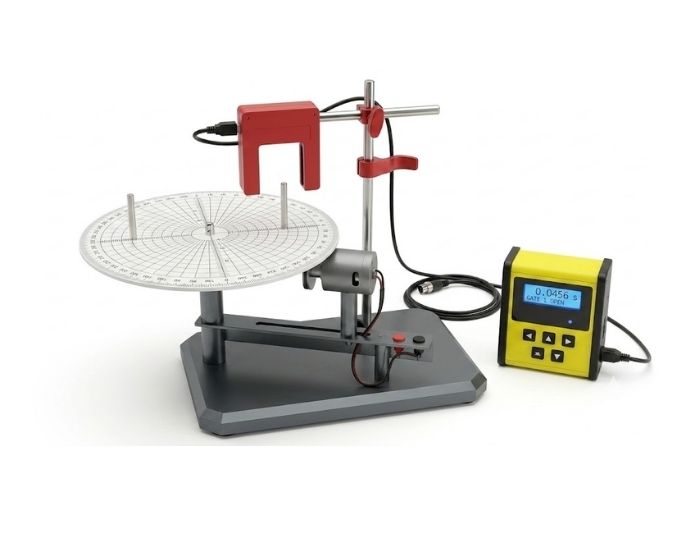
Rotational Motion Apparatus
Model Number: MTM-60
The Rotational Motion Apparatus from Micro Technologies is designed to investigate the relationship between linear (tangential) velocity and angular velocity. An AC-driven motor provides different rotational speeds, while a distance-adjustable platform allows measurements at different radii. Students can determine the rotational period, calculate angular velocity and compare it with tangential velocity. The apparatus includes a rotational table, ruler and calipers, while the required power supply and photogate system are not included.
Product Specification
The Rotational Motion Apparatus from Micro Technologies is a mechanics laboratory apparatus developed for practical investigations involving rotational motion, angular velocity, tangential velocity, radius and period of rotation.
The apparatus allows students to experimentally explore the mathematical relationship between the angular motion of a rotating system and the linear speed of a point positioned at a known distance from the axis of rotation.
An AC-driven motor produces rotational motion at various speeds, allowing experiments to be conducted under different rotational conditions.
A key feature of the apparatus is its distance-adjustable platform. The position can be varied so measurements can be performed at different distances from the center of rotation.
This enables students to investigate how tangential velocity changes with radius even when angular velocity remains constant.
Angular velocity can be determined using the rotational period:
ω = 2π / T
where:
ω = Angular Velocity
T = Period of One Complete Rotation
Once the angular velocity and radius are known, tangential velocity can be calculated using:
v = rω
where:
v = Tangential Velocity
r = Distance from Axis of Rotation
ω = Angular Velocity
This relationship demonstrates that at a constant angular velocity, a point located farther from the rotational axis has a greater tangential velocity.
The apparatus allows the period of one rotation to be measured, providing students with the information required to calculate angular velocity.
Measurements can then be repeated with the experimental point positioned at different distances from the axis.
Students can plot tangential velocity against radius and analyze the resulting relationship.
For constant angular velocity, the graph of tangential velocity versus radius should show an approximately linear relationship, illustrating:
v ∝ r
The experiment provides a useful distinction between angular velocity and linear velocity. Every point on a rigid rotating body has the same angular velocity, but points at different radii travel different linear distances during each revolution.
The apparatus can also be used to explore broader concepts involving circular motion, rotational period, frequency and rotational dynamics.
A suitable photogate system may be used for more precise measurement of rotational timing and velocity. The photogate is required for the intended precision measurement configuration but is not included with the apparatus.
The complete apparatus includes a rotational table, ruler and calipers, providing useful components for rotational and dimensional measurements.
A suitable power supply is required but not included and should be selected according to the laboratory configuration.
The adjustable arrangement allows students to change one experimental variable at a time, making the apparatus suitable for quantitative investigation and graph-based analysis.
Manufactured and supplied by Micro Technologies, the Rotational Motion Apparatus is suitable for physics and mechanics laboratories requiring practical equipment for studying angular and tangential motion.
Features
- Rotational Motion Apparatus
- AC-driven motor system
- Multiple rotational speeds
- Distance-adjustable platform
- Adjustable measurement radius
- Suitable for angular velocity experiments
- Suitable for tangential velocity studies
- Rotational period measurement
- Supports velocity-versus-radius experiments
- Rotational table included
- Ruler included
- Calipers included
- Compatible with photogate measurement
- Suitable for quantitative experiments
- Designed for rotational dynamics studies
Benefits
- Demonstrates the relationship between angular and tangential velocity
- Allows measurements at different radii
- Multiple rotational speeds expand experimental possibilities
- Helps students distinguish linear and angular motion
- Supports calculation of rotational period
- Allows angular velocity calculations
- Enables tangential velocity versus radius graphing
- Useful for circular-motion investigations
- Included measuring accessories simplify setup
- Supports quantitative mechanics laboratory experiments
Product Specifications
| Specification | Details |
|---|---|
| Product Name | Rotational Motion Apparatus |
| Product Type | Rotational Dynamics Experiment Apparatus |
| Drive | AC-Driven Motor |
| Rotational Speed | Variable / Multiple Speeds |
| Platform | Distance Adjustable |
| Measurement Radius | Adjustable |
| Rotational Table | Included |
| Ruler | Included |
| Calipers | Included |
| Period Measurement | Supported |
| Angular Velocity Study | Supported |
| Tangential Velocity Study | Supported |
| Photogate | Required, Not Included |
| Power Supply | Required, Not Included |
| Primary Application | Rotational Motion |
| Use | Physics / Mechanics Laboratory |
Applications
- Rotational motion experiments
- Angular velocity studies
- Tangential velocity experiments
- Linear versus angular velocity comparison
- Rotational period measurements
- Circular motion experiments
- Radius-versus-velocity investigations
- Rotational speed measurements
- Rotational dynamics studies
- Graph plotting experiments
- Mechanics laboratory practicals
- Physics laboratory demonstrations
Available Variants
Rotational Motion Apparatus, Angular and Tangential Velocity Apparatus, Rotational Dynamics Apparatus, Circular Motion Apparatus, Rotating Platform Experiment, Angular Velocity Demonstrator, Physics Lab Rotational Motion Apparatus
SKU System
MT-RMA-Series
FAQs
What is the Rotational Motion Apparatus used for?
It is designed to investigate the relationship between angular velocity, tangential velocity, rotational period and distance from the axis of rotation.
What type of drive does the apparatus use?
The apparatus uses an AC-driven motor to produce rotational motion at different speeds.
Can the experimental radius be changed?
Yes. The platform position is adjustable, allowing measurements to be performed at different distances from the axis of rotation.
How is angular velocity calculated?
Angular velocity can be determined from the period of rotation using ω = 2π/T.
How is tangential velocity related to angular velocity?
Tangential velocity is related to angular velocity and radius by v = rω.
What happens to tangential velocity when radius increases?
At constant angular velocity, tangential velocity increases proportionally with radius.
Can students plot tangential velocity against radius?
Yes. The apparatus is suitable for collecting measurements at different radii and plotting tangential velocity as a function of radius.
What accessories are included?
The apparatus includes a rotational table, ruler and calipers.
Is a photogate included?
No. A suitable photogate system is required separately for precision timing and velocity measurements.
Is the power supply included?
No. A compatible power supply is required but is not included with the apparatus.
Why Choose Our Products
- Manufactured and supplied by Micro Technologies
- AC-driven rotational system
- Multiple rotational speeds
- Adjustable experimental radius
- Suitable for angular and tangential velocity studies
- Rotational table included
- Ruler and calipers supplied
- Supports quantitative graph-based experiments
- Suitable for institutional laboratory procurement
- Bulk and OEM supply available
Call to Action
Explore the relationship between angular velocity, tangential velocity, radius and rotational period with the Rotational Motion Apparatus from Micro Technologies. Designed for quantitative mechanics experiments, it provides an effective platform for studying rotational dynamics and circular motion. Contact us for institutional pricing, bulk procurement, OEM supply and customized laboratory requirements.