
Planes with Different Inclinations Apparatus
Product Specification Sheet
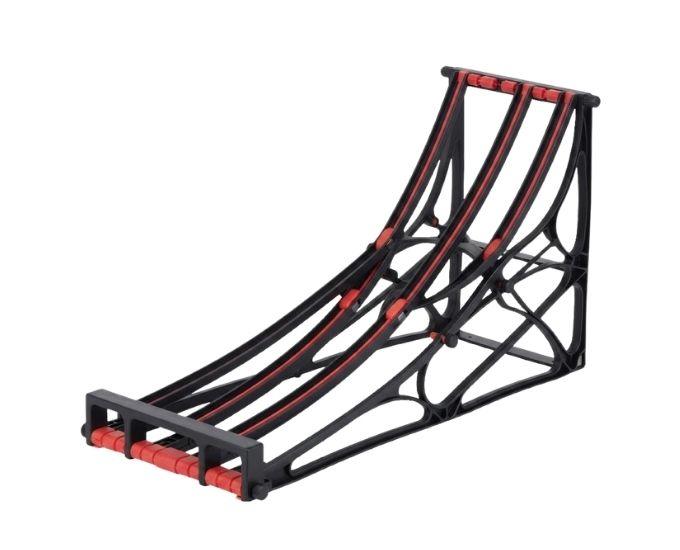
Planes with Different Inclinations Apparatus
Model Number: MTM-102
The Planes with Different Inclinations Apparatus from Micro Technologies is a multi-track mechanics apparatus modeled on the famous Brachistochrone problem. The MT-10579N/1 allows rolling objects to travel along tracks with different profiles and inclinations, demonstrating whether the shortest path between two points is also the path requiring the least travel time.
Product Specification
The Planes with Different Inclinations Apparatus from Micro Technologies is designed for practical investigation of the famous Brachistochrone problem, which examines the path along which an object moving under gravity travels between two points in the shortest possible time.
The MT-10579N/1 incorporates multiple tracks having different profiles and inclinations. Rolling objects can be released under comparable initial conditions and their motion along the different paths can be observed simultaneously.
One of the most important concepts demonstrated by the apparatus is that the geometrically shortest route does not necessarily produce the shortest travel time.
A ball travelling along a track with a steeper initial descent can gain velocity more rapidly because gravitational potential energy is converted into kinetic energy earlier in its journey. Although such a path may be longer than a more direct route, the higher velocity achieved during a significant portion of the motion can result in a shorter overall travel time.
The apparatus therefore provides an engaging experimental demonstration of the relationship between path geometry, gravitational acceleration, velocity and travel time.
It can also be used to investigate the conversion of gravitational potential energy into kinetic energy. As a rolling object descends from its starting position, its gravitational potential energy decreases while its translational and rotational kinetic energy increase.
By comparing the arrival times of objects travelling along different tracks, users can directly investigate the question:
“Is the path of shortest length also the path of quickest descent?”
The experiment provides a practical connection between classical mechanics and the Brachistochrone problem, while also supporting broader investigations involving rolling motion, acceleration, energy transformation and trajectory optimization.
Manufactured and supplied by Micro Technologies, the Planes with Different Inclinations Apparatus is suitable for physics laboratories, mechanics laboratories, dynamics laboratories and other facilities conducting motion and energy experiments.
Features
- Multi-track mechanics apparatus
- Different track inclinations and profiles
- Modeled on the Brachistochrone problem
- Suitable for simultaneous path comparison
- Demonstrates shortest path versus fastest path
- Supports rolling-motion experiments
- Demonstrates gravitational acceleration
- Suitable for velocity comparison
- Demonstrates potential-to-kinetic energy conversion
- Visual travel-time comparison
- Stable track construction
- Multi-activity experimental design
- Simple mechanical operation
- No electrical power required
Benefits
- Provides a clear demonstration of the Brachistochrone concept
- Shows that shortest distance does not necessarily mean shortest time
- Allows different trajectories to be compared directly
- Demonstrates the effect of initial slope on velocity
- Helps investigate gravitationally accelerated motion
- Supports kinetic and potential energy experiments
- Provides an engaging visual mechanics demonstration
- Suitable for repeated comparative trials
- Requires no complex electronic equipment for basic observation
Product Specifications
| Specification | Details |
|---|---|
| Product Name | Planes with Different Inclinations Apparatus |
| Model No. | MT-10579N/1 |
| Product Type | Multi-Track Motion Apparatus |
| Track Configuration | Multiple Inclinations / Profiles |
| Experimental Concept | Brachistochrone Problem |
| Motion Type | Rolling |
| Driving Force | Gravity |
| Comparative Testing | Supported |
| Main Study | Path vs. Travel Time |
| Energy Study | Potential & Kinetic Energy |
| Velocity Comparison | Supported |
| Operation | Mechanical |
| Power Requirement | None |
Experimental Capabilities
| Experiment | Principle Studied |
|---|---|
| Brachistochrone Experiment | Fastest descent between two points |
| Different Inclinations | Effect of track geometry |
| Shortest vs. Fastest Path | Distance compared with travel time |
| Rolling Motion | Motion along shaped tracks |
| Gravitational Acceleration | Effect of gravity on velocity |
| Potential Energy | Energy due to initial height |
| Kinetic Energy | Energy gained during descent |
| Velocity Comparison | Speed along different paths |
| Travel-Time Comparison | Relative arrival times |
Available Model
| Model No. | Product |
|---|---|
| MT-10579N/1 | Planes with Different Inclinations Apparatus |
Applications
- Brachistochrone experiments
- Fastest-path demonstrations
- Different inclination experiments
- Rolling-motion investigations
- Gravity-driven motion experiments
- Velocity comparison
- Travel-time comparison
- Kinetic energy investigations
- Potential energy experiments
- Conservation of mechanical energy demonstrations
- Mechanics laboratory experiments
- Dynamics investigations
Available Variants
Planes with Different Inclinations, Brachistochrone Apparatus, Different Inclination Track Apparatus, Fastest Path Track, Gravity Motion Track, Multi-Inclination Mechanics Track, Rolling Ball Path Apparatus, Brachistochrone Track Experiment
SKU System
MT-PDI-10579N-1
FAQs
What is the MT-10579N/1 apparatus used for?
The apparatus is primarily used to investigate the Brachistochrone problem and compare the travel times of rolling objects moving along paths with different inclinations and profiles.
What is the Brachistochrone problem?
The Brachistochrone problem asks which path allows an object moving under gravity to travel between two points in the shortest possible time.
Is the shortest path always the fastest path?
No. A geometrically shorter path does not necessarily give the shortest travel time. A path with a steeper initial descent may allow the object to gain velocity earlier and therefore reach the destination sooner.
Why can a longer track produce a faster arrival?
A steeper initial section converts gravitational potential energy into kinetic energy more rapidly, allowing the object to travel at a higher velocity for more of its journey.
Can potential and kinetic energy be demonstrated?
Yes. As an object descends, gravitational potential energy decreases while kinetic energy increases, making the apparatus suitable for energy-transformation demonstrations.
Can different track profiles be compared simultaneously?
Yes. The multi-track arrangement is designed to allow motion along different paths and inclinations to be compared.
Does the apparatus require electricity?
No. Standard experiments are gravity-driven and mechanically operated, so no electrical power is required.
Why Choose Our Products
- Manufactured and supplied by Micro Technologies
- Model MT-10579N/1
- Based on the famous Brachistochrone problem
- Multiple track profiles for direct comparison
- Suitable for motion and energy investigations
- Clear fastest-path demonstration
- Stable mechanical construction
- Suitable for repeated laboratory experiments
- Institutional, bulk, OEM and distributor supply available
Call to Action
Choose the Planes with Different Inclinations Apparatus – MT-10579N/1 from Micro Technologies for practical demonstrations of the Brachistochrone problem, fastest-path motion and energy transformation. Contact us for competitive pricing, complete mechanics track configurations, institutional procurement, bulk orders, OEM requirements and distributor supply.