
Pitot Static Tube Module
Product Specification Sheet
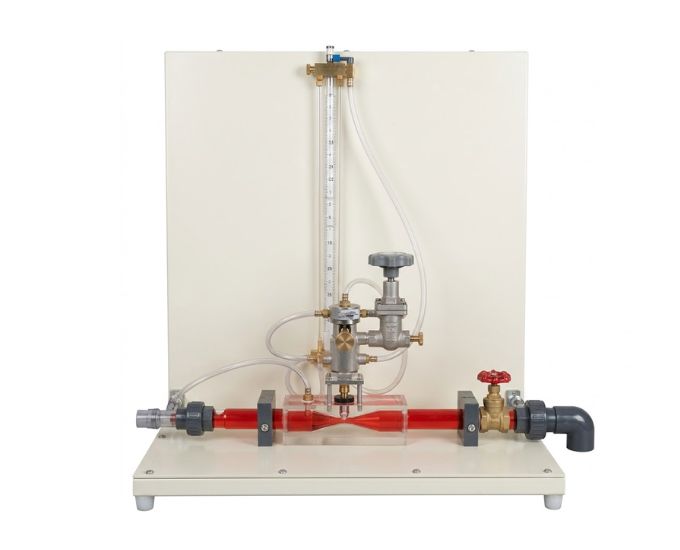
Pitot Static Tube Module
Model Number: MTHB-150.22
The Pitot Static Tube Module is an educational fluid mechanics laboratory apparatus designed to demonstrate Pitot-static tube operation as a measuring instrument and determine velocity profiles in a pipe. The system allows students to investigate static pressure, total pressure, dynamic pressure, and local fluid velocity while developing practical knowledge of flow measurement and velocity distribution.
Product Specification
The Pitot Static Tube Module is a practical educational apparatus developed for studying the measurement of fluid velocity using a Pitot-static tube and for experimentally determining the velocity profile across a pipe section.
Manufactured by Micro Technologies, the apparatus provides students with hands-on understanding of an important differential-pressure-based velocity measurement technique widely used in fluid mechanics and engineering applications.
A Pitot-static tube determines fluid velocity by measuring the difference between total pressure and static pressure. When the tube is correctly positioned in a flowing fluid, its forward-facing opening senses stagnation or total pressure, while static pressure is measured separately.
The difference between these pressures represents the dynamic component associated with the velocity of the fluid. Using the measured pressure difference and appropriate fluid properties, the local flow velocity can be determined.
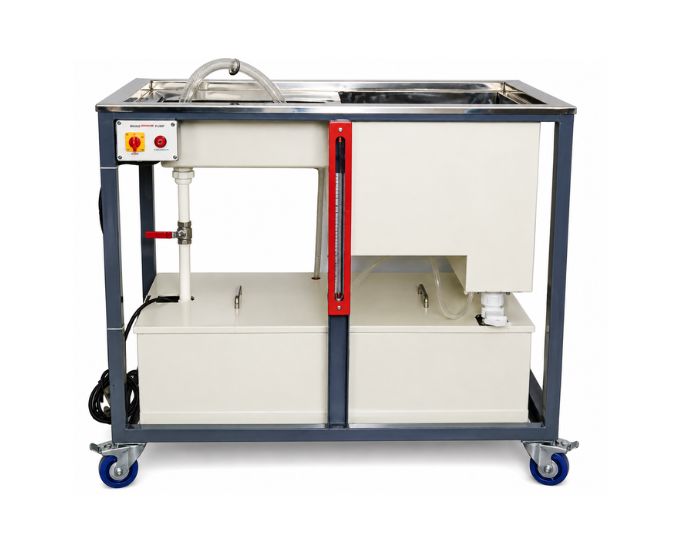
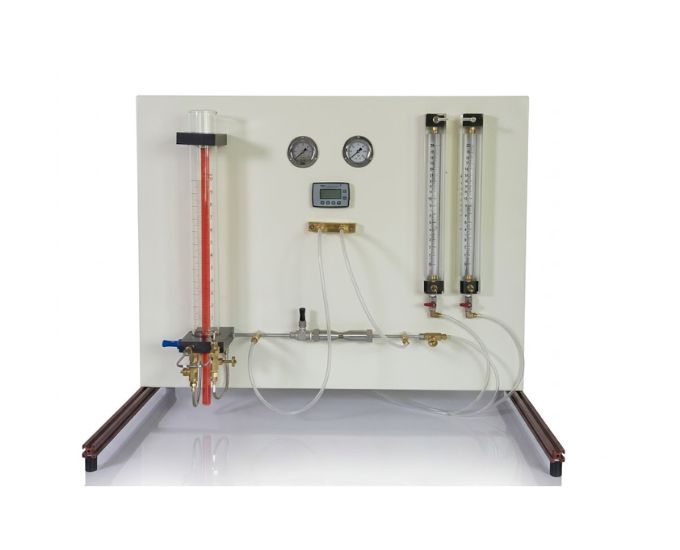
The apparatus incorporates a suitable transparent or clearly accessible flow section, Pitot-static tube, pressure measurement arrangement, flow-control components, and a positioning mechanism.
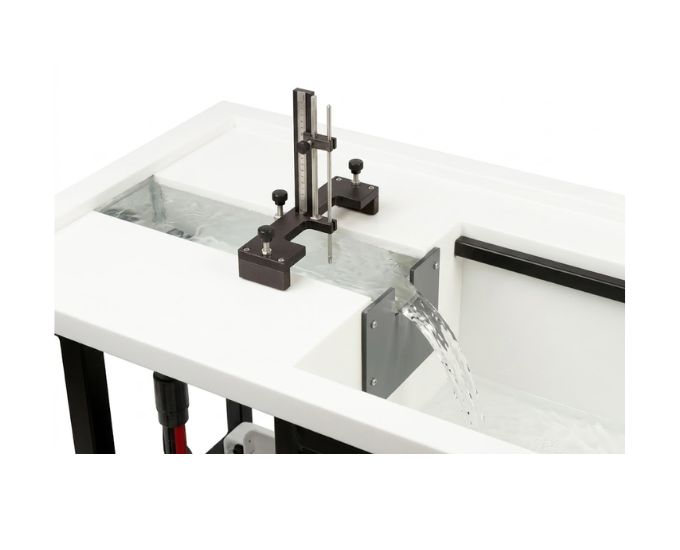
An important feature of the module is the ability to move the measuring probe across different positions within the pipe. This allows students to measure local velocity at multiple points across the flow section.
The recorded measurements can then be used to develop a velocity profile, showing how fluid velocity varies from the pipe wall toward the central region.
This experiment helps students understand that fluid velocity is generally not uniform across a pipe because of viscous effects and the no-slip condition at the pipe wall.
The apparatus therefore provides practical understanding of pressure measurement, velocity determination, pipe-flow behaviour, and flow-profile development.
Features
- Demonstrates Pitot-static tube operation
- Local fluid velocity measurement
- Velocity profile determination
- Static pressure measurement
- Total pressure measurement
- Dynamic pressure determination
- Adjustable Pitot-static tube position
- Measurement at different locations across the pipe
- Pressure measuring arrangement
- Controlled water-flow system
- Clearly visible experimental configuration
- Suitable for differential pressure studies
- Supports theoretical and experimental analysis
- Compact laboratory design
- Easy operation and observation
- Robust educational construction
- Suitable for repeated student experiments
Benefits
- Provides practical understanding of Pitot-static tube operation
- Demonstrates pressure-based velocity measurement
- Enables local velocity to be determined
- Allows complete pipe velocity profiles to be investigated
- Helps students understand static, total, and dynamic pressure
- Demonstrates velocity variation across a pipe
- Provides practical differential-pressure measurement experience
- Supports theoretical and experimental comparison
- Connects fluid mechanics theory with industrial flow measurement
- Suitable for engineering practicals and demonstrations
Product Specifications
| Specification | Details |
|---|---|
| Product Name | Pitot Static Tube Module |
| Product Type | Fluid Velocity Measurement Apparatus |
| Working Medium | Water / Suitable Laboratory Fluid |
| Measuring Instrument | Pitot-Static Tube |
| Primary Study | Fluid Velocity Measurement |
| Additional Study | Velocity Profile in a Pipe |
| Pressure Parameters | Static, Total & Dynamic Pressure |
| Probe Position | Adjustable Across Flow Section |
| Pressure Measurement | Differential Pressure Arrangement |
| Flow Control | Adjustable |
| Measurement | Local Velocity at Different Positions |
| Experimental Output | Pipe Velocity Profile |
| Installation | Laboratory Experimental Setup |
| Operation | Educational / Experimental |
| Application | Fluid Mechanics & Hydraulic Engineering Laboratories |
Main Components
The apparatus typically incorporates:
- Pitot-static tube
- Pipe flow test section
- Probe positioning arrangement
- Pressure measurement system
- Differential pressure connections
- Water inlet and outlet connections
- Flow-control valve
- Measuring scale
- Supporting structure
- Suitable hydraulic connections
Experiments Performed
- Demonstrate the operation of a Pitot-static tube
- Use a Pitot-static tube as a velocity measuring instrument
- Measure total pressure
- Measure static pressure
- Determine dynamic pressure
- Determine local fluid velocity
- Measure velocity at different positions across a pipe
- Plot the velocity profile in a pipe
- Investigate velocity variation from the pipe wall to the central region
- Study pressure and velocity relationships
- Compare velocity measurements at different radial positions
- Study practical flow-measurement techniques
Parameters Studied
The apparatus can be used to investigate:
- Static pressure
- Total pressure
- Stagnation pressure
- Dynamic pressure
- Differential pressure
- Local fluid velocity
- Radial position
- Pipe diameter
- Velocity distribution
- Velocity profile
- Flow behaviour
Pitot Static Tube Measurement
The Pitot-static tube determines fluid velocity from the difference between total and static pressure.
The relationship can be represented in simplified form as:
Dynamic Pressure = Total Pressure − Static Pressure
For suitable incompressible flow conditions:
V = √(2ΔP / ρ)
Where:
- V = Local fluid velocity
- ΔP = Difference between total and static pressure
- ρ = Fluid density
This allows the pressure difference measured by the apparatus to be converted into local flow velocity.
Velocity Profile Measurement
Fluid velocity inside a pipe generally varies across the pipe cross-section.
The Pitot-static tube can be positioned at different locations across the flow section. At each position, the pressure difference is measured and converted into a corresponding local velocity.
Students can then:
- Record the probe position
- Measure differential pressure
- Calculate local velocity
- Repeat measurements across the pipe
- Plot velocity against position
- Develop the experimental velocity profile
This provides a practical visualization of velocity distribution in internal fluid flow.
Educational Objectives
The apparatus helps students understand:
- Pitot-static tube operation
- Flow velocity measurement
- Static pressure
- Total pressure
- Dynamic pressure
- Stagnation pressure
- Differential pressure
- Local velocity
- Pipe-flow velocity distribution
- Velocity profiles
- Pressure-velocity relationships
- Practical fluid-flow instrumentation
Engineering Applications
The principles demonstrated using the apparatus are relevant to:
- Pipeline flow measurement
- Water distribution systems
- HVAC systems
- Ventilation systems
- Hydraulic pipelines
- Industrial process systems
- Flow monitoring
- Aerodynamic testing
- Duct velocity measurement
- Pumping installations
- Fluid research systems
- Process instrumentation
Applications
- Fluid Mechanics Laboratories
- Hydraulic Engineering Laboratories
- Mechanical Engineering Laboratories
- Civil Engineering Laboratories
- Chemical Engineering Laboratories
- Process Engineering Laboratories
- Aerodynamics Laboratories
- Engineering Colleges
- Universities
- Polytechnic Institutes
- Technical Training Centres
- Research Laboratories
FAQs
What is a Pitot Static Tube Module?
A Pitot Static Tube Module is an educational laboratory apparatus used to demonstrate Pitot-static tube operation and determine local fluid velocities and velocity profiles in a pipe.
What is the main objective of this apparatus?
The main objective is to demonstrate the Pitot-static tube as a measuring instrument and draw the velocity profile in a pipe.
What does a Pitot-static tube measure?
It measures total and static pressure, allowing the dynamic pressure and corresponding local fluid velocity to be determined.
What is total pressure?
Total or stagnation pressure is the pressure measured when the moving fluid is brought approximately to rest at the sensing point under appropriate flow conditions.
What is static pressure?
Static pressure is the thermodynamic pressure of the flowing fluid measured without intentionally bringing the flow to rest.
What is dynamic pressure?
Dynamic pressure is associated with the kinetic energy of the flowing fluid and can be obtained from the difference between total and static pressure for the applicable flow conditions.
Can a velocity profile be plotted with this apparatus?
Yes. The Pitot-static tube can be positioned at different points across the pipe, allowing local velocity measurements to be used to plot the velocity profile.
Why does velocity vary across a pipe?
Viscous effects and the no-slip condition cause fluid velocity to be lower near the pipe wall and generally higher toward the central region.
Where are Pitot tubes used?
Pitot and Pitot-static tubes are used in applications including pipe and duct measurements, HVAC systems, aerodynamic testing, flow monitoring, and engineering research.
Is this apparatus suitable for engineering colleges?
Yes. It is suitable for mechanical, civil, hydraulic, chemical, process, aerodynamics, and fluid mechanics engineering laboratories.
Why Choose Our Products
- Practical Pitot-static tube demonstration
- Static and total pressure measurement
- Local fluid velocity determination
- Complete velocity profile experiments
- Adjustable probe positioning
- Practical flow measurement training
- Clear educational configuration
- Robust laboratory construction
- Suitable for repeated student experiments
- Institutional and bulk laboratory supply
- Customized configurations available
- Technical and project support
Call to Action
Looking for a reliable Pitot Static Tube Module for your fluid mechanics laboratory? Micro Technologies manufactures and supplies fluid flow measurement, fluid mechanics, and hydraulic engineering laboratory equipment for universities, engineering colleges, polytechnics, research institutes, and technical training centres. Contact us for complete laboratory setups, customized configurations, institutional projects, bulk requirements, distributor inquiries, or a competitive quotation