
Path of a Pendulum Apparatus
Product Specification Sheet
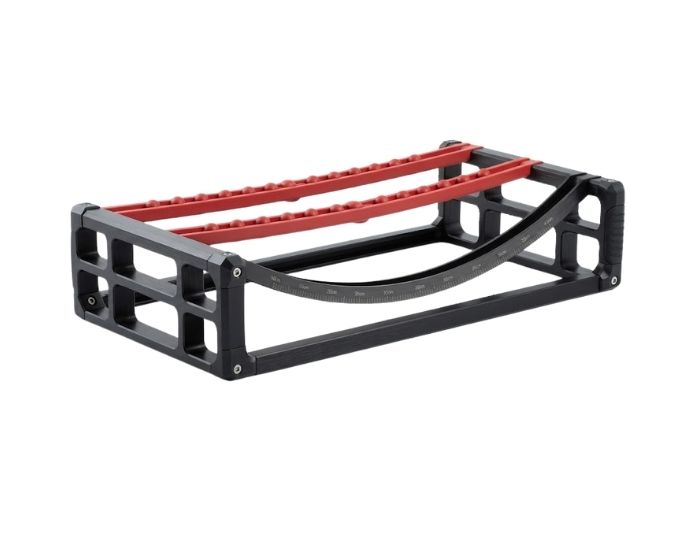
Path of a Pendulum Apparatus
Model Number: MTM-104
The Path of a Pendulum Apparatus from Micro Technologies is designed to represent and compare the paths followed by simple pendulum bobs of different lengths. The MT-10579N/3 provides a clear visual demonstration for investigating whether the time period of a simple pendulum depends on its length, bob mass or oscillation amplitude.
Product Specification
The Path of a Pendulum Apparatus from Micro Technologies is a mechanics demonstration apparatus designed to investigate the motion and time-period characteristics of a simple pendulum.
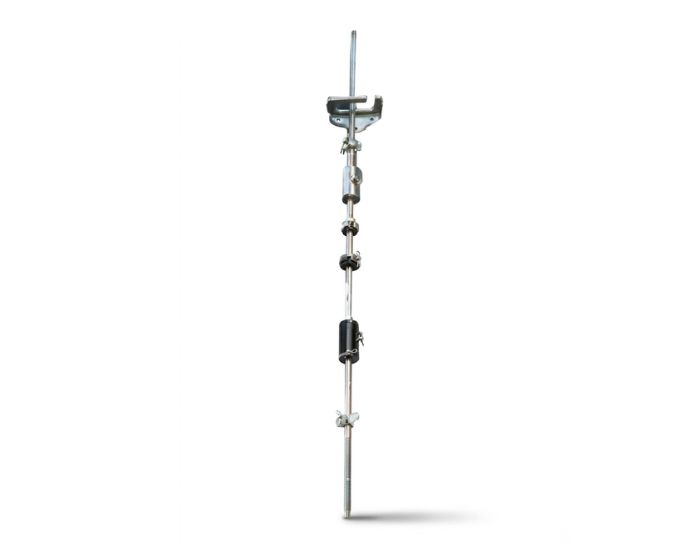
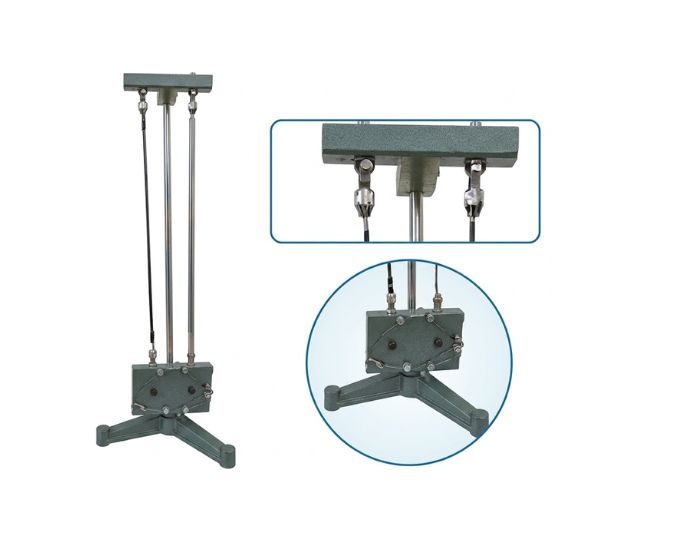
The MT-10579N/3 incorporates multiple curved tracks, with each track representing the trajectory followed by the bob of a simple pendulum having a different effective length. The arrangement provides a convenient way to visualize and compare pendulum paths within a single experimental system.
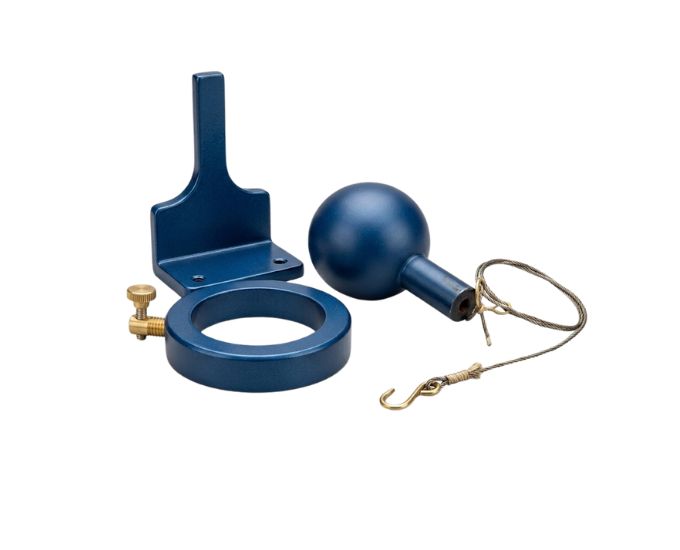
A simple pendulum consists of a bob suspended from a fixed point by a light string. When displaced from its equilibrium position and released, the bob moves along a curved arc under the influence of gravity.
For small angular displacements, the time period of a simple pendulum is approximately represented by:
T = 2π√(L/g)
where:
T = time period
L = effective pendulum length
g = acceleration due to gravity
The relationship shows that the time period depends strongly on pendulum length. A longer pendulum generally takes more time to complete one oscillation, while a shorter pendulum has a shorter period.
The apparatus can also be used to examine whether changing the mass of the pendulum bob affects its period. Under ideal conditions and for small oscillations, the period of a simple pendulum is essentially independent of bob mass.
Another useful investigation involves oscillation amplitude. For sufficiently small angular displacements, the simple-pendulum approximation predicts that the period is nearly independent of amplitude. At larger amplitudes, deviations from this approximation become more noticeable.
By representing different pendulum trajectories through carefully formed tracks, the apparatus provides a visual and comparative approach to studying periodic motion, pendulum length, oscillation period, amplitude and gravitational effects.
Manufactured and supplied by Micro Technologies, the Path of a Pendulum Apparatus is suitable for physics laboratories, mechanics laboratories, dynamics laboratories and facilities conducting pendulum and oscillation experiments.
Features
- Multiple pendulum-path track arrangement
- Represents pendulums of different lengths
- Model MT-10579N/3
- Suitable for time-period investigations
- Demonstrates effect of pendulum length
- Supports bob-mass comparison
- Suitable for amplitude investigations
- Demonstrates periodic motion
- Supports simple harmonic motion concepts
- Stable track construction
- Clear comparative demonstration
- Multi-activity mechanics apparatus
- Simple mechanical operation
- No electrical power required
Benefits
- Clearly visualizes paths followed by pendulums
- Enables comparison of different effective pendulum lengths
- Demonstrates the relationship between length and time period
- Helps investigate the effect of bob mass on pendulum motion
- Supports experiments involving oscillation amplitude
- Provides a practical representation of periodic motion
- Useful for comparative pendulum experiments
- Requires no complex electronic instrumentation
- Suitable for repeated laboratory demonstrations
Product Specifications
| Specification | Details |
|---|---|
| Product Name | Path of a Pendulum Apparatus |
| Model No. | MT-10579N/3 |
| Product Type | Pendulum Motion Demonstration Apparatus |
| Track Configuration | Multiple Curved Paths |
| Track Representation | Pendulums of Different Lengths |
| Main Principle | Simple Pendulum Motion |
| Length Comparison | Supported |
| Time Period Study | Supported |
| Bob Mass Study | Supported |
| Amplitude Study | Supported |
| Motion Type | Oscillatory / Periodic |
| Operation | Mechanical |
| Power Requirement | None |
Experimental Capabilities
| Experiment | Investigation |
|---|---|
| Pendulum Length | Effect on time period |
| Time Period | Duration of complete oscillation |
| Bob Mass | Effect of mass on period |
| Amplitude | Effect of displacement on period |
| Pendulum Path | Curved trajectory of bob |
| Periodic Motion | Repeated oscillatory behaviour |
| Simple Harmonic Motion | Approximation at small angles |
| Gravity | Role of gravitational acceleration |
Available Model
| Model No. | Product |
|---|---|
| MT-10579N/3 | Path of a Pendulum Apparatus |
Applications
- Simple pendulum experiments
- Pendulum path demonstrations
- Time-period investigations
- Pendulum length experiments
- Bob mass comparison
- Oscillation amplitude experiments
- Periodic motion studies
- Simple harmonic motion demonstrations
- Gravity-related experiments
- Mechanics laboratory experiments
- Dynamics investigations
- Comparative pendulum demonstrations
Available Variants
Path of a Pendulum Apparatus, Pendulum Path Track, Simple Pendulum Track Apparatus, Multiple Pendulum Path Apparatus, Pendulum Period Demonstrator, Pendulum Length Demonstration Track, Oscillation Path Apparatus
SKU System
MT-PPA-10579N-3
FAQs
What is the MT-10579N/3 Path of a Pendulum Apparatus used for?
It is designed to investigate the path and time-period behaviour of simple pendulums of different lengths and to explore the effects of length, mass and amplitude.
What do the different tracks represent?
Each curved track represents the path taken by the bob of a simple pendulum of a different effective length.
Does pendulum length affect its time period?
Yes. For small oscillations, the time period follows approximately T = 2π√(L/g), meaning a longer pendulum generally has a longer period.
Does the mass of the pendulum bob affect the time period?
Under ideal simple-pendulum conditions, the time period is essentially independent of the mass of the bob.
Does amplitude affect the pendulum period?
For sufficiently small amplitudes, the period is approximately independent of amplitude. At larger angular displacements, measurable deviations can occur.
Can this apparatus demonstrate simple harmonic motion?
Yes. The motion of a simple pendulum at small angular displacements provides an approximate example of simple harmonic motion.
What factors primarily determine the period of a simple pendulum?
For small oscillations, the principal factors are pendulum length and gravitational acceleration.
Does the apparatus require electricity?
No. The apparatus is mechanically operated and requires no electrical power for standard demonstrations.
Why Choose Our Products
- Manufactured and supplied by Micro Technologies
- Model MT-10579N/3
- Multiple pendulum-path configuration
- Suitable for length, period, mass and amplitude investigations
- Clear visual representation of pendulum trajectories
- Robust mechanics-track construction
- Suitable for repeated laboratory experiments
- Institutional, bulk, OEM and distributor supply available
Call to Action
Choose the Path of a Pendulum Apparatus – MT-10579N/3 from Micro Technologies for practical investigations of pendulum length, time period, mass, amplitude and oscillatory motion. Contact us for competitive pricing, complete mechanics track configurations, institutional procurement, bulk orders, OEM requirements and distributor supply.