
Osborne Reynolds Experiment Apparatus
Product Specification Sheet
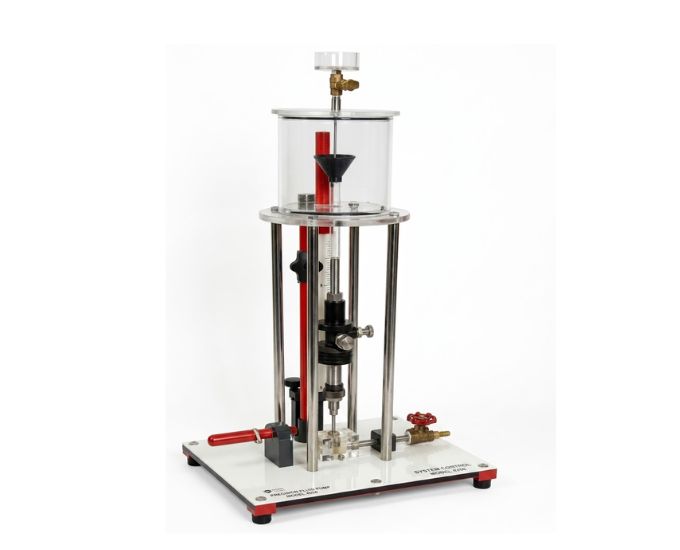
Osborne Reynolds Experiment Apparatus
Model Number: MTHB-150.16
The Osborne Reynolds Experiment Apparatus is an educational fluid mechanics laboratory system designed to demonstrate laminar, transitional, and turbulent flow regimes in a pipe. Using a controlled dye injection arrangement, students can visually observe changes in fluid-flow behaviour as the velocity is varied and experimentally determine the critical Reynolds number associated with transition between flow regimes.
Product Specification
The Osborne Reynolds Experiment Apparatus is a practical educational laboratory system developed for visualizing different fluid-flow regimes and studying the significance of the Reynolds number in internal pipe flow.
Manufactured by Micro Technologies, the apparatus provides students with a clear demonstration of the classical Reynolds experiment by introducing a fine dye filament into water flowing through a transparent test tube.
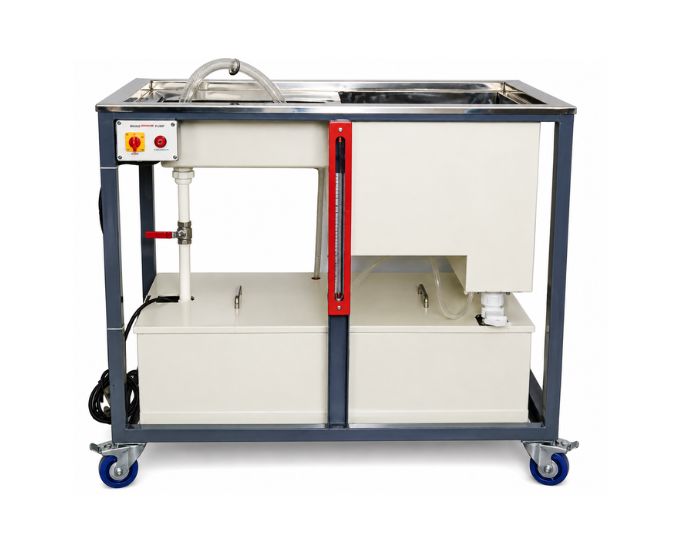
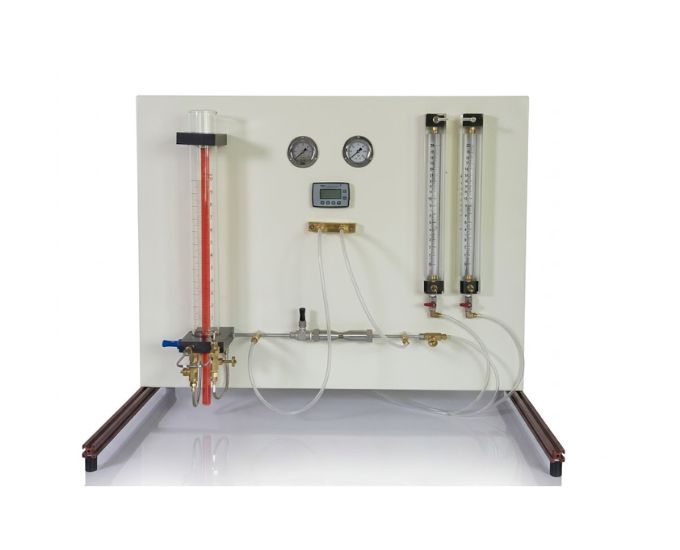
The system consists of a water supply tank, transparent flow tube, dye reservoir, dye injection arrangement, flow-control valve, and supporting structure. Water enters the test section under controlled conditions to provide a smooth flow suitable for observing changes in the dye filament.
At a relatively low water velocity, the injected dye travels through the test tube as a clearly defined line with minimal mixing. This behaviour represents laminar flow, where fluid particles move in relatively orderly layers.
As the water velocity is gradually increased, the dye filament begins to fluctuate and lose its clearly defined form. This indicates the transitional flow region, where the flow begins changing from laminar to turbulent behaviour.
At higher velocities, the dye disperses rapidly throughout the water stream, demonstrating turbulent flow. In this condition, irregular fluid motion and mixing become dominant.
By measuring the flow rate and using the relevant fluid properties and test-pipe dimensions, students can calculate the Reynolds number for different operating conditions. The experiment can therefore be used to identify the approximate critical condition at which transition between flow regimes occurs.
The apparatus provides a highly visual demonstration of an important dimensionless parameter in fluid mechanics and helps students understand the influence of fluid velocity, pipe diameter, density, and viscosity on flow behaviour.
Its compact vertical construction and transparent experimental section make the equipment suitable for engineering laboratory practicals, classroom demonstrations, and technical training.
Features
- Classical Osborne Reynolds experiment
- Clear visualization of fluid-flow regimes
- Demonstration of laminar flow
- Demonstration of transitional flow
- Demonstration of turbulent flow
- Transparent flow test section
- Controlled dye injection arrangement
- Dye reservoir
- Smooth water-entry arrangement
- Adjustable water flow rate
- Flow-control valve
- Suitable for Reynolds number determination
- Critical flow condition investigation
- Compact laboratory configuration
- Easy visual observation
- Suitable for repeated student experiments
Benefits
- Clearly demonstrates laminar and turbulent flow
- Makes flow-transition behaviour directly visible
- Helps students understand Reynolds number
- Enables determination of critical Reynolds number
- Provides practical understanding of pipe-flow regimes
- Demonstrates the effect of velocity on flow behaviour
- Connects theoretical fluid mechanics with visual experimentation
- Simple experimental procedure
- Suitable for classroom demonstrations
- Useful for practical examinations and engineering training
Product Specifications
| Specification | Details |
|---|---|
| Product Name | Osborne Reynolds Experiment Apparatus |
| Product Type | Fluid Mechanics Experimental Apparatus |
| Experimental Study | Reynolds Experiment |
| Working Medium | Water |
| Flow Visualization Medium | Suitable Dye |
| Test Section | Transparent Flow Tube |
| Flow Regimes | Laminar, Transitional & Turbulent |
| Dye Introduction | Controlled Dye Injection |
| Water Flow | Adjustable |
| Flow Control | Control Valve |
| Primary Parameter | Reynolds Number |
| Additional Study | Critical Reynolds Number |
| Observation | Visual Flow Pattern |
| Construction | Laboratory-Grade Experimental Assembly |
| Operation | Educational / Experimental |
| Application | Fluid Mechanics & Hydraulic Engineering Laboratories |
Experiments Performed
- Perform the Osborne Reynolds experiment
- Observe laminar flow
- Observe transitional flow
- Observe turbulent flow
- Identify different fluid-flow regimes
- Determine the Reynolds number
- Determine the approximate critical Reynolds number
- Study transition from laminar to turbulent flow
- Investigate the influence of flow velocity
- Observe dye-filament behaviour at different flow rates
- Relate Reynolds number to observed flow patterns
- Study internal flow through a pipe
- Compare theoretical flow classifications with visual observations
Parameters Studied
The apparatus can be used to investigate:
- Fluid velocity
- Flow rate
- Pipe diameter
- Fluid density
- Dynamic viscosity
- Kinematic viscosity
- Reynolds number
- Critical Reynolds number
- Flow regime
- Flow transition
Flow Regimes Studied
Laminar Flow
At relatively low Reynolds numbers, the fluid moves in an orderly manner with limited transverse mixing. The injected dye remains as a relatively clear filament along the transparent test section.
Transitional Flow
As the flow velocity increases, disturbances begin to develop. The dye filament becomes unstable, indicating transition between laminar and turbulent flow.
Turbulent Flow
At sufficiently high Reynolds numbers, irregular fluid motion and mixing dominate. The dye rapidly disperses through the flowing water, providing a clear visual indication of turbulent behaviour.
Reynolds Number
Reynolds number is a dimensionless parameter commonly expressed as:
Re = ρVD / μ
or
Re = VD / ν
Where:
- Re = Reynolds number
- ρ = Fluid density
- V = Mean fluid velocity
- D = Internal diameter of the test pipe
- μ = Dynamic viscosity
- ν = Kinematic viscosity
The calculated Reynolds number can be compared with the observed dye pattern to classify the flow regime.
Educational Objectives
The apparatus helps students understand:
- Reynolds number
- Critical Reynolds number
- Laminar flow
- Transitional flow
- Turbulent flow
- Internal pipe flow
- Effect of fluid velocity
- Influence of viscosity
- Flow visualization techniques
- Dimensionless parameters in fluid mechanics
- Transition between different flow regimes
Engineering Applications
The principles demonstrated using this apparatus are relevant to:
- Pipeline design
- Water distribution systems
- Hydraulic systems
- Process piping
- HVAC systems
- Oil and fluid transportation
- Chemical processing
- Water treatment systems
- Heat exchanger flow analysis
- Industrial fluid systems
- Pumping installations
Applications
- Fluid Mechanics Laboratories
- Hydraulic Engineering Laboratories
- Mechanical Engineering Laboratories
- Civil Engineering Laboratories
- Chemical Engineering Laboratories
- Process Engineering Laboratories
- Engineering Colleges
- Universities
- Polytechnic Institutes
- Technical Training Centres
- Research Laboratories
- Educational Demonstration Laboratories
FAQs
What is an Osborne Reynolds Experiment Apparatus?
It is a fluid mechanics laboratory apparatus used to visually demonstrate laminar, transitional, and turbulent flow and to study Reynolds number in internal pipe flow.
What is the main purpose of the Reynolds experiment?
The experiment demonstrates how fluid-flow behaviour changes with operating conditions and helps identify the transition between laminar and turbulent flow.
How are different flow regimes observed?
A fine dye stream is introduced into water flowing through a transparent tube. The behaviour of the dye indicates whether the flow is laminar, transitional, or turbulent.
What happens to the dye during laminar flow?
During laminar flow, the dye tends to remain as a clearly visible filament because fluid mixing is relatively limited.
What happens during turbulent flow?
During turbulent flow, irregular fluid motion causes the dye to disperse rapidly throughout the water stream.
Can Reynolds number be determined experimentally?
Yes. Flow measurements, pipe dimensions, and relevant fluid properties can be used to calculate the Reynolds number.
What is critical Reynolds number?
Critical Reynolds number refers to the Reynolds number associated with the onset of transition between laminar and turbulent flow under the particular experimental conditions.
Why is Reynolds number important?
Reynolds number helps engineers characterize flow regimes and is widely used when analysing pipelines, hydraulic systems, heat exchangers, and other fluid-flow equipment.
What parameters affect Reynolds number?
Reynolds number depends on fluid velocity, characteristic dimension such as pipe diameter, fluid density, and viscosity.
Is this apparatus suitable for engineering colleges?
Yes. It is suitable for mechanical, civil, hydraulic, chemical, process, and fluid mechanics engineering laboratories.
Why Choose Our Products
- Clear visualization of three flow regimes
- Controlled dye injection system
- Reynolds number determination
- Critical flow condition study
- Transparent experimental section
- Simple and effective educational design
- Compact laboratory configuration
- Durable construction
- Suitable for repeated student experiments
- Institutional and bulk laboratory supply
- Customized configurations available
- Technical and project support
Call to Action
Looking for a reliable Osborne Reynolds Experiment Apparatus for your fluid mechanics laboratory? Micro Technologies manufactures and supplies fluid mechanics and hydraulic engineering laboratory equipment for universities, engineering colleges, polytechnics, research institutes, and technical training centres. Contact us for complete laboratory setups, customized configurations, institutional projects, bulk requirements, distributor inquiries, or a competitive quotation.