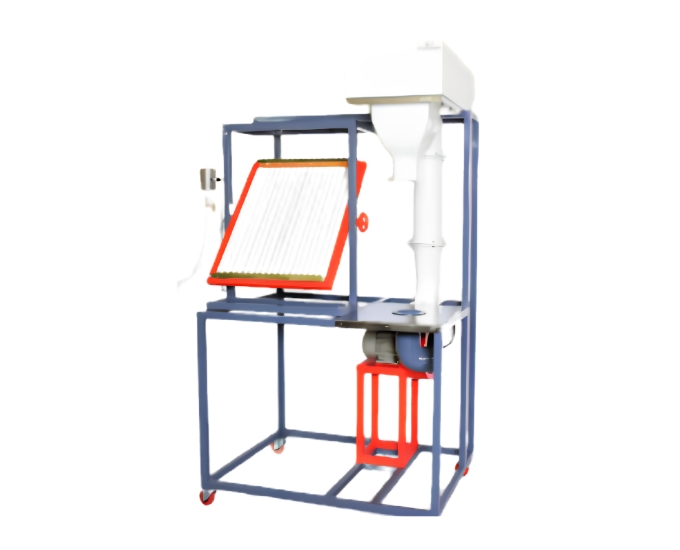

Open Wind Tunnel
Product Specification Sheet
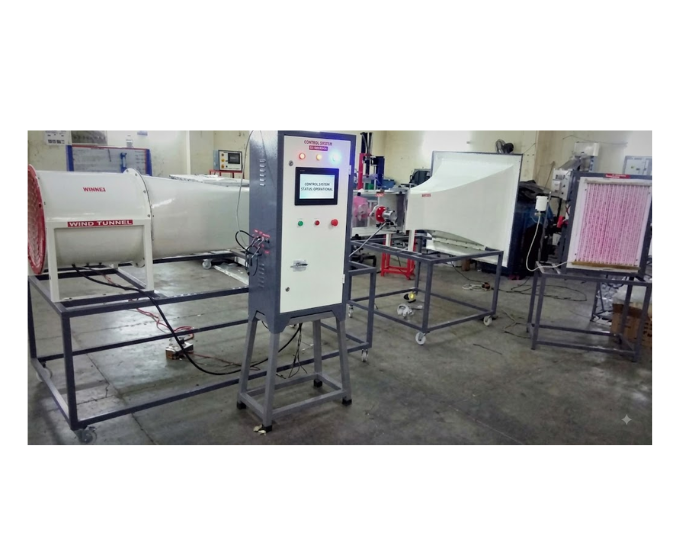
Open Wind Tunnel
Model Number: MTWT-171
The Open Wind Tunnel is an advanced aerodynamics laboratory system designed for experimental investigation of airflow around different test models. With suitable accessories, the system enables students to determine drag and lift coefficients, measure pressure distribution around bodies immersed in airflow, analyze boundary layers, investigate flutter, measure wakes, and visualize streamlines using a fog generator. It provides a comprehensive experimental platform for aerodynamics, fluid mechanics, mechanical engineering, and aerospace engineering laboratories.
Product Specification
The Open Wind Tunnel is an educational and experimental aerodynamics system designed for studying airflow characteristics and aerodynamic behaviour around different test models under controlled conditions.
The wind tunnel generates a controlled stream of air through an experimental test section where different models and measuring accessories can be installed. This arrangement allows students to directly observe and measure important aerodynamic parameters while relating theoretical fluid mechanics principles to practical airflow behaviour.
One of the major experiments performed with the system is the determination of drag and lift coefficients for different models. Suitable measuring arrangements allow aerodynamic forces acting on a test body to be determined while airflow passes around it. Experimental data can then be used to calculate and compare lift and drag characteristics.
The apparatus also enables the investigation of pressure distribution on bodies immersed in airflow. Pressure measurements at different locations around a test model help students understand how body geometry and airflow influence local pressure conditions and aerodynamic loading.
Another important application is boundary layer analysis. Measurements can be taken close to a test surface to investigate velocity variation within the boundary layer and understand the influence of viscous effects on aerodynamic flow.
The Open Wind Tunnel can also be equipped for the investigation of flutter. This enables students to observe dynamic behaviour that can occur when aerodynamic forces interact with flexible or movable structures.
Wake measurement can be performed downstream of test models to investigate the disturbed flow region produced behind a body. Wake measurements provide useful information for understanding drag, velocity deficits, turbulence, and downstream flow behaviour.
For visual demonstrations, the system can be used with a fog generator for streamline visualization. Fog introduced into the airflow makes flow patterns more visible, helping students observe how air moves around different test bodies and how model geometry influences streamline behaviour.
With its ability to accommodate different accessories and test models, the Open Wind Tunnel provides a versatile platform for a wide range of aerodynamic experiments and demonstrations.
Micro Technologies supplies Open Wind Tunnels for engineering colleges, universities, polytechnic institutes, technical training centres, research facilities, and educational institutions requiring practical aerodynamics and fluid mechanics laboratory equipment.
Features
- Open wind tunnel configuration
- Controlled airflow through experimental test section
- Suitable for different aerodynamic test models
- Drag force measurement capability
- Lift force measurement capability
- Determination of drag and lift coefficients
- Pressure distribution measurement
- Suitable for boundary layer analysis
- Supports flutter investigation
- Suitable for wake measurements
- Streamline visualization capability
- Compatible with fog generator
- Multiple experimental accessories can be provided
- Suitable for repeated student experiments
- Robust construction for educational and research use
Benefits
- Provides practical understanding of aerodynamic principles
- Enables experimental determination of lift and drag
- Allows comparison of different aerodynamic models
- Provides practical pressure distribution analysis
- Supports boundary layer experiments
- Enables investigation of wake characteristics
- Provides visual understanding of streamlines
- Supports advanced flutter demonstrations
- Combines multiple aerodynamics experiments in one system
- Connects theoretical aerodynamics with practical observations
- Suitable for teaching, demonstration, and experimental analysis
Product Specifications
| Specification | Details |
|---|---|
| Product Name | Open Wind Tunnel |
| Product Type | Aerodynamics / Fluid Mechanics Laboratory Equipment |
| Working Fluid | Air |
| Tunnel Type | Open Wind Tunnel |
| Primary Study | Aerodynamic Flow Behaviour |
| Force Measurement | Drag & Lift |
| Coefficients | Drag & Lift Coefficients |
| Pressure Study | Pressure Distribution Around Test Bodies |
| Boundary Layer Study | Supported |
| Flutter Investigation | Supported with Suitable Accessories |
| Wake Measurement | Supported |
| Flow Visualization | Streamline Visualization |
| Visualization Method | Fog Generator |
| Test Models | Different Models / Profiles |
| Accessories | Interchangeable Experimental Accessories |
| Application | Aerodynamics & Fluid Mechanics Laboratory |
| Suitable For | Engineering Colleges, Universities, Polytechnics & Research Laboratories |
Experiments Performed
- Determination of drag coefficient for different models
- Determination of lift coefficient for different models
- Measurement of aerodynamic drag force
- Measurement of aerodynamic lift force
- Study of pressure distribution on bodies immersed in airflow
- Boundary layer analysis
- Investigation of flutter
- Wake measurement behind test models
- Study of velocity distribution in the wake region
- Visualization of streamlines
- Flow visualization using a fog generator
- Comparison of airflow around different models
- Study of aerodynamic behaviour under different airflow conditions
Applications
- Aerodynamics Laboratories
- Fluid Mechanics Laboratories
- Aerospace Engineering Laboratories
- Aeronautical Engineering Laboratories
- Mechanical Engineering Laboratories
- Engineering Colleges
- Universities
- Polytechnic Institutes
- Technical Training Centres
- Research Laboratories
- Educational and Demonstration Facilities
FAQs
What is an Open Wind Tunnel used for?
An Open Wind Tunnel is used to experimentally study airflow around test models and investigate aerodynamic parameters such as lift, drag, pressure distribution, boundary layers, wakes, and streamline patterns.
Can drag and lift coefficients be determined?
Yes. With suitable force-measuring accessories, the system can be used to determine drag and lift forces and calculate their corresponding coefficients for different test models.
Can different aerodynamic models be tested?
Yes. Different compatible models and profiles can be installed in the test section to compare their aerodynamic characteristics.
Can pressure distribution around a body be measured?
Yes. Suitable pressure tapping and measuring arrangements can be used to investigate pressure distribution around bodies immersed in airflow.
Can boundary layer analysis be performed?
Yes. Boundary layer measurements can be performed to study velocity variation and viscous effects close to a test surface.
What is wake measurement in a wind tunnel?
Wake measurement involves studying the disturbed airflow downstream of a test body. It helps analyze velocity deficits, flow disturbance, and aerodynamic effects associated with the model.
Can flutter be investigated?
Yes. With suitable experimental accessories and models, the wind tunnel can be used for the investigation and demonstration of flutter.
Can streamlines be visualized?
Yes. Streamlines can be visualized using a suitable fog generator, allowing students to directly observe airflow patterns around test models.
Is the Open Wind Tunnel suitable for aerospace engineering laboratories?
Yes. It is suitable for aerospace, aeronautical, mechanical, fluid mechanics, and general aerodynamics laboratory applications.
Can the wind tunnel be customized?
Yes. Test-section dimensions, airflow arrangements, test models, measuring instruments, force measurement systems, and experimental accessories can be configured according to institutional requirements.
Why Choose Our Products
- Multiple aerodynamics experiments in one system
- Practical lift and drag measurement
- Pressure distribution and boundary layer studies
- Wake and flutter investigation capability
- Streamline visualization with suitable accessories
- Modular experimental configuration
- Durable construction for regular laboratory use
- Customized configurations available
- Institutional and bulk supply support
Call to Action
Looking for an Open Wind Tunnel for your aerodynamics laboratory? Micro Technologies supplies wind tunnels and engineering laboratory equipment for universities, engineering colleges, aerospace and aeronautical departments, polytechnic institutes, technical training centres, and research facilities. Contact us for customized configurations, experimental accessories, institutional orders, bulk supply, distributor inquiries, government tenders, or a competitive quotation.