
One-Dimensional Collision Apparatus
Product Specification Sheet
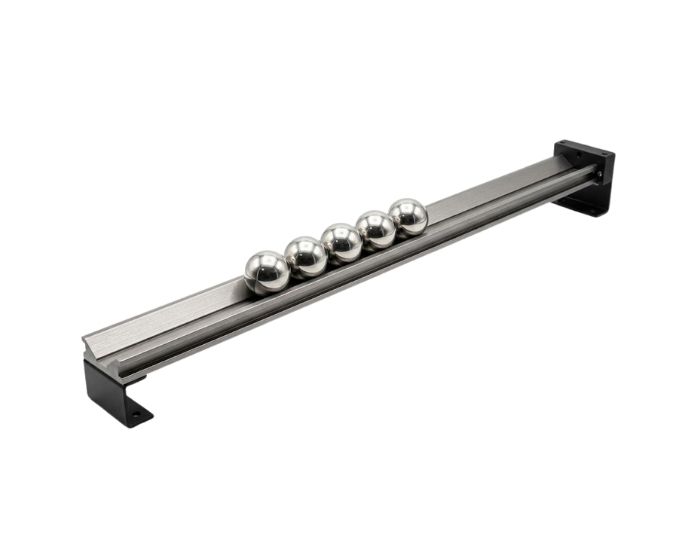
One-Dimensional Collision Apparatus
Model Number: MTM-67
The One-Dimensional Collision Apparatus from Micro Technologies is designed to demonstrate Newton’s Third Law of Motion, momentum transfer and energy transfer during collisions. Different numbers of steel balls can be made to collide along a low-friction grooved track, allowing students to observe how motion is transferred through the system. The apparatus includes a 27-inch track, five steel balls and instructions.
Product Specification
The One-Dimensional Collision Apparatus from Micro Technologies is a mechanics laboratory apparatus developed for practical demonstrations of collisions, Newton’s Third Law of Motion, momentum conservation and energy transfer.
The apparatus consists of a low-friction grooved track along which steel balls can move and collide while remaining constrained to essentially one-dimensional motion.
This controlled arrangement makes it easier for students to study collisions without the additional directional complexity associated with two-dimensional motion.
The apparatus is supplied with five steel balls. Different numbers of balls can be selected and arranged for collision experiments, allowing several combinations to be investigated using the same setup.
When one moving steel ball strikes another stationary ball, forces are exerted between the two bodies during the collision.
This interaction can be related to Newton’s Third Law of Motion, which states that when one body exerts a force on another, the second body exerts an equal and opposite force on the first.
The experiment also provides a practical demonstration of momentum transfer.
Momentum is represented by:
p = mv
where:
p = Momentum
m = Mass
v = Velocity
For an approximately isolated collision system, total linear momentum can be analyzed using:
Total Momentum Before Collision = Total Momentum After Collision
or:
Σpᵢ = Σpբ
Students can observe how momentum is transferred from one steel ball to another during impact.
The use of multiple balls makes it possible to perform experiments involving one ball colliding with one ball, multiple-ball interactions and momentum transmission through a row of balls.
The apparatus also supports demonstrations involving energy transfer.
Before impact, a moving ball possesses kinetic energy:
KE = ½mv²
During collision, part of this energy is transferred to the other ball or balls. In real experiments, some energy may also be converted into sound, heat and small deformations.
This provides an opportunity to compare idealized collision models with actual experimental behavior.
The grooved track keeps the steel balls aligned so their motion remains along a common path. This is important for studying one-dimensional collisions because it minimizes unwanted sideways movement.
The low-friction design helps reduce external resistance, allowing the collision behavior to be observed more clearly.
The track measures approximately 27 inches in length, providing sufficient distance for launching, collision and post-impact observation.
Students can vary the number and arrangement of steel balls and compare the resulting motion after each collision.
This makes the apparatus useful for discussing elastic collisions, momentum conservation, kinetic energy and action-reaction forces.
Its straightforward mechanical design requires no electrical supply or complex electronic equipment for basic demonstrations.
Instructions are supplied to support proper setup and experimental use.
Manufactured and supplied by Micro Technologies, the One-Dimensional Collision Apparatus is suitable for physics and mechanics laboratories requiring a compact and reusable setup for collision and momentum experiments.
Features
- One-Dimensional Collision Apparatus
- Low-friction grooved track
- Approx. 27-inch track length
- Five steel balls included
- Keeps balls aligned during collisions
- Demonstrates Newton’s Third Law
- Suitable for momentum-transfer experiments
- Supports conservation-of-momentum studies
- Demonstrates kinetic energy transfer
- Different numbers of balls can be used
- Suitable for multiple collision configurations
- Mechanical operation
- No electrical power required
- Compact laboratory setup
- Instructions included
Benefits
- Provides controlled one-dimensional collision experiments
- Helps demonstrate Newton’s Third Law practically
- Low-friction track improves observation of motion
- Grooved design minimizes unwanted lateral movement
- Five steel balls provide multiple experimental combinations
- Demonstrates momentum transfer clearly
- Supports conservation-of-momentum investigations
- Helps explain energy transfer during collisions
- Suitable for repeated laboratory trials
- Requires no electrical power supply
Product Specifications
| Specification | Details |
|---|---|
| Product Name | One-Dimensional Collision Apparatus |
| Product Type | Collision & Momentum Apparatus |
| Track Type | Low-Friction Grooved Track |
| Track Length | Approx. 27 in. |
| Steel Balls | 5 Nos. |
| Motion Type | One-Dimensional / Linear |
| Collision Configuration | Variable |
| Primary Study | Newton’s Third Law |
| Momentum Studies | Supported |
| Energy Transfer Studies | Supported |
| Conservation of Momentum | Supported |
| Operation | Mechanical |
| Power Requirement | None |
| Instructions | Included |
| Use | Physics / Mechanics Laboratory |
Set Components
| Component | Quantity / Details |
|---|---|
| Low-Friction Grooved Track | 1, Approx. 27 in. |
| Steel Balls | 5 Nos. |
| Instructions | Included |
Applications
- One-dimensional collision experiments
- Newton’s Third Law demonstrations
- Conservation of momentum experiments
- Momentum-transfer studies
- Energy-transfer experiments
- Steel ball collision demonstrations
- Linear collision experiments
- Elastic collision studies
- Kinetic energy demonstrations
- Action and reaction force studies
- Mechanics laboratory practicals
- Dynamics experiments
- Physics laboratory demonstrations
Available Variants
One-Dimensional Collision Apparatus, Linear Collision Apparatus, Steel Ball Collision Track, Low-Friction Collision Apparatus, Momentum Collision Track, Newton’s Third Law Collision Apparatus, Physics Lab Collision Demonstrator
SKU System
MT-ODCA-Series
FAQs
What is the One-Dimensional Collision Apparatus used for?
It is used to demonstrate Newton’s Third Law of Motion, momentum transfer, conservation of momentum and energy transfer during linear collisions.
How many steel balls are supplied?
The apparatus is supplied with five steel balls.
What is the length of the track?
The grooved collision track is approximately 27 inches long.
Why is the track grooved?
The groove helps keep the steel balls moving along the same linear path, making the collision approximately one-dimensional.
Why is a low-friction track used?
Reducing friction minimizes external resistance, allowing students to observe the effects of the collision and momentum transfer more clearly.
Can different numbers of balls be used?
Yes. Different numbers and arrangements of the five supplied steel balls can be used to perform multiple collision experiments.
How does it demonstrate Newton’s Third Law?
During a collision, each ball exerts a force on the other. These interaction forces are equal in magnitude and opposite in direction, illustrating Newton’s Third Law.
Can conservation of momentum be studied?
Yes. The apparatus allows students to compare motion before and after collisions and investigate conservation of linear momentum.
Does the apparatus require electricity?
No. The One-Dimensional Collision Apparatus is completely mechanical and requires no electrical power.
Are instructions included?
Yes. The apparatus is supplied with instructions for laboratory experimentation.
Why Choose Our Products
- Manufactured and supplied by Micro Technologies
- Approx. 27-inch low-friction track
- Five steel balls included
- Controlled linear collision arrangement
- Suitable for Newton’s Third Law demonstrations
- Supports momentum and energy-transfer experiments
- No electrical supply required
- Suitable for repeated physics practicals
- Institutional and bulk procurement available
- OEM supply requirements supported
Call to Action
Demonstrate Newton’s Third Law, momentum conservation and energy transfer with the One-Dimensional Collision Apparatus from Micro Technologies. Its low-friction grooved track and five-ball configuration provide a practical setup for controlled collision experiments. Contact us for institutional pricing, bulk laboratory procurement, OEM supply and customized quotations.