
Maxwell’s Wheel Apparatus
Product Specification Sheet

Maxwell’s Wheel Apparatus
Model Number: MTM-94
The Maxwell’s Wheel Apparatus from Micro Technologies is designed for demonstrating conservation of energy, rotational motion, momentum and torque. The apparatus consists of a large flywheel suspended by two strong cords. When the cords are wound around the shaft and the wheel is released, it moves downward while unwinding and subsequently winds itself upward again, providing a clear demonstration of energy transformation and rotational dynamics.
Product Specification
The Maxwell’s Wheel Apparatus from Micro Technologies is a classic mechanics apparatus designed for practical investigation of conservation of energy, rotational dynamics, torque, angular motion and moment of inertia.
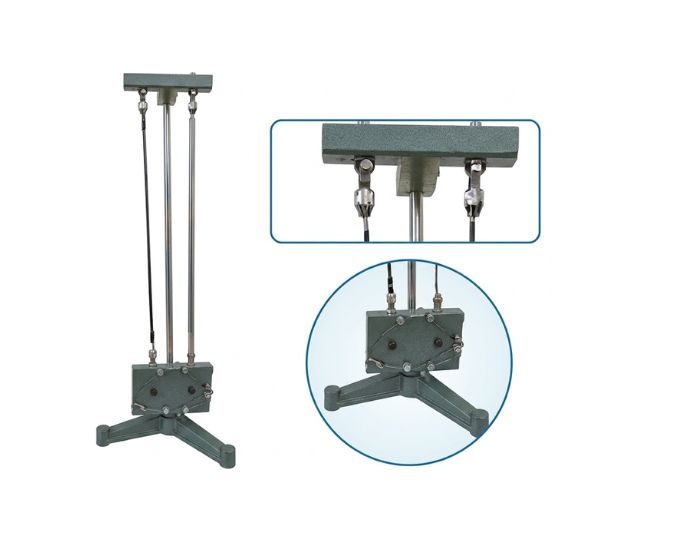
The apparatus consists of a large flywheel mounted on an axle and suspended by two strong cords. The cords support the wheel from both sides and can be wound around the axle before beginning an experiment.
To perform the demonstration, the cords are wound around the shaft and the wheel is raised to its starting position. When released, gravity causes the wheel to descend while the cords progressively unwind from the axle.
During the downward movement, gravitational potential energy is converted into a combination of translational kinetic energy and rotational kinetic energy. The wheel gains both linear and angular velocity as it approaches the bottom of its travel.
After reaching the lowest position, the rotating wheel continues turning because of its angular momentum. This causes the cords to wind around the axle in the opposite direction, lifting the wheel upward again.
The wheel then slows as kinetic energy is converted back into gravitational potential energy. It reaches an upper position, reverses direction and repeats the cycle. Because of friction and other energy losses, each successive rise is generally lower until the wheel eventually comes to rest.
This repeated upward and downward movement provides a clear visual demonstration of energy conversion and conservation in a rotating mechanical system.
The apparatus can also be used to investigate how moment of inertia influences rotational acceleration. The relationship between applied torque and angular acceleration can be considered using:
τ = Iα
where τ represents torque, I represents moment of inertia and α represents angular acceleration.
Manufactured and supplied by Micro Technologies, Maxwell’s Wheel Apparatus is suitable for physics laboratories, mechanics laboratories, dynamics laboratories, research facilities and other applications involving rotational-motion experiments.
Features
- Classic Maxwell’s Wheel configuration
- Large flywheel arrangement
- Axle-mounted rotating wheel
- Suspended using two strong cords
- Adjustable axle support arrangement
- Demonstrates conservation of energy
- Suitable for momentum investigations
- Demonstrates rotational and translational motion
- Useful for torque experiments
- Supports moment of inertia studies
- Repeated upward and downward motion
- Simple mechanical operation
- No electrical power required
- Instructions included
Benefits
- Clearly demonstrates conversion between potential and kinetic energy
- Combines rotational and translational motion in one experiment
- Helps investigate angular momentum and torque
- Provides practical understanding of moment of inertia
- Repeated oscillatory movement makes energy losses observable
- Simple mechanical arrangement enables repeated demonstrations
- Requires no electrical power for operation
- Suitable for quantitative and qualitative mechanics investigations
Product Specifications
| Specification | Details |
|---|---|
| Product Name | Maxwell’s Wheel Apparatus |
| Model No. | MT-1056 Series |
| Product Type | Rotational Dynamics Apparatus |
| Main Component | Large Flywheel |
| Suspension | Two Strong Cords |
| Rotation | Axle Mounted |
| Axle Support | Adjustable |
| Motion | Vertical & Rotational |
| Main Principle | Conservation of Energy |
| Other Principles | Momentum, Torque & Moment of Inertia |
| Operation | Manual / Mechanical |
| Power Requirement | None |
| Instructions | Included |
| Primary Application | Rotational Dynamics Experiments |
Experimental Principles
| Concept | Demonstration |
|---|---|
| Gravitational Potential Energy | Maximum near upper position |
| Translational Kinetic Energy | Develops during vertical motion |
| Rotational Kinetic Energy | Develops as wheel rotates |
| Torque | Produced by gravitational force through the axle/cord system |
| Moment of Inertia | Influences rotational acceleration |
| Angular Momentum | Maintains wheel rotation near the bottom |
| Energy Conversion | Potential ↔ Kinetic |
| Energy Loss | Observed through gradually reduced rise height |
Applications
- Conservation of energy experiments
- Rotational motion investigations
- Momentum demonstrations
- Angular momentum studies
- Torque experiments
- Moment of inertia investigations
- Potential and kinetic energy studies
- Rotational dynamics experiments
- Mechanical energy investigations
- Angular acceleration studies
- Mechanics laboratory experiments
- Dynamics laboratory investigations
Available Variants
Maxwell’s Wheel Apparatus, Maxwell Wheel, Maxwell Wheel Experiment Apparatus, Conservation of Energy Wheel, Rotational Dynamics Wheel, Momentum Demonstration Wheel, Torque and Inertia Apparatus, Maxwell Flywheel Apparatus
FAQs
What is Maxwell’s Wheel Apparatus used for?
Maxwell’s Wheel is used for demonstrating conservation of mechanical energy, rotational motion, momentum, torque and moment of inertia.
How does Maxwell’s Wheel work?
The cords are wound around the axle and the wheel is released. As it falls, the cords unwind and the wheel rotates. Its continued rotation at the bottom causes the cords to wind again, lifting the wheel upward.
Why does the wheel rise again after falling?
The wheel possesses rotational kinetic energy and angular momentum when it reaches the lower position. Continued rotation rewinds the cords around the axle, causing the wheel to rise.
Why does Maxwell’s Wheel eventually stop?
Some mechanical energy is dissipated through bearing friction, air resistance and other losses during each cycle. Therefore, the wheel reaches a progressively lower height until it eventually stops.
What types of energy are involved in the experiment?
The experiment primarily involves gravitational potential energy, translational kinetic energy and rotational kinetic energy.
Can Maxwell’s Wheel demonstrate moment of inertia?
Yes. The rotational acceleration of the wheel depends partly on its moment of inertia, making the apparatus useful for rotational dynamics investigations.
Does the apparatus require electricity?
No. Maxwell’s Wheel is a mechanically operated apparatus and does not require an electrical power supply.
Why Choose Our Products
- Manufactured and supplied by Micro Technologies
- Robust flywheel and axle arrangement
- Strong twin-cord suspension
- Adjustable support configuration
- Demonstrates multiple rotational mechanics principles
- Suitable for repeated laboratory experiments
- Simple mechanical operation
- Institutional, bulk, OEM and distributor supply available
Call to Action
Choose Maxwell’s Wheel Apparatus from Micro Technologies for effective experiments involving conservation of energy, momentum, torque and rotational dynamics. Contact us for competitive pricing, institutional procurement, bulk orders, OEM requirements, distributor supply and customized quotations.