
Malus Law Apparatus
Product Specification Sheet
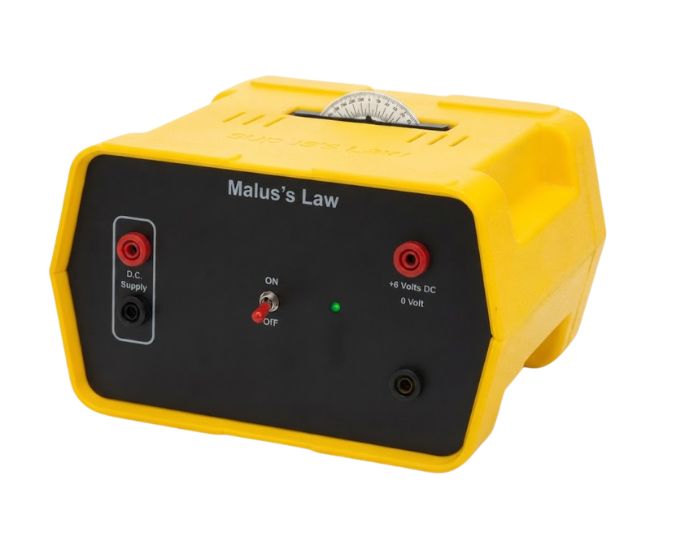
Malus Law Apparatus
Model Number: MTO-33
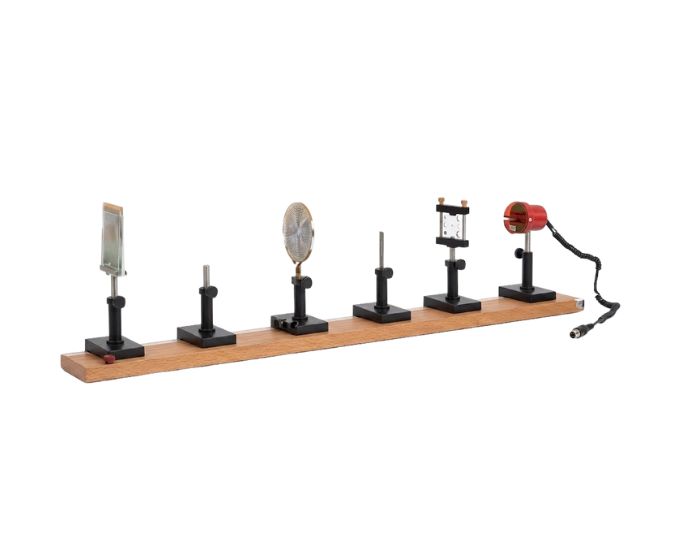
The Malus Law Apparatus is a precision optical setup used to investigate the relationship between transmitted light intensity and the angular orientation of polarizing filters. Micro Technologies supplies the apparatus with a graduated card that allows the relative angle between two polarizing filters to be adjusted and measured accurately. During operation, the filters are rotated from minimum to maximum transmission while quantitative intensity readings are obtained using the analyzer. Measurements can be taken at approximately five-degree intervals, allowing the variation in transmitted intensity to be recorded across a range of angular positions. The analyzer output varies linearly with detected light intensity, enabling the collected results to be used for quantitative analysis and verification of Malus Law.
Product Specification
The Malus Law Apparatus is designed for quantitative investigation of polarized light and the relationship between transmitted intensity and the relative angular orientation of two polarizing filters. It provides a controlled experimental arrangement in which polarization angle can be changed systematically while the corresponding light intensity is measured.
The apparatus incorporates two polarizing elements whose relative orientation can be adjusted. A graduated angular card provides a convenient reference for setting and recording the angle between the filters. This enables observations to be made as the filters move from an orientation corresponding to minimum transmission toward maximum transmission.
Micro Technologies supplies the Malus Law Apparatus with an analyzer system capable of providing quantitative light-intensity readings. Measurements can be recorded at approximately 5° angular intervals, producing a useful series of values for plotting and mathematical analysis.
As the relative angle between the polarizer and analyzer changes, the transmitted light intensity also changes. The output from the analyzer varies linearly with the detected light intensity, allowing experimental readings to be compared directly across different angular positions.
The collected measurements can be used to verify the characteristic relationship described by Malus Law, in which transmitted intensity depends on the square of the cosine of the angle between the relevant polarization axes. This makes the apparatus particularly useful where quantitative measurements are required rather than simple visual observation of polarization.
The controlled angular scale, polarizing filters, and electronic intensity measurement arrangement make the system suitable for repeated experimental work. Its integrated configuration reduces the need to assemble separate optical and measurement components.
With precise angular adjustment and quantitative intensity measurement, the Malus Law Apparatus provides a practical solution for polarization, light transmission, and wave-optics investigations.
Features
- Designed for Malus Law investigations
- Two polarizing filters
- Adjustable relative polarization angle
- Graduated angular reference card
- Quantitative light-intensity measurement
- Readings can be taken at approx. 5° intervals
- Covers minimum to maximum transmission positions
- Analyzer output proportional to detected light intensity
- Suitable for data collection and graphical analysis
- Integrated optical and measurement arrangement
Benefits
- Enables quantitative verification of Malus Law
- Provides direct comparison of intensity against polarization angle
- Fine angular intervals support detailed data collection
- Electronic analyzer improves measurement convenience
- Suitable for plotting intensity-versus-angle relationships
- Integrated construction reduces separate equipment requirements
- Reusable system provides good value for laboratory installations
Product Specifications
| Specification | Details |
|---|---|
| Product Name | Malus Law Apparatus |
| Internal Model No. | MT-30686 |
| Product Type | Polarization & Light Intensity Apparatus |
| Optical Elements | Two polarizing filters |
| Angular Adjustment | Rotatable polarizing filters |
| Angular Reference | Graduated card |
| Reading Interval | Approx. 5° |
| Measurement Parameter | Transmitted light intensity |
| Detection System | Light intensity analyzer |
| Analyzer Output | Linear with detected light intensity |
| Experimental Range | Minimum to maximum transmission |
| Data Output | Quantitative readings |
| Primary Application | Verification of Malus Law |
| Usage / Application | Polarization and light-intensity experiments |
| Compliance Standard | Laboratory-grade optical and electronic construction |
Available Variants
- MT-30686 – Standard Malus Law Apparatus
- Malus Law Apparatus with polarizing filters
- Polarization Intensity Measurement Apparatus
- Malus Law setup with angular scale
- Customized configuration for bulk requirements
SKU System
- MT-MLA-STD – Standard Malus Law Apparatus
- MT-MLA-POL – Polarization Configuration
- MT-MLA-ANG – Angular Measurement Configuration
- MT-MLA-INT – Light Intensity Configuration
- MT-MLA-CUS – Customized Configuration
FAQs
What is the Malus Law Apparatus used for?
The apparatus is used to investigate how the intensity of polarized light changes with the relative angle between two polarizing filters and to experimentally verify Malus Law.
What does Malus Law describe?
Malus Law describes the relationship between transmitted polarized-light intensity and the angle between polarization axes. The transmitted intensity varies according to a cosine-squared relationship.
How is the polarization angle measured?
A graduated angular reference is provided so the relative orientation of the polarizing filters can be adjusted and recorded during the experiment.
At what intervals can readings be taken?
The apparatus allows quantitative readings to be recorded at approximately 5° intervals as the filters are rotated between minimum and maximum transmission positions.
Does the apparatus measure light intensity?
Yes. An analyzer is provided to obtain quantitative readings corresponding to the transmitted light intensity.
Can the experimental data be plotted?
Yes. Intensity readings recorded at different angular positions can be plotted and analyzed to compare the experimental relationship with Malus Law.
What happens when the polarizers are aligned?
When their transmission axes are appropriately aligned, transmitted intensity approaches its maximum value for the experimental arrangement.
What happens when the polarizers are perpendicular?
When the transmission axes approach 90° relative orientation, the transmitted intensity approaches its minimum value, although practical systems may not reach absolute zero.
Does the apparatus require calibration?
For quantitative experiments, the analyzer response, angular zero position, and optical alignment should be checked before recording measurements.
How should the polarizing filters be maintained?
Keep the optical surfaces clean and avoid fingerprints, scratches, moisture, and excessive heat. Handle the filters carefully and store the apparatus securely after use.
Can Malus Law Apparatus be ordered in bulk?
Yes. Bulk quantities can be supplied for physics laboratories, optics laboratories, universities, colleges, research facilities, distributors, and institutional projects.
Can the apparatus be customized?
Certain optical, measurement, power, packaging, and accessory configurations may be customized for bulk requirements depending on technical feasibility.
Why Choose Our Products
- Quantitative polarization measurement system
- Fine angular measurement at approximately 5° intervals
- Integrated light intensity analyzer
- Suitable for experimental verification and data analysis
- Bulk supply capability for laboratories and distributors
Call to Action
Looking for Malus Law Apparatus for polarization and light-intensity experiments? Contact Micro Technologies for competitive quotations, bulk orders, institutional procurement, distributor inquiries, and customized optics laboratory requirements.