
Loop the Loop Apparatus
Product Specification Sheet
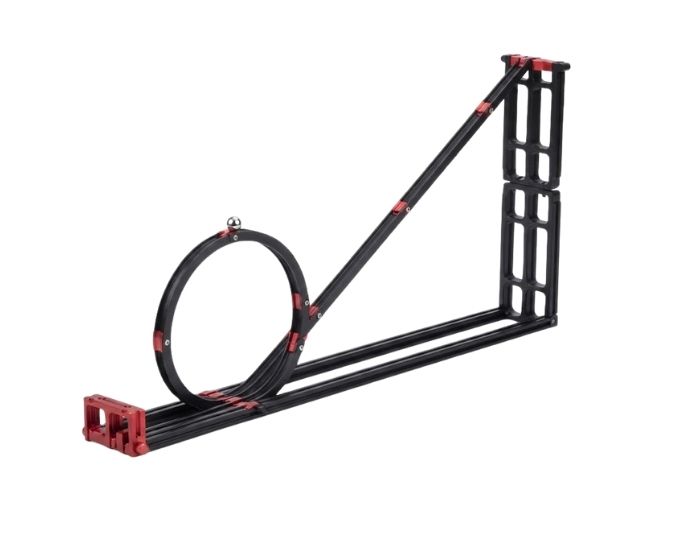
Loop the Loop Apparatus
Model Number: MTM-107
The Loop the Loop Apparatus from Micro Technologies is a mechanics track designed for investigating vertical circular motion, minimum release height, velocity, centripetal acceleration and conservation of energy. The MT-10579N/6 allows a rolling ball to enter a vertical loop and helps determine the minimum starting height required to complete the loop and whether this height depends on the mass of the ball.
Product Specification
The Loop the Loop Apparatus from Micro Technologies is a mechanics experiment system designed to demonstrate the behaviour of a rolling body moving through a vertical circular loop.
The MT-10579N/6 consists of an inclined entry track connected to a complete vertical loop. A ball is released from a selected position on the inclined section, where gravitational potential energy causes it to accelerate toward the loop.
As the ball descends the initial track, its gravitational potential energy is converted into kinetic energy. The ball then enters the circular section and begins moving upward along the loop.
To successfully complete the loop, the ball must have sufficient velocity at the top to remain in contact with the track. If the release height is too low, the ball may lose contact before completing the circular path.
This enables users to experimentally investigate the minimum release height required for successful loop completion.
At the top of the loop, the ball requires inward acceleration toward the centre of the circular path. This centripetal acceleration is expressed as:
aᶜ = v²/r
where v is the velocity of the ball and r is the radius of the circular path.
For an idealized particle just maintaining contact at the top of a vertical loop:
v²/r = g
This provides a useful foundation for discussing the minimum-speed condition for vertical circular motion.
The apparatus can also be used to investigate whether the minimum starting height depends on the mass of the ball. Under idealized conditions, mass cancels from the governing energy and circular-motion equations, so the theoretical minimum height does not depend directly on ball mass. Real experimental results can differ because of rolling dynamics, friction and other losses.
Because the test object is typically a rolling ball rather than an ideal point mass, both translational and rotational kinetic energy can contribute to its total mechanical energy. This makes the apparatus useful for deeper investigations of rolling dynamics as well as basic circular motion.
Manufactured and supplied by Micro Technologies, the Loop the Loop Apparatus provides a visually clear setup for experiments involving circular motion, energy transformation, minimum velocity, minimum release height and track contact.
Features
- Complete vertical loop track
- Inclined ball-release section
- Model MT-10579N/6
- Suitable for rolling-ball experiments
- Demonstrates vertical circular motion
- Minimum release-height investigation
- Minimum velocity investigation
- Supports centripetal acceleration studies
- Demonstrates gravitational potential energy
- Demonstrates kinetic energy
- Supports conservation-of-energy experiments
- Suitable for different ball masses
- Stable mechanics-track construction
- Clear visual demonstration
- Mechanical operation
- No electrical power required
Benefits
- Clearly demonstrates vertical circular motion
- Helps determine the minimum height required to complete a loop
- Allows investigation of the effect of ball mass
- Demonstrates the requirement for sufficient velocity at the top of the loop
- Provides practical understanding of centripetal acceleration
- Shows conversion of potential energy into kinetic energy
- Supports rolling-motion investigations
- Enables repeated experiments using different release positions
- Combines several important mechanics concepts in one apparatus
Product Specifications
| Specification | Details |
|---|---|
| Product Name | Loop the Loop Apparatus |
| Model No. | MT-10579N/6 |
| Product Type | Vertical Circular Motion Track |
| Track Configuration | Inclined Track with Vertical Loop |
| Test Object | Rolling Ball |
| Motion Type | Rolling & Circular |
| Driving Force | Gravity |
| Minimum Height Experiment | Supported |
| Ball Mass Comparison | Supported |
| Circular Motion Study | Supported |
| Centripetal Acceleration Study | Supported |
| Energy Transformation | Supported |
| Operation | Mechanical |
| Power Requirement | None |
Experimental Capabilities
| Experiment | Principle Studied |
|---|---|
| Loop the Loop | Vertical circular motion |
| Minimum Release Height | Height needed for loop completion |
| Minimum Velocity | Speed required to maintain track contact |
| Ball Mass Comparison | Effect of mass on minimum height |
| Centripetal Acceleration | a = v²/r |
| Potential Energy | Energy associated with release height |
| Kinetic Energy | Energy developed during descent |
| Energy Conservation | Transformation of mechanical energy |
| Rolling Motion | Translational and rotational movement |
| Track Contact | Conditions for maintaining circular trajectory |
Available Model
| Model No. | Product |
|---|---|
| MT-10579N/6 | Loop the Loop Apparatus |
Applications
- Loop-the-loop experiments
- Vertical circular motion investigations
- Minimum release-height experiments
- Minimum velocity investigations
- Centripetal acceleration experiments
- Conservation of energy demonstrations
- Potential energy experiments
- Kinetic energy investigations
- Rolling-ball experiments
- Effect-of-mass investigations
- Mechanics laboratory experiments
- Dynamics and motion studies
Available Variants
Loop the Loop Apparatus, Vertical Loop Track, Circular Motion Track Apparatus, Rolling Ball Loop Apparatus, Centripetal Motion Apparatus, Minimum Height Loop Track, Energy Conservation Loop Apparatus, Mechanics Loop Track
SKU System
MT-LTL-10579N-6
FAQs
What is the MT-10579N/6 Loop the Loop Apparatus used for?
It is designed for experiments involving vertical circular motion, minimum release height, minimum velocity, centripetal acceleration and mechanical energy transformation.
What is the main experiment performed with the apparatus?
A ball is released from different heights to determine the minimum starting height required for it to successfully complete the vertical loop.
Why does the ball need a minimum release height?
The ball needs enough initial gravitational potential energy to develop sufficient velocity to travel around the loop while maintaining contact with the track.
What happens if the ball is released from too low a height?
If its speed becomes insufficient, the ball can lose contact with the track before completing the loop.
Does the minimum release height depend on the mass of the ball?
In the ideal theoretical model, the minimum height is independent of mass because mass cancels from the relevant equations. Actual measurements can vary due to rolling behaviour, friction and other experimental losses.
Can centripetal acceleration be demonstrated?
Yes. The apparatus provides a practical demonstration of centripetal acceleration, which is directed toward the centre of the circular path.
Can conservation of energy be investigated?
Yes. The experiment demonstrates the conversion between gravitational potential energy and translational/rotational kinetic energy as the ball moves along the track.
Does the Loop the Loop Apparatus require electricity?
No. The MT-10579N/6 is a gravity-driven mechanical apparatus and requires no electrical power.
Why Choose Our Products
- Manufactured and supplied by Micro Technologies
- Model MT-10579N/6
- Complete vertical loop configuration
- Suitable for minimum-height experiments
- Supports circular-motion and energy investigations
- Suitable for different ball masses
- Stable and reusable track construction
- Multi-concept mechanics apparatus
- Institutional, bulk, OEM and distributor supply available
Call to Action
Choose the Loop the Loop Apparatus – MT-10579N/6 from Micro Technologies for practical investigations of vertical circular motion, centripetal acceleration, minimum release height and conservation of energy. Contact us for competitive pricing, institutional procurement, bulk orders, OEM requirements and distributor supply.