
Light Optics Kit
Product Specification Sheet
Light Optics Kit
Model Number: MTO-38
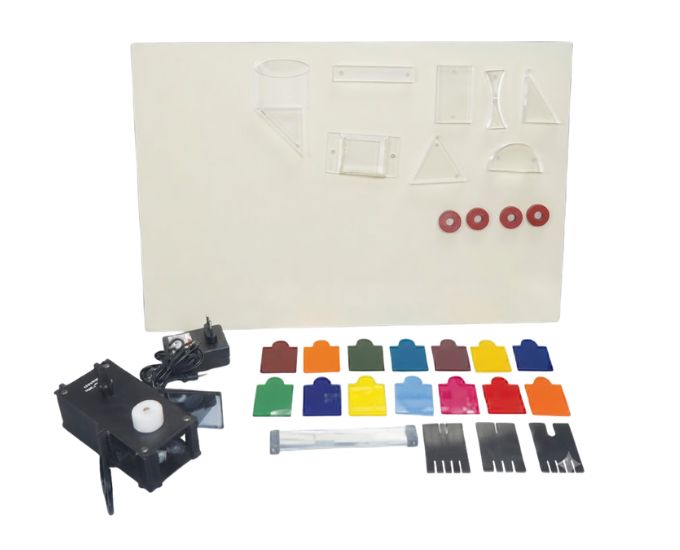
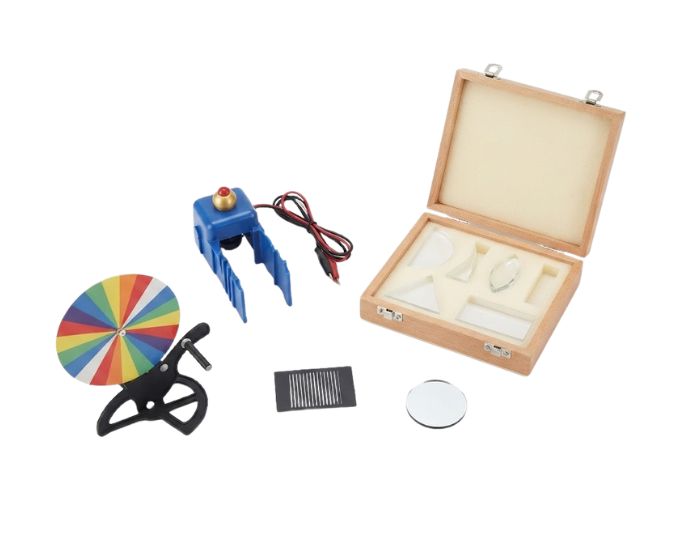
The Light Optics Kit is a multi-component laboratory set for investigating reflection, refraction, lens behaviour, prism optics, and color mixing. Micro Technologies supplies the kit with mirrors, lenses, a ray box, acrylic prisms of different geometries, and a Newton color disc. The optical components allow light rays to be reflected, refracted, converged, diverged, and redirected in different experimental arrangements. Included prism shapes comprise triangular, half-round, double convex, rectangular, and double concave forms, providing useful options for comparing light behaviour through different optical profiles. The Newton color disc extends the kit to color-mixing demonstrations involving the visual combination of seven spectrum colors. Compact and versatile, the set provides a convenient solution for physics and optics laboratory installations.
Product Specification
The Light Optics Kit combines a practical selection of optical components in one convenient set for experiments involving light, mirrors, lenses, prisms, and color. Its modular arrangement allows components to be repositioned and combined according to the optical principle being investigated.
A ray box provides the light source required for many of the experiments. When used with the supplied mirrors, users can investigate reflection and observe changes in ray direction at reflecting surfaces. Different lens and prism components allow the same setup to be adapted for refraction, convergence, divergence, and ray-deviation investigations.
Micro Technologies supplies the Light Optics Kit with a varied collection of acrylic optical elements. These include triangular, half-round, double convex, rectangular, and double concave forms. The different geometries allow light to encounter flat, curved, and angled surfaces, providing a useful basis for comparing how optical shape influences the path of a ray.
The double convex element can be used to observe converging behaviour, while the double concave component demonstrates divergence. Rectangular and triangular optical elements provide additional arrangements for examining refraction through parallel or angled surfaces. The half-round component is particularly useful for investigations involving curved optical boundaries.
A Newton color disc is also included as part of the set. The disc contains seven colored sections and can be used to demonstrate visual color mixing. When rotated sufficiently fast, the individual colors become difficult to distinguish and visually combine into a lighter appearance.
By bringing together a ray box, mirrors, lenses, acrylic optical elements, and a color disc, the Light Optics Kit reduces the need to procure numerous basic optics accessories separately. Its reusable components and flexible experimental configurations provide good long-term value for complete optics laboratory installations.
Features
- Complete multi-component light optics kit
- Ray box included for optical experiments
- Mirror components for reflection investigations
- Lens components for studying ray behaviour
- Triangular acrylic prism
- Half-round acrylic optical element
- Double convex acrylic lens
- Rectangular acrylic prism/block
- Double concave acrylic lens
- Newton color disc with seven spectrum colors
Benefits
- Combines several fundamental optics experiments in one kit
- Supports both reflection and refraction investigations
- Different acrylic profiles allow comparative ray studies
- Convex and concave components demonstrate convergence and divergence
- Newton disc expands the kit to color-mixing experiments
- Reusable components reduce separate equipment procurement
- Provides strong value for bulk laboratory installations
Product Specifications
| Specification | Details |
|---|---|
| Product Name | Light Optics Kit |
| Internal Model No. | MT-30703 |
| Product Type | Multi-Component Optics Experiment Kit |
| Optical Components | Mirrors, lenses and acrylic prisms |
| Light Source | Ray box |
| Triangular Prism | Included |
| Half-Round Element | Included |
| Double Convex Lens | Included |
| Rectangular Prism / Block | Included |
| Double Concave Lens | Included |
| Color Disc | Newton color disc |
| Color Disc Sections | Seven colors |
| Material | Optical acrylic and supporting materials |
| Accuracy / Tolerance | Laboratory-grade optical specification |
| Calibration Standard | Optical alignment verification as required |
| Stopper Type | Not applicable |
| Usage / Application | Reflection, refraction, lenses, prisms and color mixing |
| Compliance Standard | Laboratory-grade optical and mechanical construction |
Available Variants
- MT-30703 – Standard Light Optics Kit
- Light Kit with ray box and optical elements
- Reflection & Refraction Optics Kit
- Light Kit with Newton color disc
- Customized optical component kit for bulk requirements
SKU System
- MT-LOK-STD – Standard Light Optics Kit
- MT-LOK-RB – Light Kit with Ray Box
- MT-LOK-PRM – Prism & Lens Configuration
- MT-LOK-FULL – Complete Light Optics Kit
- MT-LOK-CUS – Customized Optics Kit
FAQs
What is the Light Optics Kit used for?
The kit supports experiments involving reflection, refraction, lenses, prisms, ray behaviour, and color mixing. Different components can be arranged according to the required optical investigation.
Is a ray box included with the kit?
Yes. A ray box is supplied as part of the standard configuration and provides the light required for compatible reflection and refraction experiments.
Which acrylic optical components are included?
The kit includes triangular, half-round, double convex, rectangular, and double concave acrylic optical components for investigating different ray paths.
Can reflection experiments be performed with this kit?
Yes. Mirrors are included and can be combined with the ray box to observe incident and reflected light and investigate fundamental reflection principles.
Can the kit demonstrate convergence and divergence?
Yes. The double convex component can demonstrate converging ray behaviour, while the double concave component can be used to investigate divergence.
What is the purpose of the Newton color disc?
The Newton color disc demonstrates visual color mixing. When its seven colored sections rotate rapidly, they visually combine and produce a lighter appearance.
Does the kit require calibration?
Most components require only correct optical alignment rather than routine calibration. For measurement-based experiments, component positioning and any measuring scales should be checked before use.
How durable are the acrylic components?
The optical elements are suitable for repeated laboratory handling when used correctly. They should be protected against scratches, impact, excessive heat, and unsuitable cleaning materials.
How should the Light Optics Kit be maintained?
Keep mirrors, lenses, and acrylic prisms clean and free from fingerprints. Store all components securely after use and periodically inspect the ray box and electrical connections.
Can the Light Optics Kit be ordered in bulk?
Yes. Bulk quantities can be supplied for physics laboratories, optics laboratories, universities, colleges, research facilities, distributors, and institutional projects.
Can the components be customized?
Component combinations, quantities, accessories, packaging, and certain optical configurations may be customized for bulk orders depending on technical requirements.
How is the kit packed for shipping?
Individual optical components are protected against scratching, impact, and movement during transportation. Bulk and export-grade packaging can also be arranged.
Why Choose Our Products
- Multiple optics experiments from one integrated kit
- Broad selection of acrylic lenses and prisms
- Ray box and Newton color disc included
- Quality-checked optical components
- Bulk supply capability for laboratory projects
Call to Action
Looking for Light Optics Kits for reflection, refraction, lens, prism, or color experiments? Contact Micro Technologies for competitive quotations, bulk orders, institutional procurement, distributor inquiries, and customized optics laboratory requirements.