
Laboratory Receiving Screen
Product Specification Sheet
Laboratory Receiving Screen
Model Number: MTO-29
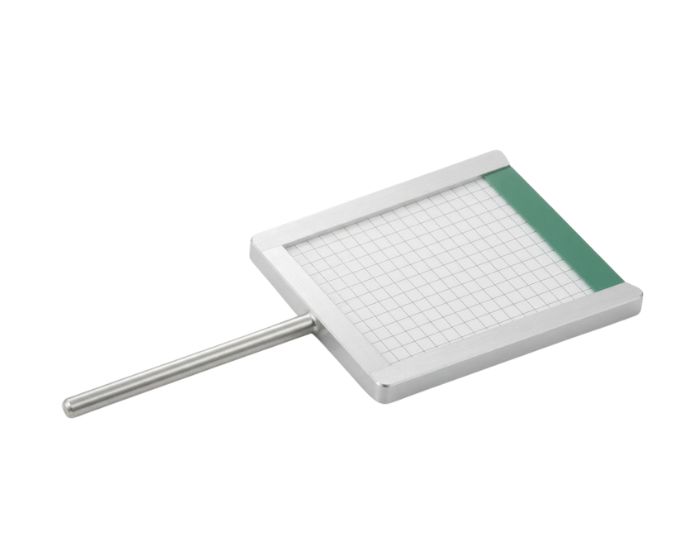
The Laboratory Receiving Screen is a compact optical accessory used for observing and recording light patterns, projected images, and ray positions during optics experiments. Micro Technologies supplies the screen with a black enamel-finished plastic frame measuring approximately 100 × 75 mm and a graph-paper working surface. The printed grid provides a convenient visual reference for examining image position, dimensions, displacement, and alignment during practical investigations. A supporting rod allows the screen to be mounted in compatible optical arrangements and positioned according to experimental requirements. Its simple, durable construction makes it suitable for ray optics, lens experiments, image formation, optical bench setups, and other laboratory investigations requiring a clearly defined receiving surface.
Product Specification
The Laboratory Receiving Screen provides a convenient target surface for observing projected light, images, and optical patterns during laboratory experiments. Its compact rectangular format makes it easy to integrate with lenses, light sources, mirrors, optical benches, and ray-optics arrangements.
The screen incorporates graph paper within a rigid plastic frame. The grid pattern offers a useful reference when users need to observe the position, approximate dimensions, displacement, or alignment of an image formed by an optical system. This makes the receiving screen more useful for measurement-oriented work than a completely plain surface.
Micro Technologies supplies the Laboratory Receiving Screen in an approximate frame size of 100 × 75 mm. The frame has a black enamel finish that provides a neat laboratory appearance while protecting the supporting structure during routine handling.
A mounting rod extends from the frame, allowing the screen to be secured in a compatible holder, optical bench, or laboratory support arrangement. Its position can therefore be adjusted relative to a lens or light source until a clear image or required optical pattern is obtained.
The apparatus can be used during experiments involving convex lenses, image formation, focal length, light projection, and other optical investigations where a receiving surface is required. The graph-paper background can also assist with comparative observations when image size or location changes as optical components are repositioned.
Compact dimensions make the screen convenient to store with other optics accessories, while its reusable construction supports repeated laboratory operation. With a rigid frame, graph-paper surface, and practical rod mounting, the Laboratory Receiving Screen provides a straightforward and economical accessory for complete optics laboratory setups.
Features
- Compact optical receiving screen
- Approximate frame size of 100 × 75 mm
- Durable plastic frame construction
- Black enamel-finished frame
- Graph-paper receiving surface
- Printed grid assists visual measurements
- Rod-mounted configuration
- Easy positioning in compatible optical setups
- Suitable for image and light-pattern observation
- Reusable construction for regular laboratory work
Benefits
- Provides a clear surface for observing projected images
- Graph grid assists with image positioning and size comparison
- Compact dimensions simplify setup and storage
- Rod mounting allows convenient positional adjustment
- Durable frame supports repeated laboratory handling
- Compatible with various optical experiments and accessories
- Economical choice for bulk laboratory procurement
Product Specifications
| Specification | Details |
|---|---|
| Product Name | Laboratory Receiving Screen |
| Internal Model No. | MT-30585R |
| Product Type | Optical Receiving Screen |
| Frame Material | Plastic |
| Frame Finish | Black enamel |
| Screen Size | Approx. 100 × 75 mm |
| Screen Surface | Graph paper |
| Grid Type | Printed reference grid |
| Mounting Type | Rod mounted |
| Color | Black frame with light graph surface |
| Accuracy / Tolerance | Suitable for visual laboratory observations |
| Calibration Standard | Reference grid verification as required |
| Usage / Application | Image formation, ray optics and light experiments |
| Compliance Standard | Laboratory-grade mechanical construction |
Available Variants
- MT-30585R – Standard Receiving Screen
- Receiving Screen with graph paper
- Rod-mounted optical receiving screen
- Receiving Screen for compatible optical bench systems
- Customized screen configuration for bulk requirements
SKU System
- MT-RS-10075 – 100 × 75 mm Receiving Screen
- MT-RS-GP – Graph Paper Receiving Screen
- MT-RS-ROD – Rod-Mounted Receiving Screen
- MT-RS-OPT – Optics Experiment Screen
- MT-RS-CUS – Customized Receiving Screen
FAQs
What is a Laboratory Receiving Screen used for?
A receiving screen provides a visible surface for observing projected images, light patterns, and optical effects. It is commonly positioned behind lenses or other optical components during experiments.
What is the size of the Receiving Screen?
The standard screen frame measures approximately 100 × 75 mm. Its compact dimensions make it suitable for common laboratory optics arrangements.
Why is graph paper provided on the screen?
The graph-paper grid provides a visual reference for observing image size, position, displacement, and alignment. It can make comparative optical observations easier.
Can it be used for lens experiments?
Yes. The screen can receive images produced by suitable converging lenses and can be repositioned to investigate image formation and focal behaviour.
Can the Receiving Screen be mounted on an optical bench?
The screen incorporates a supporting rod that can be fitted into a compatible optical bench holder or laboratory support system.
Is the frame durable?
Yes. The rigid plastic frame is suitable for regular laboratory handling and has an enamel-finished surface for a clean and practical finish.
Does the Receiving Screen require calibration?
Routine calibration is generally unnecessary. If the graph grid is being used for quantitative measurements, its scale should be verified before precision work.
How should the screen be maintained?
Keep the graph-paper surface clean and dry and avoid bending or damaging the frame. Store the apparatus securely to protect the screen surface and mounting rod.
Can it be used with a ray box?
Yes. The receiving screen can be incorporated into compatible ray-box and optical arrangements where observation of projected light or optical patterns is required.
Can Receiving Screens be ordered in bulk?
Yes. Bulk quantities can be supplied for physics laboratories, optics laboratories, universities, colleges, research facilities, distributors, and institutional projects.
Can different screen sizes be supplied?
Alternative dimensions or mounting configurations may be available for bulk requirements depending on the required specifications and manufacturing feasibility.
How is the screen packed for shipping?
The screen surface, frame, and mounting rod are protected against bending, scratching, and impact during transportation. Bulk packaging can also be arranged.
Why Choose Our Products
- Practical 100 × 75 mm graph-paper screen
- Durable framed construction
- Convenient rod-mounted configuration
- Quality-checked laboratory accessory
- Bulk supply capability for laboratories, institutions, and distributors
Call to Action
Looking for Laboratory Receiving Screens for optical benches, image formation, ray optics, or laboratory installations? Contact Micro Technologies for competitive quotations, bulk orders, institutional procurement, distributor inquiries, and customized optics accessory requirements.