
Inertia Balance
Product Specification Sheet
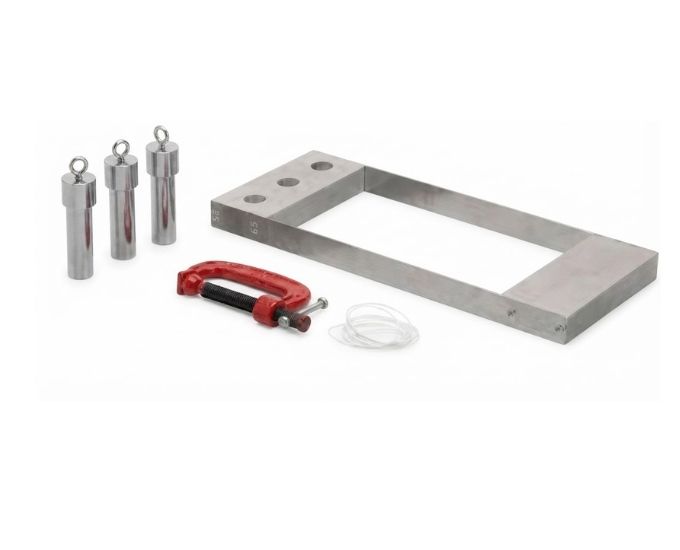
Inertia Balance
Model Number: MTM-113
The Inertia Balance is a mechanical laboratory apparatus used to investigate inertial mass and examine the distinction between mass and weight through oscillatory motion. Micro Technologies supplies the apparatus with two metal trays connected by spring steel strips, creating a flexible system that responds to changes in applied mass. Three cylindrical masses are provided for controlled experimental loading, while the tray assembly can be clamped to a bench in either horizontal or vertical orientation. By observing changes in oscillation as known masses are added, users can investigate how inertia relates to mass independently of conventional weighing methods. Its robust metal construction and straightforward arrangement make it suitable for physics laboratories, universities, colleges, research facilities, and institutional laboratory procurement.
Product Specification
The Inertia Balance is a practical mechanics apparatus developed for investigating the nature of mass and demonstrating the difference between mass and weight. Rather than determining mass through gravitational force in the manner of a conventional balance, the apparatus uses oscillatory motion to investigate inertial behaviour. This provides a useful experimental method for examining the relationship between an object's mass and its resistance to changes in motion.
The apparatus consists of two rigid metal trays approximately 130 × 55 × 23 mm, connected by two spring steel strips approximately 23 mm wide. The trays are positioned about 215 mm apart, producing a flexible mechanical arrangement capable of controlled oscillation. When a sample or known mass is placed on the moving tray and the system is displaced, the resulting oscillatory behaviour changes according to the total inertial mass.
Micro Technologies supplies the Inertia Balance with three equal cylindrical masses for comparative investigations and calibration-based experimental work. The supplied masses allow different loading conditions to be established systematically, making it possible to compare oscillation periods and examine their relationship with mass. The tray can be clamped securely to a laboratory bench, with provision for horizontal or vertical orientation depending on the required experimental configuration.
Durable metal trays and resilient spring steel strips provide the mechanical stability and flexibility required for repeated oscillation experiments. The simple construction contains no complicated electronic mechanism, resulting in low maintenance requirements and dependable long-term operation when correctly handled.
The Inertia Balance is suitable for experiments involving inertial mass, oscillatory motion, mass comparison, periodic motion, and the distinction between gravitational weight and inertia. Its reusable components and straightforward operation provide good procurement value for laboratories requiring a robust mechanics apparatus for regular experimental work.
Features
- Two rigid metal trays for stable experimental loading
- Twin spring steel strips provide controlled oscillatory movement
- Approximate tray dimensions of 130 × 55 × 23 mm
- Approximately 215 mm spacing between the trays
- Spring steel strips approximately 23 mm wide
- Supplied with three equal cylindrical masses
- Can be mounted horizontally or vertically
- Bench-clamping arrangement for secure operation
- Robust mechanical construction for repeated laboratory use
- Simple configuration with minimal maintenance requirements
Benefits
- Provides a practical method for investigating inertial mass
- Helps demonstrate the distinction between mass and weight
- Known cylindrical masses support comparative measurements
- Horizontal and vertical mounting provides experimental flexibility
- Robust spring and tray construction supports repeated operation
- Mechanical configuration reduces servicing and maintenance requirements
- Reusable components provide strong long-term procurement value
Product Specifications
| Specification | Details |
|---|---|
| Product Name | Inertia Balance |
| Internal Model No. | MT-10587 |
| Product Type | Inertial Mass Investigation Apparatus |
| Material | Metal trays with spring steel strips |
| Number of Trays | 2 |
| Tray Size | Approx. 130 × 55 × 23 mm |
| Spring Arrangement | Twin spring steel strips |
| Spring Strip Width | Approx. 23 mm |
| Distance Between Trays | Approx. 215 mm |
| Masses Supplied | 3 equal cylindrical masses |
| Mounting Position | Horizontal or vertical |
| Mounting Method | Bench clamp |
| Measurement Method | Oscillation-based mass investigation |
| Accuracy / Tolerance | Suitable for comparative laboratory investigations |
| Calibration Standard | Comparative calibration using known masses |
| Stopper Type | Not applicable |
| Usage / Application | Inertia, mass, weight and oscillation experiments |
| Compliance Standard | Laboratory-grade manufacturing and dimensional quality |
Available Variants
- Standard Inertia Balance
- Inertia Balance with Three Masses
- Inertia Balance with Bench Clamp
- Replacement Cylindrical Mass Set
- Custom laboratory configuration for bulk requirements
SKU System
- MT-IB-STD – Standard Inertia Balance
- MT-IB-3M – Inertia Balance with Three Masses
- MT-IB-BC – Inertia Balance with Bench Clamp
- MT-IB-MS – Replacement Mass Set
- MT-IB-CUS – Customized Configuration
FAQs
What is an Inertia Balance used for?
An Inertia Balance is used to investigate inertial mass through oscillatory motion. It provides a practical way to examine how the addition of mass changes the motion of a spring-supported mechanical system.
What is the difference between an Inertia Balance and a weighing balance?
A conventional weighing balance determines mass through its relationship with gravitational force. An Inertia Balance investigates mass through resistance to acceleration and changes in oscillatory behaviour, allowing inertial mass to be studied.
How does the Inertia Balance work?
The movable tray is displaced and allowed to oscillate on the spring steel strips. Adding different known masses changes the oscillation period, and these observations can be compared to investigate the relationship between inertia and mass.
What are the dimensions of the metal trays?
Each metal tray is approximately 130 × 55 × 23 mm. The two trays are separated by approximately 215 mm and connected through spring steel strips.
Are calibration masses supplied with the apparatus?
Yes. The standard configuration includes three equal cylindrical masses. These known masses can be used to establish comparative loading conditions during inertial mass investigations.
Can the apparatus be mounted horizontally and vertically?
Yes. The tray assembly can be clamped to a suitable laboratory bench in either horizontal or vertical orientation, providing flexibility for different experimental arrangements.
How accurate is an Inertia Balance?
Experimental performance depends on consistent timing, correct mass placement, stable mounting, and the mechanical condition of the spring strips. Using repeated measurements can improve the reliability of comparative results.
Is the apparatus durable for repeated use?
Yes. Metal trays and spring steel strips provide a robust mechanical arrangement for routine laboratory operation. Correct handling of the springs is important to prevent permanent bending or deformation.
Can replacement masses or components be supplied?
Replacement masses and compatible components can be supplied subject to specification and availability. Buyers should provide the required component details when requesting replacements.
Can Inertia Balances be ordered in bulk?
Yes. Bulk quantities can be supplied for universities, colleges, physics laboratories, distributors, laboratory projects, and institutional procurement requirements.
What maintenance does the apparatus require?
Keep the trays and spring strips clean and dry, and avoid over-flexing the spring components. Periodically inspect the clamp, spring strips, tray alignment, and masses for wear or physical damage.
How is the apparatus packed for transportation?
The balance, masses, and associated components can be securely packed to protect the spring strips and trays from deformation during transportation. Bulk and export packaging can also be arranged when required.
Why Choose Our Products
- Controlled manufacturing of trays, springs, and mechanical components
- Quality checks for alignment, spring movement, and overall construction
- Robust materials suitable for repeated laboratory operation
- Low-maintenance configuration for dependable long-term use
- Bulk supply capability for laboratories, institutions, projects, and distributors
Call to Action
Looking for an Inertia Balance for laboratory experiments, institutional procurement, or bulk supply? Contact Micro Technologies for competitive quotations, quantity orders, distributor inquiries, replacement components, and customized requirements. Share your required quantity and specifications to receive suitable pricing, packaging, and delivery information.