
Inertia Apparatus
Product Specification Sheet
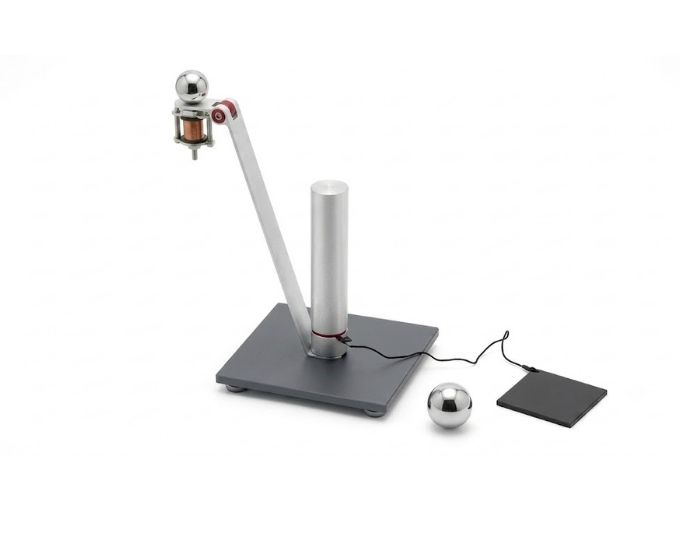
Inertia Apparatus
Model Number: MTM-61
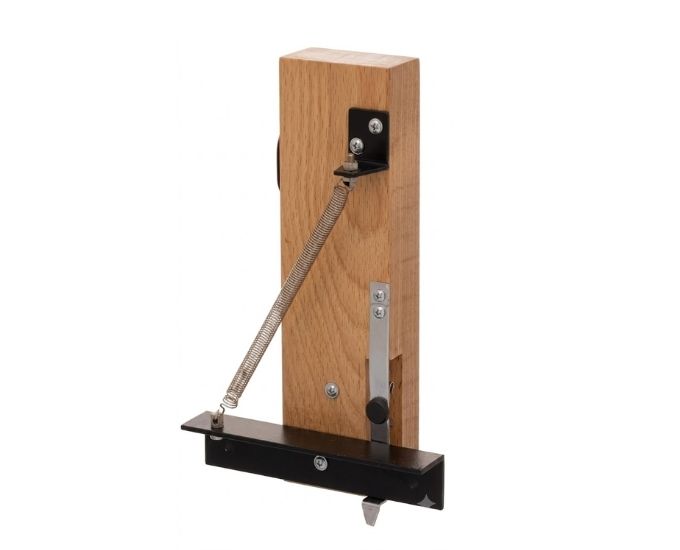
The Inertia Apparatus from Micro Technologies is a compact laboratory demonstrator designed to illustrate the principle of inertia and Newton’s First Law of Motion. It consists of an aluminium rod mounted on a plastic base, with a recessed top for holding a steel ball. A card square is positioned beneath the ball and quickly propelled using the supplied elastic arrangement, causing the card to move away while the ball falls vertically due to its inertia.
Product Specification
The Inertia Apparatus from Micro Technologies is designed to provide a simple and effective practical demonstration of inertia, one of the fundamental concepts of classical mechanics.
The apparatus helps demonstrate Newton’s First Law of Motion, commonly known as the law of inertia. According to this principle, an object at rest tends to remain at rest and an object in motion tends to remain in uniform motion unless acted upon by an external net force.
The apparatus consists of an aluminium rod mounted securely on a plastic base. The upper portion of the rod incorporates a recessed area designed to support the supplied steel ball.
A card square is positioned beneath the steel ball as part of the experimental setup.
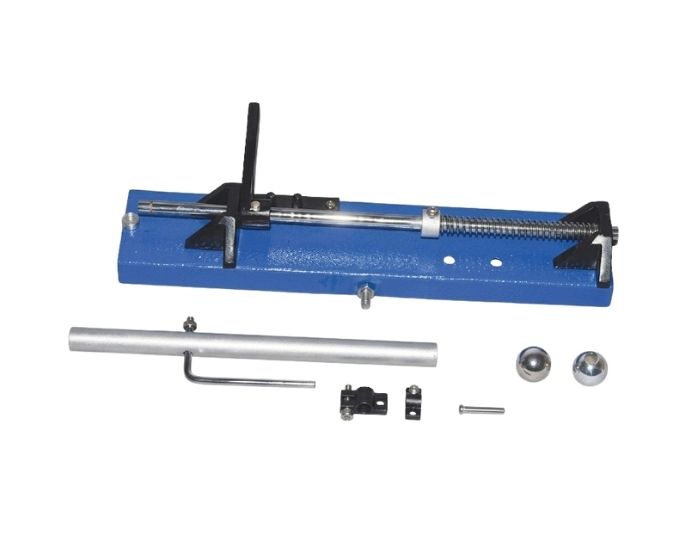
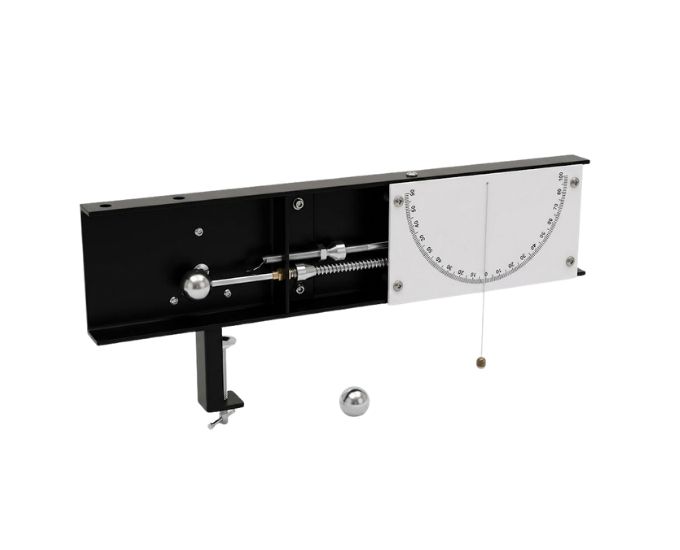
The apparatus also includes a ball-unaffected elastic arrangement that allows the card to be propelled rapidly from beneath the ball.
When the striker is pulled back and released, the card square is quickly moved horizontally away from beneath the steel ball.
Because the horizontal force acts primarily on the card rather than directly on the ball, the steel ball tends to maintain its state of rest due to inertia.
Once the supporting card has moved away, gravity causes the ball to fall vertically downward.
The experiment therefore provides a clear visual demonstration that the ball does not automatically acquire the horizontal motion of the card simply because it was initially resting on it.
This concept is closely related to many familiar demonstrations, such as quickly pulling a card from beneath a coin or rapidly removing a tablecloth from beneath stationary objects.
The apparatus converts this principle into a controlled and reusable laboratory experiment.
Students can use the demonstration to distinguish between inertia and force. Inertia itself is not a force; rather, it is the tendency of matter to resist changes in its state of motion.
The experiment also provides an opportunity to discuss the role of mass in inertia. Objects with greater mass possess greater inertia and therefore require a larger net force to produce the same acceleration.
The relationship between force, mass and acceleration can subsequently be connected to Newton’s Second Law:
F = ma
Although the apparatus primarily demonstrates Newton’s First Law, this connection helps students build a broader understanding of Newtonian mechanics.
The steel ball and card arrangement provides a visible and immediate result, making the apparatus particularly useful for instructor-led demonstrations.
Its compact construction requires little laboratory space and allows the experiment to be repeated quickly.
The apparatus operates entirely mechanically and requires no electrical power supply.
The complete setup includes the steel ball and card square required for the intended demonstration.
Manufactured and supplied by Micro Technologies, the Inertia Apparatus is suitable for physics and mechanics laboratories requiring a straightforward demonstration of inertia and Newton’s First Law.
Features
- Inertia demonstration apparatus
- Demonstrates Newton’s First Law of Motion
- Aluminium rod construction
- Rod mounted on plastic base
- Recessed top for steel ball
- Steel ball included
- Card square included
- Elastic propulsion arrangement
- Rapid card-release demonstration
- Demonstrates inertia of rest
- Compact laboratory construction
- Clear visual experiment
- Mechanical operation
- No electrical supply required
- Suitable for repeated demonstrations
Benefits
- Clearly demonstrates the principle of inertia
- Helps explain Newton’s First Law practically
- Simple experiment produces an immediate visual result
- Demonstrates that inertia is different from force
- Helps explain why the ball retains its initial state of rest
- Compact apparatus requires minimal laboratory space
- Mechanical operation simplifies experimental setup
- Reusable components support repeated demonstrations
- Suitable for individual and instructor-led experiments
- Useful for introductory mechanics studies
Product Specifications
| Specification | Details |
|---|---|
| Product Name | Inertia Apparatus |
| Product Type | Newton’s First Law Demonstrator |
| Rod Material | Aluminium |
| Base | Plastic |
| Rod Mounting | Vertical |
| Rod Top | Recessed for Ball |
| Ball | Steel |
| Card Square | Included |
| Propulsion Arrangement | Elastic / Striker |
| Motion Demonstrated | Inertia of Rest |
| Primary Application | Principle of Inertia |
| Related Study | Newton’s First Law |
| Operation | Mechanical |
| Power Requirement | None |
| Use | Physics / Mechanics Laboratory |
Set Components
| Component | Details |
|---|---|
| Main Base | Plastic |
| Aluminium Rod | Mounted on Base |
| Steel Ball | Included |
| Card Square | Included |
| Elastic / Striker Arrangement | Included |
Applications
- Principle of inertia experiments
- Newton’s First Law demonstrations
- Inertia of rest experiments
- Force and motion studies
- Classical mechanics demonstrations
- Laws of motion experiments
- Mass and inertia discussions
- Motion concept demonstrations
- Mechanics laboratory practicals
- Physics laboratory experiments
- Classroom science demonstrations
Available Variants
Inertia Apparatus, Inertia Demonstrator, Newton’s First Law Apparatus, Law of Inertia Demonstration Apparatus, Steel Ball Inertia Apparatus, Physics Lab Inertia Experiment, Mechanics Inertia Demonstrator
SKU System
MT-INA-Series
FAQs
What is the Inertia Apparatus used for?
The apparatus is used to demonstrate the principle of inertia and Newton’s First Law of Motion.
How does the Inertia Apparatus work?
A steel ball rests above a card square. When the card is rapidly propelled horizontally away, the ball tends to remain at rest because of inertia and then falls vertically under gravity.
What is inertia?
Inertia is the tendency of an object to resist a change in its state of rest or uniform motion.
Which law of motion does this apparatus demonstrate?
It primarily demonstrates Newton’s First Law of Motion, also known as the law of inertia.
What is the rod made from?
The apparatus uses an aluminium rod mounted on a plastic base.
Is a steel ball included?
Yes. A steel ball is supplied as part of the complete apparatus.
Is the card square included?
Yes. The apparatus is supplied complete with the card square required for the demonstration.
Why does the ball fall vertically instead of moving with the card?
The rapid horizontal force primarily acts on the card. Due to inertia, the ball initially tends to remain at rest, and once its support is removed, gravity pulls it downward.
Does the apparatus require electricity?
No. The Inertia Apparatus is mechanically operated and requires no electrical supply.
Where can the Inertia Apparatus be used?
It is suitable for physics laboratories, mechanics laboratories, colleges, universities and scientific teaching facilities.
Why Choose Our Products
- Manufactured and supplied by Micro Technologies
- Clear Newton’s First Law demonstration
- Aluminium rod with stable base
- Steel ball and card square included
- Simple mechanical operation
- Compact and reusable laboratory apparatus
- Suitable for mechanics experiments
- No electrical power required
- Institutional and bulk procurement available
- OEM supply requirements supported
Call to Action
Demonstrate inertia and Newton’s First Law of Motion effectively with the Inertia Apparatus from Micro Technologies. Its simple steel-ball and card arrangement provides a clear, repeatable experiment for mechanics laboratories. Contact us for institutional pricing, bulk laboratory procurement, OEM supply and customized quotations.