
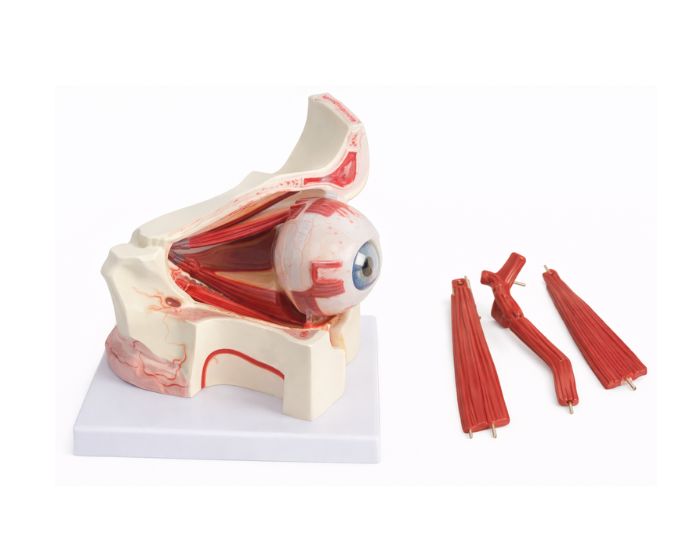
Human Eye Anatomy Model – 2× Life Size
The Human Eye Anatomy Model is an enlarged educational model designed to demonstrate the detailed structure of the human eye. Built at two times life size, the model provides a clearer and more visible representation of the internal components of the eye, making it easier for students to study eye anatomy. The model clearly illustrates important structures such as the cornea, iris, lens, retina and optic nerve, helping learners understand how the eye functions in the process of vision. By observing the enlarged structure, students can better understand how light enters the eye and how visual signals are transmitted to the brain. The larger scale makes the model especially useful for classroom demonstrations and anatomy teaching. This model is widely used in medical colleges, nursing institutes, biology laboratories and educational institutions for studying eye anatomy and the human visual system.
Product Description
Human Eye Anatomy Model – 2× Life Size
The Human Eye Anatomy Model is a detailed educational model designed to help students study the structure and function of the human eye. The model is enlarged to two times life size, allowing students to observe the anatomical features of the eye more clearly than with standard-sized models.
The human eye is a complex sensory organ responsible for vision. It works by receiving light and converting it into electrical signals that are transmitted to the brain through the optic nerve. This anatomical model provides a clear visual representation of the structures involved in this process.
The model illustrates major anatomical components of the eye, including the cornea, iris, lens, retina and optic nerve. These structures are designed with anatomical accuracy so students can understand how the eye captures and processes visual information.
Because the model is enlarged, it allows instructors to clearly demonstrate the internal parts of the eye during lectures and practical sessions. This makes the model particularly effective for classroom teaching and laboratory demonstrations.
The Human Eye Model is widely used in medical colleges, nursing institutes, biology laboratories and health science programs for studying ophthalmology, anatomy and the human visual system.
Key Features
Enlarged 2× Life Size Model
The model is built at two times life size, allowing clear visualization of eye structures.
Detailed Eye Anatomy
Important parts such as the cornea, iris, lens, retina and optic nerve are clearly represented.
Clear Educational Demonstration
The enlarged design makes the model ideal for classroom teaching and demonstrations.
Realistic Anatomical Representation
The eye structures are designed to accurately reflect the anatomy of the human eye.
Durable Construction
Manufactured from high-quality materials suitable for long-term educational use.
Applications
Medical and Nursing Education
Used in medical colleges and nursing institutes for studying eye anatomy and physiology.
Biology and Anatomy Laboratories
Serves as an effective visual teaching aid for studying the human visual system.
Classroom Demonstrations
Teachers use the model to demonstrate the structure and function of the human eye.
Health Science Training
Students studying ophthalmology, physiology and healthcare programs use the model for anatomical learning.
Product Specifications
| Specification | Details |
|---|---|
| Model Number | MT-087 |
| Product Name | Human Eye Model |
| Size | 2× Life Size |
| Type | Human Eye Anatomical Model |
| Material | High Quality PVC |
| Category | Anatomy Educational Model |
| Usage | Medical, Nursing and Biology Education |
| Application | Classroom Teaching, Laboratory Demonstration |
Frequently Asked Questions (FAQ)
What does the Human Eye Model show?
The model demonstrates the internal structure of the human eye including the cornea, iris, lens, retina and optic nerve.
What does 2× life size mean?
It means the model is built twice the size of a real human eye, making the structures easier to observe.
Who can use this anatomical model?
Medical students, nursing students, biology students and teachers commonly use this model.
Where is this model commonly used?
It is widely used in medical colleges, nursing institutes, schools and biology laboratories for teaching eye anatomy.
Why is an enlarged eye model useful?
An enlarged model allows students to clearly see and understand small anatomical structures of the eye.