
Galileo’s Inclined Plane Apparatus
Product Specification Sheet
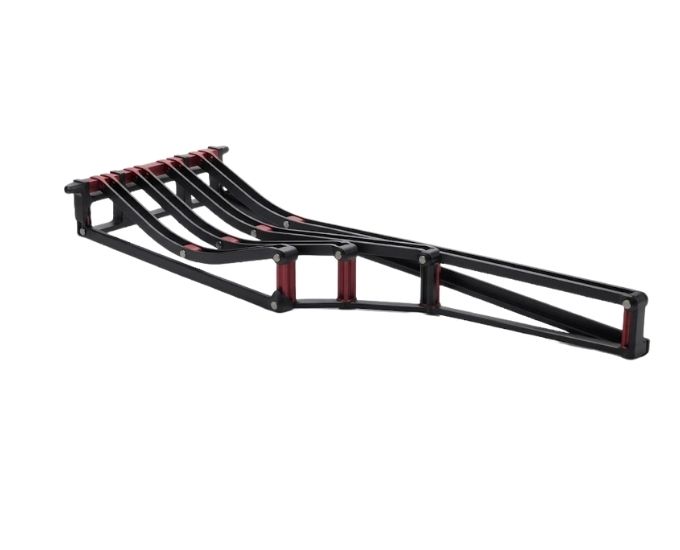
Galileo’s Inclined Plane Apparatus
Model Number: MTM-103
The Galileo’s Inclined Plane Apparatus from Micro Technologies is designed to study and verify Newton’s First Law of Motion through Galileo’s classic inclined-plane concept. The apparatus uses different track inclinations and rolling bodies to demonstrate conservation of energy, inertia of motion and the tendency of a moving object to maintain its state of motion.
Product Specification
The Galileo’s Inclined Plane Apparatus from Micro Technologies is a mechanics demonstration system designed to investigate the principles underlying Newton’s First Law of Motion, inertia and conservation of mechanical energy.
Galileo’s investigations of objects moving on inclined planes played an important role in developing the modern understanding of inertia. By reducing the effect of gravity along an inclined surface, motion could be observed over a longer period than in direct free fall.
The apparatus incorporates track arrangements with different inclinations, allowing a rolling body to descend one section and subsequently travel along another section.
When a ball rolls down an inclined track, its gravitational potential energy is converted into kinetic energy. As it climbs an opposing incline, the kinetic energy is progressively converted back into gravitational potential energy.
Under ideal conditions with negligible friction and other losses, the ball would tend to rise toward approximately the same vertical height from which it was released, irrespective of the inclination of the returning track.
If the return track is made less steep, the ball must travel a greater distance to reach the corresponding height. As the returning inclination approaches a horizontal path, the distance required becomes increasingly large.
This reasoning leads to the concept of inertia: if resistance and external forces were absent, an object already in motion would continue moving rather than spontaneously coming to rest.
This concept is closely related to Newton’s First Law:
An object remains at rest or continues in uniform straight-line motion unless acted upon by a net external force.
The apparatus can also demonstrate conservation of energy. During descent, gravitational potential energy decreases while kinetic energy increases. During ascent, kinetic energy is converted back into potential energy.
The multi-track configuration provides a clear way to compare the motion of rolling bodies under different inclinations and to investigate how track geometry influences distance, velocity and motion.
Manufactured and supplied by Micro Technologies, Galileo’s Inclined Plane Apparatus is suitable for physics laboratories, mechanics laboratories, dynamics laboratories and other facilities conducting experiments in classical mechanics.
Features
- Galileo-type inclined plane apparatus
- Multiple track inclinations
- Suitable for rolling-body experiments
- Demonstrates Newton’s First Law of Motion
- Demonstrates conservation of energy
- Illustrates inertia of motion
- Supports comparative track experiments
- Suitable for motion and velocity investigations
- Demonstrates potential and kinetic energy conversion
- Stable track construction
- Simple mechanical operation
- Reusable experimental apparatus
- No electrical power required
Benefits
- Provides a practical demonstration of Newton’s First Law
- Clearly illustrates the concept of inertia
- Shows how inclination affects travel distance
- Demonstrates gravitational potential and kinetic energy conversion
- Helps connect Galileo’s experiments with Newtonian mechanics
- Different track configurations enable comparative investigations
- Provides an intuitive demonstration of continued motion
- Suitable for repeated mechanics experiments
- No complicated electronic instrumentation is required
Product Specifications
| Specification | Details |
|---|---|
| Product Name | Galileo’s Inclined Plane Apparatus |
| Product Type | Motion & Inertia Demonstration Apparatus |
| Track Arrangement | Multiple Inclinations |
| Motion Type | Rolling |
| Main Principle | Newton’s First Law |
| Additional Principle | Inertia of Motion |
| Energy Principle | Conservation of Mechanical Energy |
| Potential Energy Study | Supported |
| Kinetic Energy Study | Supported |
| Comparative Motion | Supported |
| Operation | Mechanical |
| Power Requirement | None |
| Primary Application | Classical Mechanics Experiments |
Experimental Capabilities
| Experiment | Principle Studied |
|---|---|
| Galileo Inclined Plane | Classical motion |
| Newton’s First Law | Uniform motion and inertia |
| Conservation of Energy | Mechanical energy transformation |
| Inertia of Motion | Tendency to continue moving |
| Different Inclinations | Effect of slope on motion |
| Rolling Motion | Movement along tracks |
| Potential Energy | Energy due to elevation |
| Kinetic Energy | Energy due to motion |
| Incline-to-Incline Motion | Recovery of vertical height |
| Near-Horizontal Motion | Concept of continued motion |
Applications
- Galileo inclined-plane experiments
- Newton’s First Law demonstrations
- Law of inertia experiments
- Conservation of energy investigations
- Inertia of motion demonstrations
- Rolling-motion experiments
- Potential energy studies
- Kinetic energy investigations
- Motion and velocity experiments
- Classical mechanics demonstrations
- Dynamics laboratory experiments
- Inclined-track investigations
Available Variants
Galileo’s Inclined Plane Apparatus, Galileo Inclined Plane, Newton’s First Law Apparatus, Law of Inertia Apparatus, Galileo Motion Track, Conservation of Energy Track, Inclined Track Motion Apparatus, Inertia Demonstration Track
FAQs
What is Galileo’s Inclined Plane Apparatus used for?
It is primarily used to demonstrate Newton’s First Law of Motion, inertia, conservation of energy and the behaviour of rolling objects on tracks with different inclinations.
How does the apparatus demonstrate Newton’s First Law?
As the return track becomes progressively less inclined, a rolling object must travel farther to regain its original height. In the ideal horizontal limit with no resistance, this reasoning indicates that the object would continue moving, illustrating inertia.
What is inertia of motion?
Inertia of motion is the tendency of a moving object to continue in uniform straight-line motion unless acted upon by a net external force.
How is conservation of energy demonstrated?
During descent, gravitational potential energy is converted into kinetic energy. During the subsequent ascent, kinetic energy is converted back into gravitational potential energy.
Why are different track inclinations used?
Different inclinations allow users to compare how slope affects velocity, travel distance and the motion required to reach a given vertical height.
Does a ball always return to exactly the same height?
In a real apparatus, friction, rolling resistance and air resistance dissipate some mechanical energy, so the ball may reach a slightly lower height than its initial release point.
Can the apparatus demonstrate kinetic and potential energy?
Yes. It provides a clear demonstration of the transformation between gravitational potential energy and kinetic energy.
Does Galileo’s Inclined Plane require electricity?
No. The apparatus is mechanically operated and requires no electrical power for standard experiments.
Why Choose Our Products
- Manufactured and supplied by Micro Technologies
- Demonstrates Newton’s First Law clearly
- Suitable for conservation-of-energy experiments
- Multiple inclination configurations
- Supports inertia and rolling-motion investigations
- Stable mechanical track construction
- Suitable for repeated laboratory demonstrations
- Institutional, OEM, bulk and distributor supply available
Call to Action
Choose Galileo’s Inclined Plane Apparatus from Micro Technologies for practical demonstrations of Newton’s First Law, inertia, conservation of energy and rolling motion. Contact us for competitive pricing, complete mechanics track setups, institutional procurement, bulk orders, OEM requirements, distributor supply and customized quotations.