
Free and Forced Vortex Apparatus
Product Specification Sheet
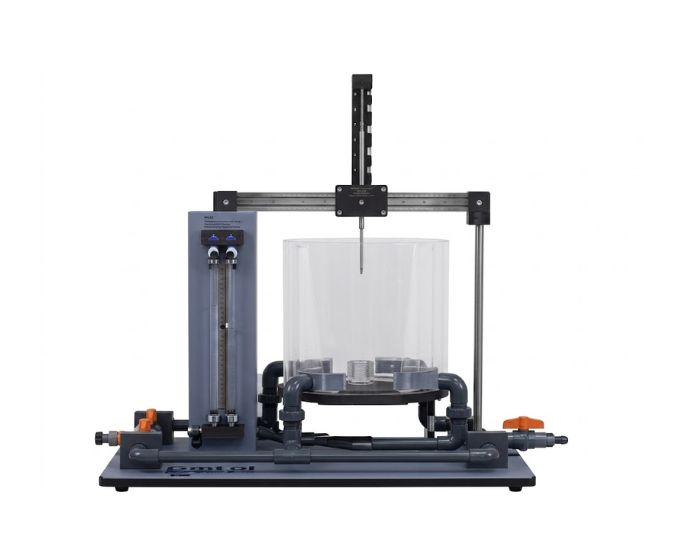
Free and Forced Vortex Apparatus
Model Number: MTHB-150.13
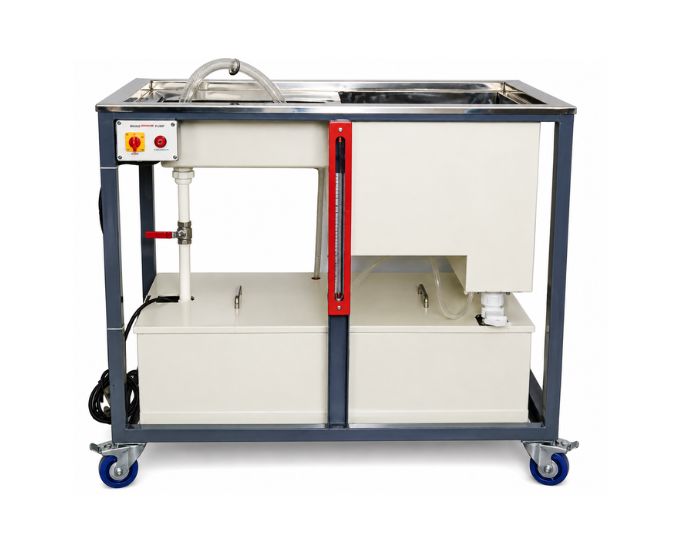
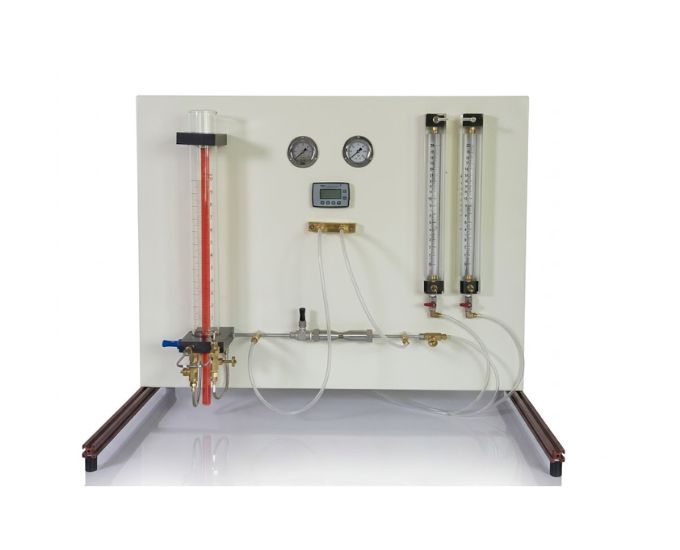
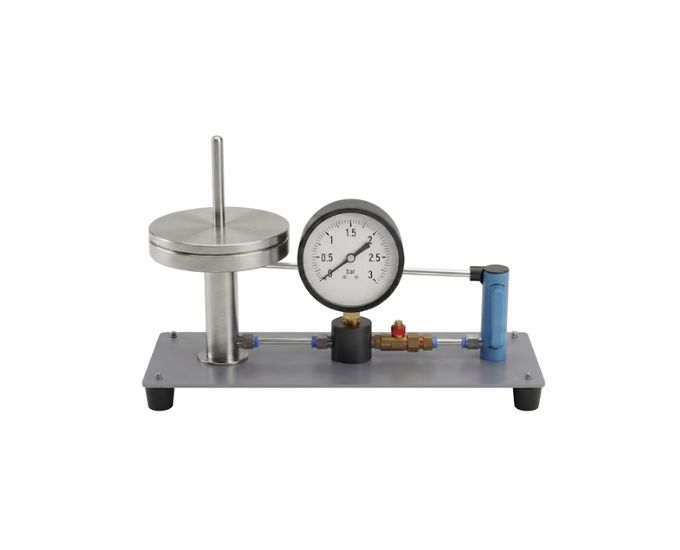
The Free and Forced Vortex Apparatus is an educational fluid mechanics laboratory system designed for the recognition and investigation of liquid surface profiles under free and forced vortex conditions. The apparatus allows students to observe rotational fluid motion, measure changes in the free surface, and understand the fundamental differences between free and forced vortices through practical experimentation.
Product Specification
The Free and Forced Vortex Apparatus is a practical educational system developed for studying rotational motion in liquids and investigating the characteristic surface profiles formed during free and forced vortex flow.
Manufactured by Micro Technologies, the apparatus provides a clear visual and experimental demonstration of vortex behaviour, allowing students to connect theoretical fluid mechanics concepts with actual observations.
A vortex is formed when a fluid rotates around a central axis. Depending on how this rotation is produced, vortex motion can generally be studied as either a free vortex or a forced vortex. The apparatus enables both conditions to be investigated and compared.
In a free vortex, fluid rotation occurs without continuous external torque being applied to each fluid element. The tangential velocity varies with radial position, producing a characteristic free-surface profile.
In a forced vortex, the liquid is rotated through an external driving action so that the fluid tends to rotate in a manner similar to a solid body. This produces a distinctly curved free surface that can be measured experimentally.
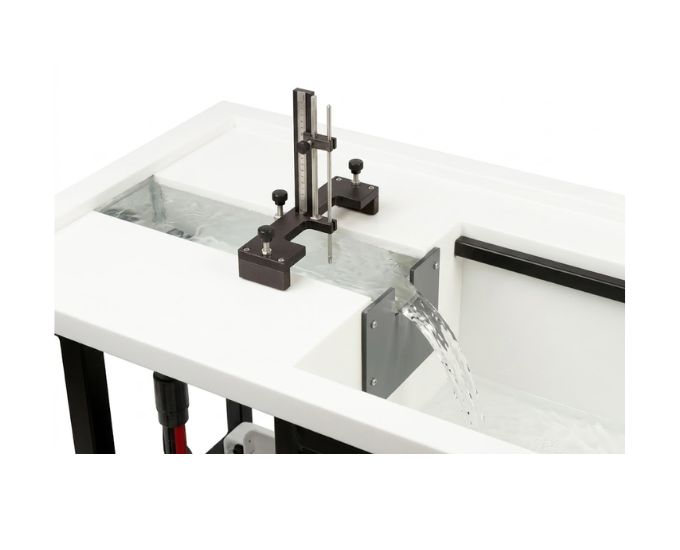
The apparatus incorporates a transparent experimental vessel that allows the liquid surface and vortex formation to be clearly observed. A suitable measuring arrangement enables students to record the elevation of the liquid surface at different radial positions.
These measurements can be used to plot the surface profile of the vortex and compare experimental observations with theoretical predictions. Students can therefore investigate how rotational speed, radial distance, and vortex type affect the liquid surface.
The experimental setup is particularly useful for understanding fluid rotation and centrifugal effects. Vortex principles have practical relevance in hydraulic engineering, turbines, pumps, separators, mixing systems, cyclones, and various industrial fluid-handling processes.
The compact construction and accessible measurement arrangement make the apparatus suitable for routine laboratory experiments, demonstrations, and practical examinations.
Features
- Study of free vortex flow
- Study of forced vortex flow
- Recognition of vortex surface profiles
- Transparent experimental vessel
- Clear visualization of rotational fluid motion
- Surface profile measuring arrangement
- Measurement at different radial positions
- Adjustable experimental conditions
- Suitable for theoretical and experimental comparison
- Demonstrates centrifugal effects in rotating liquids
- Enables comparison of free and forced vortices
- Compact laboratory configuration
- Easy observation and measurement
- Robust educational construction
- Suitable for repeated student experiments
Benefits
- Clearly demonstrates vortex formation
- Allows free and forced vortex conditions to be compared
- Helps students understand rotational fluid motion
- Enables measurement of liquid surface profiles
- Supports experimental verification of vortex theory
- Demonstrates the effect of radial position on surface elevation
- Provides practical understanding of centrifugal effects
- Connects theoretical fluid mechanics with visible experiments
- Suitable for student practicals and demonstrations
- Provides knowledge relevant to hydraulic machinery and industrial fluid systems
Product Specifications
| Specification | Details |
|---|---|
| Product Name | Free and Forced Vortex Apparatus |
| Product Type | Fluid Mechanics Experimental Apparatus |
| Experimental Study | Free & Forced Vortex |
| Working Medium | Water / Suitable Laboratory Liquid |
| Flow Behaviour | Rotational Fluid Motion |
| Vortex Modes | Free Vortex & Forced Vortex |
| Primary Observation | Liquid Surface Profile |
| Measurement | Surface Elevation at Different Radial Positions |
| Experimental Vessel | Transparent Observation Vessel |
| Parameters Studied | Surface Profile, Radius & Rotational Behaviour |
| Experimental Analysis | Theoretical vs. Experimental Profile |
| Mounting | Laboratory Bench Arrangement |
| Operation | Educational / Experimental |
| Application | Fluid Mechanics & Hydraulic Engineering Laboratories |
Experiments Performed
- Recognize the surface profile of a free vortex
- Recognize the surface profile of a forced vortex
- Study free vortex formation
- Study forced vortex formation
- Observe rotational motion of a liquid
- Measure liquid surface elevation at different radial positions
- Plot the free-surface profile
- Compare free and forced vortex behaviour
- Investigate the effect of radial distance on liquid surface level
- Study the effect of rotational motion on the free surface
- Compare theoretical and experimental vortex profiles
- Demonstrate centrifugal effects in rotating liquids
Parameters Studied
The apparatus can be used to investigate:
- Vortex type
- Rotational fluid motion
- Radial distance
- Surface elevation
- Free-surface profile
- Tangential motion
- Angular motion
- Rotational speed
- Centrifugal effects
- Vortex characteristics
Educational Objectives
The apparatus helps students understand:
- Vortex flow
- Free vortex
- Forced vortex
- Rotational fluid motion
- Surface profiles
- Radial position
- Tangential velocity
- Angular velocity
- Centrifugal effects
- Fluid rotation
- Theoretical vortex behaviour
- Practical vortex measurement
Free Vortex Study
A free vortex is produced when fluid rotates primarily due to its existing angular momentum without continuous external driving of the entire fluid mass.
Using the apparatus, students can:
- Observe free vortex formation
- Measure the resulting liquid surface
- Record surface elevation at different radial positions
- Study the relationship between radial position and vortex behaviour
- Compare experimental results with theoretical predictions
Forced Vortex Study
A forced vortex is produced when an external mechanism causes the liquid to rotate. Under ideal forced-vortex conditions, the fluid behaves approximately like a rotating solid body.
The experiment enables students to:
- Observe forced vortex formation
- Measure the curved free-surface profile
- Study the effect of rotational motion
- Record surface elevation at different radii
- Plot the experimental surface profile
- Compare observations with theoretical behaviour
Engineering Applications
Vortex-flow principles are relevant to:
- Hydraulic turbines
- Centrifugal pumps
- Mixing vessels
- Cyclone separators
- Centrifugal separators
- Industrial process equipment
- Water treatment systems
- Drainage systems
- Rotating tanks
- Hydraulic machinery
- Fluid separation processes
Applications
- Fluid Mechanics Laboratories
- Hydraulic Engineering Laboratories
- Mechanical Engineering Laboratories
- Civil Engineering Laboratories
- Chemical Engineering Laboratories
- Process Engineering Laboratories
- Hydraulic Machinery Laboratories
- Engineering Colleges
- Universities
- Polytechnic Institutes
- Technical Training Centres
- Research Laboratories
FAQs
What is a Free and Forced Vortex Apparatus?
It is an educational fluid mechanics apparatus used to investigate rotational liquid flow and recognize the characteristic surface profiles produced under free and forced vortex conditions.
What is the main objective of this apparatus?
The primary objective is the recognition and study of surface profiles for free and forced vortices.
What is a free vortex?
A free vortex is a rotational flow in which the fluid rotates primarily due to its angular momentum without continuous external driving of the complete fluid mass.
What is a forced vortex?
A forced vortex occurs when an external mechanism causes the liquid to rotate, producing rotational behaviour similar to that of a solid body under ideal conditions.
Can the surface profile be measured?
Yes. The apparatus provides a suitable measuring arrangement for determining the elevation of the liquid surface at different radial positions.
Can free and forced vortices be compared?
Yes. One of the main purposes of the apparatus is to allow students to observe and compare the different surface profiles and flow characteristics of free and forced vortices.
Why does the liquid surface change during vortex formation?
Rotational motion creates radial pressure variations and centrifugal effects, causing the free surface of the liquid to develop a characteristic profile.
Can theoretical and experimental profiles be compared?
Yes. Surface measurements can be plotted and compared with theoretically predicted vortex profiles.
What can students learn from this apparatus?
Students can understand rotational fluid motion, free and forced vortices, surface profiles, centrifugal effects, radial variation, and practical vortex behaviour.
Is this apparatus suitable for engineering colleges?
Yes. It is suitable for fluid mechanics, hydraulic, mechanical, civil, chemical, process, and hydraulic machinery laboratories.
Why Choose Our Products
- Free and forced vortex experiments in one setup
- Clear visualization of rotational fluid motion
- Surface profile measurement
- Practical comparison of vortex types
- Theoretical and experimental analysis
- Compact educational configuration
- Easy observation and operation
- Durable laboratory construction
- Suitable for repeated student practicals
- Institutional and bulk supply capability
- Customized configurations available
- Technical and project support
Call to Action
Looking for a reliable Free and Forced Vortex Apparatus for your fluid mechanics laboratory? Micro Technologies manufactures and supplies fluid mechanics and hydraulic engineering laboratory equipment for universities, engineering colleges, polytechnics, research institutes, and technical training centres. Contact us for complete laboratory setups, customized configurations, institutional projects, bulk requirements, distributor inquiries, or a competitive quotation.