
Four Stroke Diesel Engine Cutaway Model
Product Specification Sheet
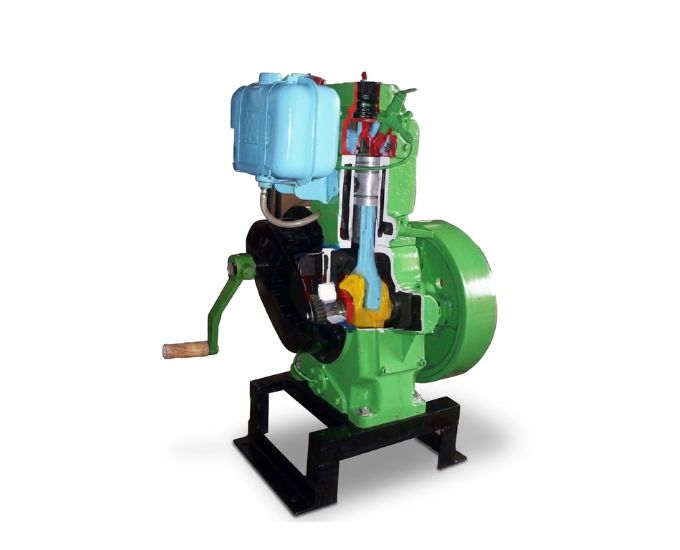
Four Stroke Diesel Engine Cutaway Model
Model Number: MT-202
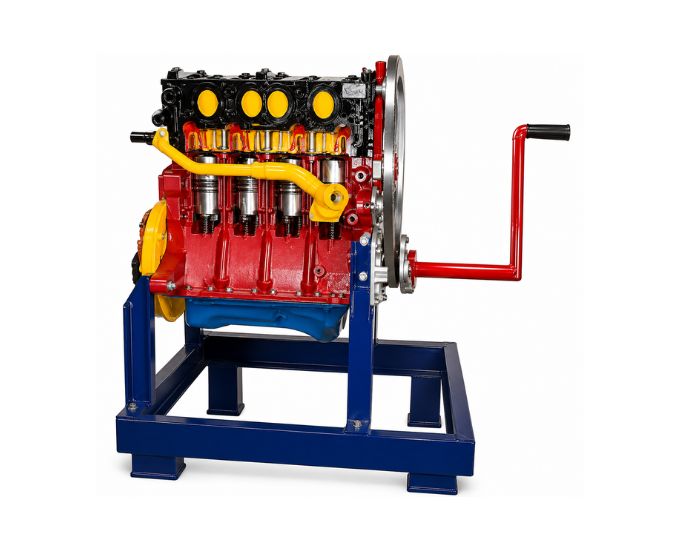
The Four Stroke Diesel Engine Cutaway Model from Micro Technologies is designed to demonstrate the internal construction and working of a single-cylinder diesel engine. Its cutaway design provides clear visibility of the piston, connecting rod, crankshaft, valves and valve timing mechanism. Manual operation allows easy demonstration of the suction, compression, power and exhaust strokes, making it suitable for automobile, mechanical and IC engine laboratories.
Product Specification
The Four Stroke Diesel Engine Cutaway Model from Micro Technologies is a practical demonstration unit designed to provide a clear visual understanding of the construction, internal components, operating cycle and valve timing of a single-cylinder four-stroke diesel engine.
Selected sections of the engine are carefully cut away to expose important internal components while maintaining their mechanical relationship. The model allows users to observe the movement of the piston, connecting rod, crankshaft, flywheel, inlet valve, exhaust valve and valve-operating mechanism.
A manual rotating arrangement enables the engine mechanism to be operated slowly, making individual stages of the four-stroke cycle easy to observe and explain.
Product Description
The Four Stroke Diesel Engine Cutaway Model is designed for practical study of the internal construction and mechanical operation of a compression-ignition engine.
In a conventional diesel engine, most working components are enclosed within the cylinder block and cylinder head. This makes it difficult to understand their movement and interaction through external observation alone.
The cutaway model solves this problem by exposing selected internal sections of the engine. Users can directly observe how piston reciprocation is converted into crankshaft rotation and how the valve mechanism operates in relation to piston position.
The engine is mounted securely on a rigid supporting frame and incorporates a manual operating handle. Rotating the handle turns the crankshaft at a controlled speed, allowing the complete mechanical sequence to be studied without running the engine through combustion.
The model is particularly useful for demonstrating four-stroke diesel engine operation and valve timing in automobile, mechanical, thermal and IC engine laboratories.
Key Features
- Four-stroke diesel engine cutaway construction
- Single-cylinder configuration
- Clearly exposed internal mechanism
- Manual operating arrangement
- Visible piston movement
- Visible connecting rod movement
- Crankshaft rotation demonstration
- Flywheel movement demonstration
- Inlet valve operation
- Exhaust valve operation
- Valve timing demonstration
- Compression-ignition engine principle
- Four-stroke cycle visualization
- Strong supporting frame
- Suitable for repeated demonstrations
- Easy identification of major engine components
- No combustion required for basic mechanical demonstration
Technical Specifications
| Specification | Details |
|---|---|
| Product Name | Four Stroke Diesel Engine Cutaway Model |
| Engine Type | Diesel Engine |
| Model Type | Cutaway / Sectional Demonstration Model |
| Cylinder Configuration | Single Cylinder |
| Operating Cycle | Four Stroke |
| Ignition Principle | Compression Ignition |
| Operation | Manual |
| Valve Timing Demonstration | Provided |
| Piston Movement | Visible |
| Connecting Rod Movement | Visible |
| Crankshaft Movement | Visible |
| Valve Operation | Visible |
| Flywheel | Provided |
| Manual Rotation | Hand-Operated Arrangement |
| Mounting | Rigid Supporting Frame |
| Primary Use | Engine Construction & Working Demonstration |
Exact engine size, construction, component arrangement, finish and cut-section locations may vary according to the engine selected for manufacturing.
Main Components
Cylinder
The cylinder provides the working chamber in which the piston moves upward and downward.
Piston
The piston reciprocates inside the cylinder and demonstrates the movement associated with the four strokes of engine operation.
Connecting Rod
The connecting rod connects the piston to the crankshaft and transfers reciprocating motion between these components.
Crankshaft
The crankshaft converts the reciprocating motion of the piston and connecting rod into rotary movement.
Flywheel
The flywheel rotates with the crankshaft and helps demonstrate the rotational motion of the engine mechanism.
Cylinder Head
The cylinder head forms the upper section of the engine and accommodates important valve-related components.
Inlet Valve
The inlet valve demonstrates the opening and closing action associated with the intake of fresh air.
Exhaust Valve
The exhaust valve demonstrates the discharge stage associated with exhaust gases.
Valve Operating Mechanism
The valve mechanism coordinates the opening and closing of inlet and exhaust valves relative to crankshaft position.
Manual Operating Handle
The manual handle enables slow rotation of the engine mechanism so that component movement can be observed clearly.
Four Stroke Diesel Engine Working Cycle
1. Suction Stroke
During the suction stroke, the piston moves downward from the upper position.
The inlet valve opens, allowing fresh air to enter the cylinder, while the exhaust valve remains closed.
This model allows users to observe the relationship between piston movement and inlet valve operation.
2. Compression Stroke
During compression, the piston moves upward.
Both the inlet and exhaust valves remain closed, causing the trapped air to be compressed.
In an operating diesel engine, this compression substantially raises the pressure and temperature of the air.
3. Power Stroke
Near the end of compression in an actual diesel engine, fuel is injected into the hot compressed air and combustion occurs.
The resulting high-pressure gases force the piston downward, producing the power stroke.
The cutaway model demonstrates the mechanical movement associated with this stage, rather than actual combustion.
4. Exhaust Stroke
During the exhaust stroke, the piston moves upward while the exhaust valve opens.
In an operating engine, this movement pushes combustion gases out of the cylinder.
After completion of the exhaust stroke, the cycle begins again.
Valve Timing Demonstration
Understanding Valve Timing
Valve timing determines when the inlet and exhaust valves open and close relative to the position of the piston and crankshaft.
By slowly rotating the cutaway model, users can observe the relationship between:
- Piston position
- Crankshaft position
- Inlet valve opening
- Inlet valve closing
- Exhaust valve opening
- Exhaust valve closing
- Four-stroke operating sequence
This provides a much clearer understanding of engine timing than diagrams alone.
Working Principle of the Model
The model is operated manually using the provided rotating handle.
When the handle is rotated:
- The crankshaft begins to rotate.
- The connecting rod transfers motion between the crankshaft and piston.
- The piston moves upward and downward inside the cylinder.
- The valve mechanism operates according to crankshaft position.
- The inlet and exhaust valves open and close in sequence.
- Continued rotation demonstrates the complete four-stroke cycle.
Because the mechanism can be rotated slowly, each movement can be observed individually.
Demonstrations Performed
Study of Diesel Engine Construction
The model helps identify the major internal components and understand their physical arrangement.
Study of Four Stroke Operation
The mechanical sequence of suction, compression, power and exhaust strokes can be demonstrated.
Study of Valve Timing
Users can observe the timing relationship between valve movement, piston position and crankshaft rotation.
Study of Piston and Crank Mechanism
The model demonstrates how piston reciprocation and crankshaft rotation are mechanically related.
Study of Connecting Rod Movement
The angular movement of the connecting rod during crankshaft rotation can be observed.
Study of Valve Mechanism
The operation of the inlet and exhaust valve mechanism can be demonstrated clearly.
Learning Objectives
The Four Stroke Diesel Engine Cutaway Model helps users understand:
- Construction of a diesel engine
- Four-stroke operating principle
- Compression-ignition concept
- Internal engine components
- Piston reciprocation
- Connecting rod movement
- Crankshaft rotation
- Flywheel movement
- Inlet valve operation
- Exhaust valve operation
- Valve timing
- Mechanical motion conversion
- Relationship between engine components
Cutaway Construction
Clear Internal Visibility
Selected engine sections are opened or cut away to provide visibility of important internal parts.
This makes it easier to understand component positioning and mechanical interaction without dismantling a complete engine.
Functional Mechanical Relationship
The exposed components remain mechanically connected so that their coordinated movement can be demonstrated through manual rotation.
Manual Operating System
The manually operated design provides several practical advantages.
Users can:
- Rotate the mechanism slowly
- Stop at any crank position
- Observe individual component movements
- Repeat a particular stroke
- Demonstrate valve timing clearly
- Explain the cycle step-by-step
This makes the model particularly useful for instructor-led demonstrations and practical training.
Benefits
- Clear visualization of internal engine construction
- Demonstrates actual mechanical relationships
- Four-stroke cycle can be observed practically
- Valve timing can be demonstrated
- Manual operation provides controlled observation
- Helps identify individual engine components
- No combustion required for normal demonstration
- Useful for repeated practical sessions
- Makes theoretical engine concepts easier to understand
- Suitable for classroom and laboratory demonstrations
- Robust supporting structure
- Useful for technical skill development
Scope of Application
- Diesel Engine Construction Study
- Four Stroke Engine Demonstration
- Valve Timing Study
- IC Engine Component Identification
- Piston Movement Demonstration
- Connecting Rod Mechanism Study
- Crankshaft Movement Study
- Valve Mechanism Demonstration
- Automobile Engine Training
- Diesel Engine Working Principle
- Mechanical Engineering Demonstration
- Technical Training
Applications
- Automobile Engineering Laboratories
- Mechanical Engineering Laboratories
- IC Engine Laboratories
- Thermal Engineering Laboratories
- Engineering Colleges
- Polytechnic Institutes
- Industrial Training Institutes
- Technical Universities
- Vocational Training Centers
- Automobile Training Centers
- Skill Development Centers
- Technical Demonstration Laboratories
Frequently Asked Questions
What is a Four Stroke Diesel Engine Cutaway Model?
It is a sectional engine demonstration model in which selected areas are opened to expose internal components and demonstrate their mechanical operation.
Which type of engine does the model represent?
The model represents a single-cylinder four-stroke diesel engine.
Is the model manually operated?
Yes. The shown configuration includes a manual rotating handle for operating the engine mechanism slowly.
Can valve timing be demonstrated?
Yes. Valve timing is one of the important demonstrations possible with this model.
Can piston movement be observed?
Yes. The cutaway construction makes the piston and its reciprocating movement visible.
Can the four-stroke cycle be demonstrated?
Yes. The mechanical sequence corresponding to suction, compression, power and exhaust strokes can be demonstrated by manually rotating the engine.
Does the model require diesel fuel?
No fuel is required for its normal mechanical demonstration. The model is primarily intended to demonstrate engine construction and component movement.
Can the crankshaft and connecting rod be observed?
Yes. Selected cutaway sections allow the crankshaft, connecting rod and associated mechanical movement to be studied.
What is the main purpose of this model?
Its primary purpose is to provide a practical visual demonstration of diesel engine construction, four-stroke operation, valve timing and internal mechanical movement.
Where can this model be used?
It is suitable for automobile engineering, mechanical engineering, IC engine, thermal engineering and technical training laboratories.
Why Choose Micro Technologies?
- Four-stroke diesel engine cutaway construction
- Clear internal component visibility
- Manual operating mechanism
- Valve timing demonstration
- Visible piston and crankshaft movement
- Practical four-stroke cycle study
- Strong laboratory mounting
- Suitable for repeated demonstrations
- Engineering and technical training applications
- Custom configurations available
- Institutional and bulk supply
- Technical support
Call to Action
Choose the Four Stroke Diesel Engine Cutaway Model from Micro Technologies for practical demonstration of diesel engine construction, valve timing and internal working mechanisms. Contact us for technical specifications, customization, institutional procurement, bulk requirements and quotation.