
Foot joint Without Ligaments
Product Specification Sheet
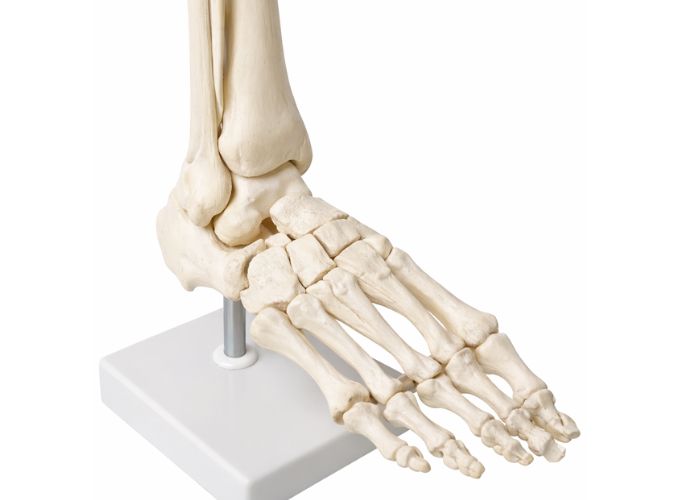
Foot joint Without Ligaments
Model Number: MT-028
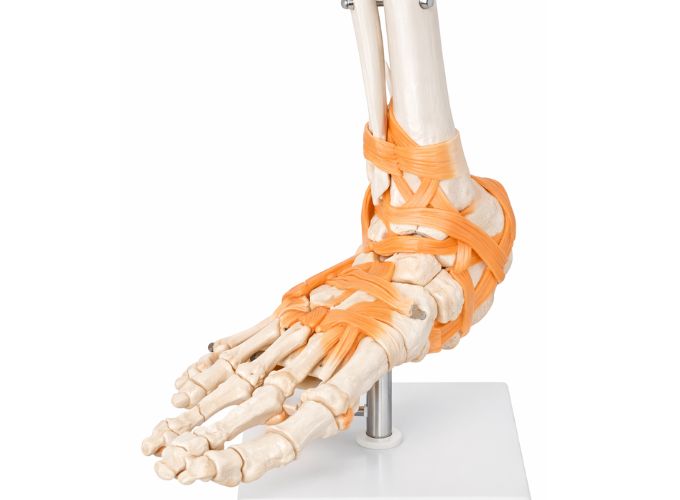
The Foot Joint (Without Ligaments) anatomical model is a detailed educational tool designed to demonstrate the structure of the human foot joint and its bone arrangement. This model focuses specifically on the skeletal framework of the foot, allowing students and professionals to clearly observe the alignment and connection of foot bones without the presence of ligaments. By highlighting the bone structure alone, the model helps learners understand the fundamental anatomy of the foot in a simple and clear way. Offered by MicrolabEquipment, this model is widely used in medical colleges, biology laboratories, nursing institutes, and physiotherapy training centers for anatomy education and demonstrations. It allows instructors to explain the composition of the tarsal bones, metatarsals, and phalanges while showing how these bones form the foot joint and support body movement.
Product Specification
The Human Foot Joint Anatomy Model Without Ligaments (Life Size) is a scientifically accurate representation of the skeletal framework of the human foot. Designed to highlight bone structure, it clearly displays the arrangement of tarsals, metatarsals, and phalanges, allowing learners to study joint formation and alignment in detail.
By excluding ligaments, this model provides an unobstructed view of how the bones connect and interact, making it easier to understand the fundamental structure of the foot. It is especially useful for beginners and students who need a clear and simplified understanding of skeletal anatomy before progressing to more complex structures.
The life-size design enhances realism and improves visual learning, making it suitable for classroom demonstrations and laboratory study. Manufactured using durable, high-quality materials, the model ensures long-term usability. It serves as an essential teaching aid in medical education, physiotherapy training, and biological sciences, supporting both theoretical and practical learning of the musculoskeletal system.
Features
-
Life-size representation of the foot skeletal structure
- Clearly displays tarsals, metatarsals, and phalanges
- Ligament-free design for clear bone visualization
- Demonstrates joint alignment and structure
- Durable construction for long-term use
- Ideal for teaching basic skeletal anatomy
- Suitable for classroom and laboratory demonstrations
Applications
-
Medical colleges
- Nursing and physiotherapy institutes
- Universities and schools
- Anatomy and biology laboratories
- Research and training centers
Product Specifications
| Specification | Details |
|---|---|
| Product Name | Foot Joint Anatomy Model Without Ligaments |
| Model No. | MT-028 |
| Type | Anatomical Skeletal Model |
| Material | High-quality durable polymer |
| Size / Model | Life-size |
| Usage | Educational and medical training purposes |
FAQs
Q1. What does this foot joint model show?
It shows the skeletal structure of the foot, including tarsals, metatarsals, and phalanges.
Q2. Why are ligaments not included in this model?
The absence of ligaments allows clearer visualization of bone arrangement and joint structure.
Q3. Is this model suitable for beginners?
Yes, it is ideal for students learning basic skeletal anatomy of the foot.
Q4. Can it be used in physiotherapy training?
Yes, it is widely used in physiotherapy and medical education for teaching purposes.
Why Choose Our Products
-
High anatomical accuracy for effective learning
- Durable materials for long-lasting performance
- Simplified design for better understanding
- Suitable for a wide range of educational and clinical uses