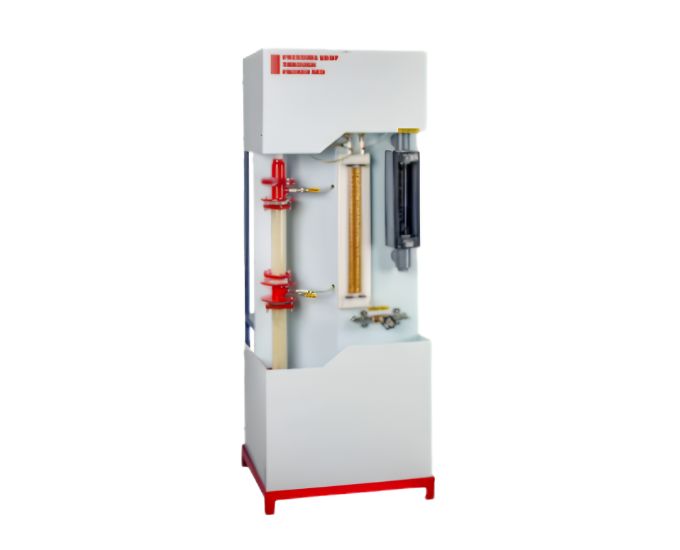

Flow Through Fluidized Bed Apparatus
Product Specification Sheet
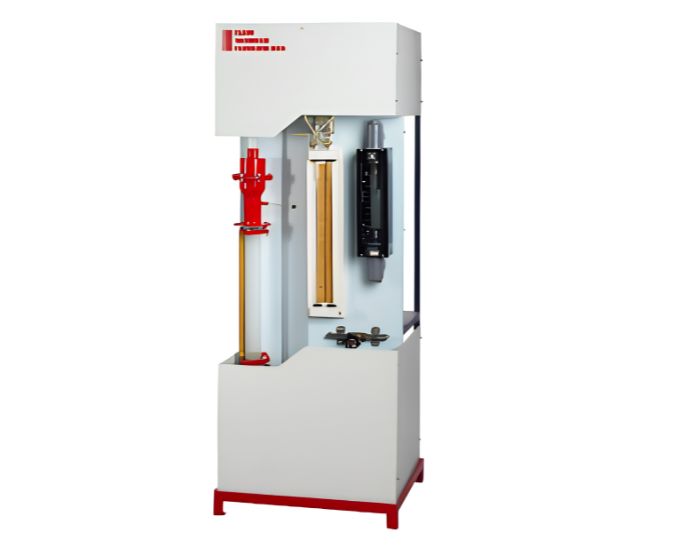
Flow Through Fluidized Bed Apparatus
Model Number: MTFA-193
The Flow Through Fluidized Bed Apparatus is an educational engineering laboratory system designed for studying the fundamental behaviour of fluidization of bulk solid layers. The apparatus enables students to investigate pressure loss as a function of flow velocity, study the influence of particle type and size, determine fluidization velocity, compare experimental values with theoretically calculated values using the Ergun equation, and analyze the relationship between fluidized bed height and flow velocity.
Product Specification
The Flow Through Fluidized Bed Apparatus is an educational laboratory system developed for the practical investigation of fluidization phenomena and the flow behaviour of fluids through beds of solid particles.
Fluidization occurs when an upward-flowing fluid passes through a bed of solid particles at a sufficient velocity to suspend and mobilize the particles. Under suitable conditions, the solid bed begins to behave in a fluid-like manner. This phenomenon is important in chemical processing, thermal systems, drying, combustion, reaction engineering, and particle-handling applications.
The apparatus enables students to understand the fundamentals of fluidization of bulk solid layers through direct observation and experimental measurement.
One of the primary experiments is the investigation of pressure loss as a function of flow velocity. The fluid flow rate can be varied while the corresponding pressure difference across the particle bed is measured. The resulting data can be used to analyze pressure-drop behaviour before and after the onset of fluidization.
The apparatus also enables investigation of the influence of type and particle size of the bulk solid. Different suitable particulate materials can be used to understand how particle properties influence pressure loss and fluidization behaviour.
An important experiment is the determination of fluidization velocity. By gradually changing the fluid velocity and monitoring the pressure conditions and particle-bed behaviour, students can identify the transition from a fixed bed to a fluidized state.
The experimentally determined fluidization velocity can be compared with theoretically calculated values using the Ergun equation. This provides students with an opportunity to compare theoretical fluid mechanics correlations with practical laboratory measurements.
The apparatus further enables investigation of the dependency of fluidized bed height on flow velocity. As the fluid velocity increases above the fluidization condition, expansion of the particle bed can be observed and measured.
Suitable pressure and flow measuring arrangements allow the important operating variables to be monitored during experimentation. The transparent experimental section facilitates visual observation of particle-bed behaviour and bed expansion.
The Flow Through Fluidized Bed Apparatus provides practical understanding of fixed beds, fluidized beds, pressure drop, superficial flow velocity, particle characteristics, fluidization velocity, bed expansion, and the Ergun equation.
Micro Technologies supplies Flow Through Fluidized Bed Apparatus for engineering colleges, universities, polytechnic institutes, technical training centres, and research laboratories requiring practical fluid mechanics, chemical engineering, and process engineering laboratory equipment.
Features
- Designed for studying fluidization of bulk solid layers
- Transparent experimental section for visual observation
- Suitable for fixed-bed and fluidized-bed studies
- Adjustable fluid-flow conditions
- Pressure-loss measurement arrangement
- Flow-velocity measurement provision
- Suitable for different compatible bulk solids
- Enables study of particle-size effects
- Fluidization velocity determination
- Comparison with theoretical Ergun equation values
- Fluidized bed-height measurement
- Enables bed expansion studies
- Suitable for characteristic curve plotting
- Laboratory-scale educational configuration
- Robust construction for repeated experiments
Benefits
- Provides practical understanding of fluidization fundamentals
- Demonstrates transition from fixed bed to fluidized bed
- Enables pressure-loss versus flow-velocity analysis
- Helps investigate the influence of particle size
- Enables experimental determination of fluidization velocity
- Allows experimental and theoretical results to be compared
- Demonstrates application of the Ergun equation
- Provides visual observation of bed expansion
- Helps analyze bed height at different flow velocities
- Connects theoretical fluid mechanics with practical experimentation
- Suitable for chemical and process engineering education
Product Specifications
| Specification | Details |
|---|---|
| Product Name | Flow Through Fluidized Bed Apparatus |
| Product Type | Fluid Mechanics / Process Engineering Laboratory Apparatus |
| Primary Study | Fluidization of Bulk Solid Layers |
| Bed Material | Suitable Particulate / Bulk Solid Material |
| Flow Parameter | Flow Velocity |
| Pressure Study | Pressure Loss Across Bed |
| Particle Study | Type & Particle Size |
| Fluidization Study | Fluidization Velocity |
| Theoretical Analysis | Ergun Equation |
| Experimental Comparison | Experimental vs. Theoretical Fluidization Velocity |
| Bed Study | Fluidized Bed Height |
| Bed Expansion Study | Bed Height vs. Flow Velocity |
| Pressure Measurement | Provided |
| Flow Measurement | Provided |
| Observation Section | Transparent |
| Application | Fluid Mechanics, Chemical & Process Engineering Laboratory |
| Suitable For | Engineering Colleges, Universities, Polytechnics & Technical Institutes |
Experiments Performed
- Study of fundamentals of fluidization
- Study of fluidization of bulk solid layers
- Observation of fixed-bed behaviour
- Observation of fluidized-bed behaviour
- Measurement of pressure loss across the particle bed
- Study of pressure loss as a function of flow velocity
- Study of the influence of bulk-solid type
- Investigation of particle-size effects on fluidization
- Determination of fluidization velocity
- Determination of minimum fluidization conditions
- Calculation of theoretical fluidization parameters
- Application of the Ergun equation
- Comparison of experimentally determined and theoretically calculated values
- Measurement of fluidized bed height
- Study of bed expansion
- Study of fluidized bed height as a function of flow velocity
- Plotting of fluidization characteristic curves
Applications
- Chemical Engineering Laboratories
- Process Engineering Laboratories
- Fluid Mechanics Laboratories
- Particle Technology Laboratories
- Mechanical Engineering Laboratories
- Thermal Engineering Laboratories
- Unit Operations Laboratories
- Engineering Colleges
- Universities
- Polytechnic Institutes
- Technical Training Centres
- Research and Educational Laboratories
FAQs
What is the Flow Through Fluidized Bed Apparatus used for?
The apparatus is used to study fluidization of bulk solid particles, pressure loss, flow velocity, fluidization velocity, particle-size effects, and expansion of the fluidized bed.
What is fluidization?
Fluidization is a process in which an upward-flowing fluid interacts with a bed of solid particles until the particles become suspended and the bed begins to behave in a fluid-like manner.
Can pressure loss be measured?
Yes. Pressure loss across the particle bed can be measured and analyzed as a function of flow velocity.
Can different particle sizes be studied?
Yes. Different suitable particle sizes and bulk-solid materials can be used to investigate their influence on fluidization behaviour.
Can fluidization velocity be determined?
Yes. The apparatus enables experimental determination of the flow velocity at which the particle bed begins to fluidize.
What is minimum fluidization velocity?
Minimum fluidization velocity is the superficial fluid velocity at which the upward fluid force becomes sufficient for the particle bed to begin behaving as a fluidized bed.
Can the Ergun equation be studied using this apparatus?
Yes. Theoretical values can be calculated using the Ergun equation and compared with experimentally determined results.
Can fluidized bed height be measured?
Yes. The bed height can be observed and measured at different flow velocities to investigate bed expansion.
What happens to bed height when flow velocity increases?
After fluidization begins, increasing flow velocity can cause greater separation between particles and expansion of the fluidized bed.
Is this apparatus suitable for chemical engineering laboratories?
Yes. It is particularly suitable for chemical engineering, process engineering, fluid mechanics, particle technology, and unit operations laboratory courses.
Why Choose Our Products
- Practical fluidization experiments
- Pressure loss and flow velocity studies
- Fluidization velocity determination
- Particle-size effect analysis
- Ergun equation comparison
- Fluidized bed expansion experiments
- Transparent section for easy observation
- Student-friendly laboratory configuration
- Durable construction for institutional use
- Customized configurations available
- Institutional and bulk supply support
Call to Action
Looking for a reliable Flow Through Fluidized Bed Apparatus for your engineering laboratory? Micro Technologies supplies fluid mechanics, chemical engineering, process engineering, and unit operations laboratory equipment for universities, engineering colleges, polytechnic institutes, technical training centres, and research facilities. Contact us for technical specifications, customized configurations, institutional orders, bulk supply, distributor inquiries, government tenders, or a competitive quotation.