
Floating Bodies Apparatus
Product Specification Sheet
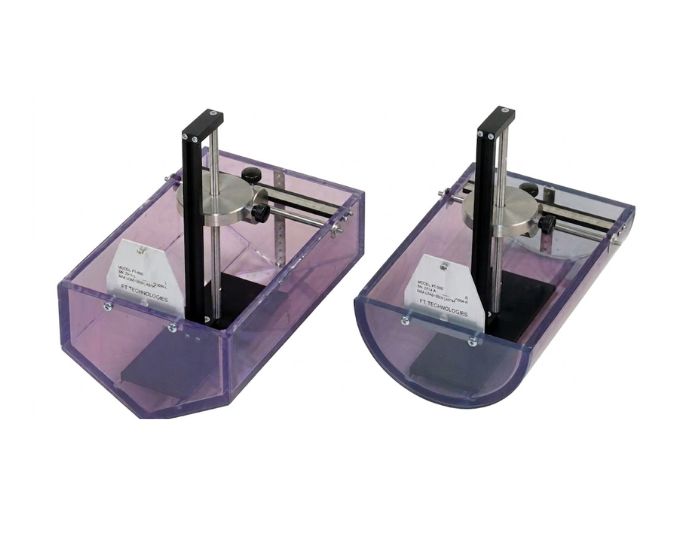
Floating Bodies Apparatus
Model Number: MTHB-150.27
The Floating Bodies Apparatus is an educational fluid mechanics laboratory system designed to determine the metacentric height and center of gravity of different shaped floating bodies. The apparatus allows students to investigate the stability of floating vessels, understand the relationship between the center of gravity, center of buoyancy and metacentre, and experimentally evaluate the effect of weight distribution on floating-body stability.
Product Specification
The Floating Bodies Apparatus is a practical educational system developed for studying the stability and equilibrium characteristics of floating bodies of different shapes.
Manufactured by Micro Technologies, the apparatus enables students to experimentally determine the metacentric height and center of gravity while gaining practical understanding of hydrostatic stability and buoyancy.
The experimental arrangement uses specially shaped floating bodies that can be placed in a suitable water tank or hydraulic bench arrangement. Different hull profiles allow students to investigate how the geometry of a floating body influences its stability.
A vertical mast is mounted on the floating body and incorporates an adjustable weight arrangement. By moving a known weight laterally from the central position, a controlled heeling moment can be produced.
The resulting angular inclination of the floating body can be measured using the provided inclination measuring arrangement. The measured displacement, applied weight and angle of heel can then be used for experimental calculations.
The apparatus demonstrates the relationship between the center of gravity (G), center of buoyancy (B), and metacentre (M). These parameters are fundamental to determining whether a floating vessel remains stable after a small angular displacement.
By changing the position of the adjustable weights, students can observe how raising, lowering, or laterally shifting the center of gravity influences stability.
The use of different shaped floating bodies also enables comparative experiments to investigate the influence of hull geometry on metacentric height and overall stability.
The apparatus is particularly useful for fluid mechanics, hydrostatics, civil engineering, mechanical engineering, marine engineering, naval architecture, and hydraulic engineering laboratories.
Features
- Determination of metacentric height
- Center of gravity investigation
- Different shaped floating bodies
- Hydrostatic stability experiments
- Adjustable vertical weight
- Movable transverse weight arrangement
- Controlled heeling moment
- Inclination measurement arrangement
- Clear observation of floating-body behaviour
- Comparative study of different hull shapes
- Center of buoyancy concept demonstration
- Metacentre investigation
- Stable and unstable condition studies
- Compact educational construction
- Simple experimental operation
- Suitable for repeated student practicals
Benefits
- Provides practical understanding of floating-body stability
- Enables metacentric height to be determined experimentally
- Helps students investigate the center of gravity
- Demonstrates center of buoyancy and metacentre concepts
- Allows different shaped floating bodies to be compared
- Shows the influence of weight distribution on stability
- Demonstrates the effect of center-of-gravity position
- Supports theoretical and experimental comparison
- Provides practical knowledge relevant to ships and floating structures
- Suitable for demonstrations and engineering practical examinations
Product Specifications
| Specification | Details |
|---|---|
| Product Name | Floating Bodies Apparatus |
| Product Type | Hydrostatics Experimental Apparatus |
| Working Medium | Water |
| Experimental Bodies | Different Shaped Floating Bodies |
| Primary Measurement | Metacentric Height |
| Additional Study | Center of Gravity |
| Stability Study | Floating Body Stability |
| Weight Arrangement | Adjustable |
| Transverse Weight | Movable |
| Vertical Weight | Adjustable |
| Inclination Measurement | Provided |
| Parameters Studied | Metacentric Height, Heel Angle & Center of Gravity |
| Experimental Principle | Buoyancy & Hydrostatic Stability |
| Operation | Educational / Experimental |
| Application | Fluid Mechanics & Hydraulic Engineering Laboratories |
Main Components
The apparatus typically incorporates:
- Different shaped floating bodies
- Floating hull sections
- Vertical mast
- Adjustable vertical weight
- Movable transverse weight
- Weight positioning scale
- Inclination indicator
- Angular measuring arrangement
- Supporting and balancing components
- Suitable water tank or hydraulic bench interface
Experiments Performed
- Determine the metacentric height of a floating body
- Determine the center of gravity
- Investigate the stability of different shaped floating bodies
- Study the effect of transverse weight displacement
- Determine the angle of heel
- Study the effect of raising the center of gravity
- Study the effect of lowering the center of gravity
- Compare stability of different hull shapes
- Investigate center of buoyancy
- Study the position of the metacentre
- Determine the relationship between metacentric height and stability
- Demonstrate stable equilibrium of floating bodies
- Study the effect of weight distribution on vessel stability
- Compare theoretical and experimental stability characteristics
Parameters Studied
The apparatus can be used to investigate:
- Metacentric height
- Center of gravity
- Center of buoyancy
- Metacentre
- Angle of heel
- Transverse weight displacement
- Vertical weight position
- Floating-body geometry
- Buoyant force
- Stability
- Weight distribution
- Restoring moment
Metacentric Height
Metacentric height is an important parameter used to evaluate the initial stability of a floating body.
It is generally represented as:
GM = Distance between Center of Gravity (G) and Metacentre (M)
For small angular displacements, the experimental metacentric height can be related to the applied heeling moment and measured heel angle.
A commonly used experimental relationship is:
GM = (w × x) / (W × tan θ)
Where:
- GM = Metacentric height
- w = Movable weight
- x = Transverse displacement of the weight
- W = Total weight of the floating system
- θ = Angle of heel
Center of Gravity Study
The position of the center of gravity significantly influences floating-body stability.
The adjustable weight arrangement allows students to change the center-of-gravity position and observe the resulting effect on stability.
Generally, increasing the vertical position of the center of gravity reduces initial stability, while lowering it tends to increase initial stability, subject to the geometry and operating condition of the floating body.
Stability of Floating Bodies
The apparatus helps demonstrate three important points:
- Center of Gravity (G): Point through which the body's weight acts.
- Center of Buoyancy (B): Effective point through which the buoyant force acts.
- Metacentre (M): Reference point used in analysing the initial stability of a slightly inclined floating body.
Their relative positions are important in evaluating floating-body stability.
Different Shaped Floating Bodies
Different floating-body shapes can be used to compare their hydrostatic characteristics.
Students can investigate how variations in:
- Hull geometry
- Width
- Cross-sectional profile
- Weight distribution
- Center-of-gravity position
affect the measured metacentric height and stability.
Educational Objectives
The apparatus helps students understand:
- Archimedes' principle
- Buoyancy
- Floating-body equilibrium
- Metacentric height
- Center of gravity
- Center of buoyancy
- Metacentre
- Heel angle
- Restoring moment
- Hydrostatic stability
- Influence of hull geometry
- Effect of weight distribution
Engineering Applications
The principles demonstrated using the apparatus are relevant to:
- Ship stability
- Naval architecture
- Marine vessels
- Floating platforms
- Barges
- Pontoons
- Floating docks
- Offshore structures
- Marine engineering
- Floating storage systems
- Buoyant structures
- Vessel design
Applications
- Fluid Mechanics Laboratories
- Hydrostatics Laboratories
- Hydraulic Engineering Laboratories
- Civil Engineering Laboratories
- Mechanical Engineering Laboratories
- Marine Engineering Laboratories
- Naval Architecture Laboratories
- Ocean Engineering Laboratories
- Engineering Colleges
- Universities
- Polytechnic Institutes
- Technical Training Centres
- Research Laboratories
FAQs
What is a Floating Bodies Apparatus?
A Floating Bodies Apparatus is an educational hydrostatics system used to investigate floating-body stability and determine parameters such as metacentric height and center of gravity.
What is the main objective of this apparatus?
The main objective is to find the metacentric height and center of gravity for different shaped floating bodies.
What is metacentric height?
Metacentric height is the vertical distance between the center of gravity and the metacentre and is an important indicator of the initial stability of a floating body.
Can different floating-body shapes be compared?
Yes. Different shaped bodies can be investigated to study how geometry influences hydrostatic stability and metacentric height.
How is the floating body inclined during the experiment?
A known movable weight is displaced transversely, producing a controlled heeling moment and causing the body to incline.
What is the purpose of the adjustable vertical weight?
It allows the center-of-gravity position to be changed so that its effect on floating-body stability can be investigated.
What is the center of buoyancy?
The center of buoyancy is the effective point through which the resultant buoyant force on the submerged portion of a floating body acts.
What does a larger positive metacentric height indicate?
For small-angle initial stability, a larger positive metacentric height generally indicates a stronger restoring tendency, although practical vessel design must also consider other stability and operating requirements.
What engineering fields use this experiment?
The experiment is useful in fluid mechanics, hydrostatics, civil engineering, marine engineering, naval architecture, mechanical engineering, and ocean engineering.
Is this apparatus suitable for engineering colleges?
Yes. It is designed for universities, engineering colleges, polytechnics, technical institutes, and laboratory training applications.
Why Choose Our Products
- Different shaped floating-body experiments
- Metacentric height determination
- Center-of-gravity investigation
- Adjustable weight arrangement
- Practical hydrostatic stability studies
- Comparative hull-shape experiments
- Simple educational operation
- Robust laboratory construction
- Suitable for repeated student experiments
- Institutional and bulk laboratory supply
- Customized configurations available
- Technical and project support
Call to Action
Looking for a reliable Floating Bodies Apparatus for your fluid mechanics laboratory? Micro Technologies manufactures and supplies hydrostatics, fluid mechanics, and hydraulic engineering laboratory equipment for universities, engineering colleges, polytechnics, marine institutes, research centres, and technical training facilities. Contact us for complete laboratory setups, customized configurations, institutional projects, bulk requirements, distributor inquiries, or a competitive quotation.