
Equal Mass Density Cubes
Product Specification Sheet
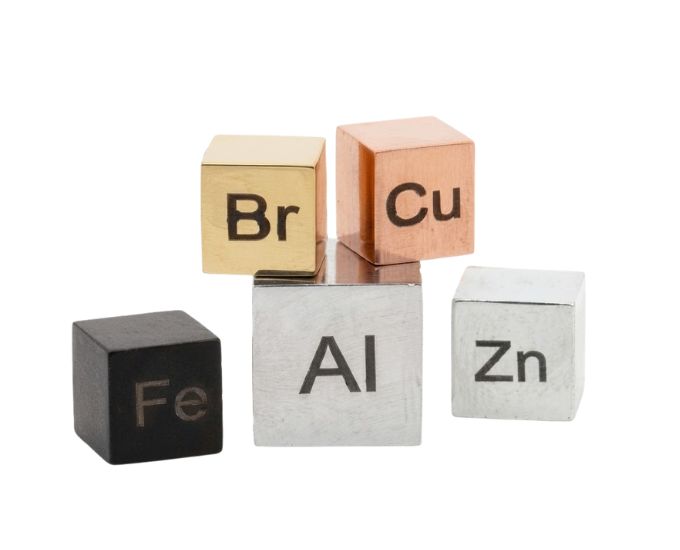
Equal Mass Density Cubes
Model Number: MTM-40
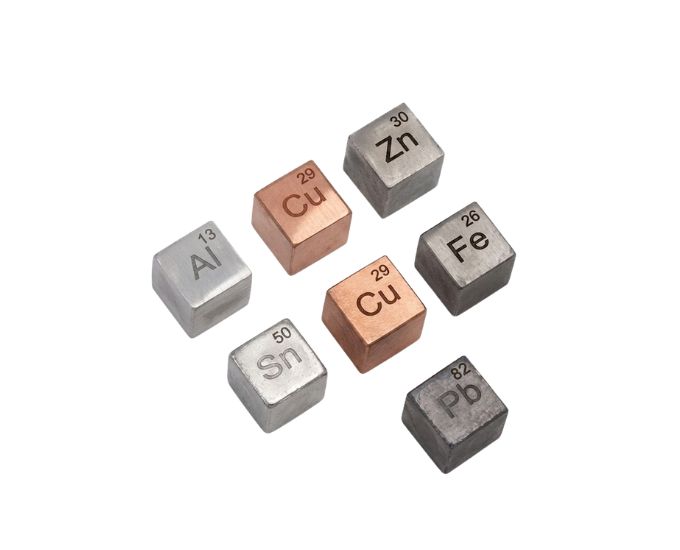
The Equal Mass Density Cubes from Micro Technologies are designed to demonstrate the inverse relationship between density and volume. The set contains five metal cubes made from copper, aluminium, zinc, iron and brass, with each specimen having an equal mass of approximately 20 g. Their different sizes provide a clear physical demonstration of how equal masses of different materials occupy different volumes.
Product Specification
The Equal Mass Density Cubes from Micro Technologies provide a practical method for studying the relationship between density, mass and volume using specimens made from different metals.
The complete set contains five metal cubes manufactured from copper, aluminium, zinc, iron and brass. Each specimen has an equal mass of approximately 20 g, while its physical dimensions vary according to the density of the material.
Because mass is maintained at approximately the same value for every specimen, differences in cube volume provide a direct visual demonstration of differences in material density.
The set is specifically useful for demonstrating the inverse relationship between density and volume when mass remains constant. A higher-density material requires a smaller volume to provide the same mass, while a lower-density material requires a larger volume.
This relationship can be understood using:
Density = Mass ÷ Volume
or, for equal mass:
Volume = Mass ÷ Density
The aluminium cube, having a comparatively lower density than the other listed metals, occupies a larger volume for the same 20 g mass.
Metals such as copper and brass have higher densities and therefore require comparatively smaller volumes to achieve approximately the same mass.
Students can compare the physical dimensions of the specimens before performing calculations, making the concept of density easier to understand visually.
The dimensions of each cube can be measured using a suitable Vernier Caliper or other measuring instrument. From these measurements, students can calculate the volume of each specimen.
Since the mass is known to be approximately 20 g, students can use the calculated volume to determine the experimental density of each metal.
The specimens can also be weighed using a suitable laboratory balance to verify their equal-mass configuration and introduce concepts such as measurement tolerance and experimental accuracy.
Comparing five different metals allows students to investigate how material composition affects density and volume, even when specimen mass remains unchanged.
The set can support lessons involving properties of matter, material identification, mass-to-volume relationships and comparative physical properties of metals.
It is particularly useful as a companion to equal-volume density sets. When both types are demonstrated, students can observe that equal-volume specimens have different masses, while equal-mass specimens have different volumes.
The compact cube configuration makes the specimens convenient for laboratory handling, measurement and storage.
Manufactured and supplied by Micro Technologies, the Equal Mass Density Cubes are suitable for physics laboratories, material science laboratories and educational institutions conducting density and material-property experiments.
Features
- Set of five metal density cubes
- Equal-mass specimen configuration
- Approx. 20 g mass per cube
- Copper cube included
- Aluminium cube included
- Zinc cube included
- Iron cube included
- Brass cube included
- Different volumes according to material density
- Regular cubic specimen shape
- Suitable for density experiments
- Useful for volume comparison
- Suitable for dimensional measurements
- Compact laboratory specimens
- Suitable for comparative metal studies
Benefits
- Clearly demonstrates density-volume relationships
- Equal mass simplifies comparison between materials
- Different cube sizes provide a visual density demonstration
- Helps explain why equal masses can occupy different volumes
- Includes five commonly studied metals
- Suitable for quantitative density calculations
- Supports dimensional measurement exercises
- Helps students understand properties of materials
- Useful for material identification activities
- Suitable for practical physics education
Product Specifications
| Specification | Details |
|---|---|
| Product Name | Equal Mass Density Cubes |
| Product Type | Equal-Mass Metal Density Set |
| Number of Cubes | 5 |
| Materials | Copper, Aluminium, Zinc, Iron, Brass |
| Mass per Specimen | Approx. 20 g |
| Specimen Shape | Cube |
| Mass Configuration | Equal Mass |
| Volume | Varies by Material |
| Primary Application | Density vs. Volume Demonstration |
| Additional Application | Material Comparison |
| Use | Physics / Material Science Laboratory |
Set Composition
| Material | Approx. Mass | Relative Volume |
|---|---|---|
| Copper | 20 g | Smaller |
| Brass | 20 g | Smaller |
| Iron | 20 g | Intermediate |
| Zinc | 20 g | Intermediate |
| Aluminium | 20 g | Larger |
Relative sizes are intended to illustrate the relationship between material density and volume; actual specimen dimensions should be measured during quantitative experiments.
Applications
- Density and volume experiments
- Equal-mass demonstrations
- Density comparison of metals
- Mass-volume relationship studies
- Material property experiments
- Metal identification activities
- Dimensional measurement practicals
- Properties of matter demonstrations
- Density calculations
- Comparative material studies
- Physics laboratory experiments
- Material science demonstrations
- Educational science practicals
Available Variants
Equal Mass Density Cubes, 20 g Metal Density Cubes, Five Metal Density Cube Set, Equal Mass Metal Cubes, Density and Volume Cubes, Physics Lab Density Cubes, Material Comparison Cube Set
SKU System
MT-EMDC-Series
FAQs
What are Equal Mass Density Cubes used for?
They are primarily used to demonstrate the relationship between density and volume when the mass of different material specimens is kept equal.
Which metals are included in the set?
The set contains copper, aluminium, zinc, iron and brass cubes.
How many cubes are included?
The complete set contains five metal cubes.
What is the mass of each cube?
Each specimen has an approximate mass of 20 g.
Are all the cubes the same size?
No. Their masses are equal, but their volumes and physical dimensions vary because the metals have different densities.
Why does aluminium have a larger volume?
Aluminium has a lower density than metals such as copper and brass. Therefore, a larger volume of aluminium is required to provide the same approximately 20 g mass.
Can students calculate density using these cubes?
Yes. Students can measure the dimensions, calculate the volume and use the known or measured mass to determine density.
Can the cubes be measured with a Vernier Caliper?
Yes. A suitable Vernier Caliper can be used to measure cube dimensions for quantitative volume calculations.
Can the set be used for material comparison?
Yes. The five specimens allow students to compare how different metals behave when mass is held constant but density and volume vary.
Where are Equal Mass Density Cubes commonly used?
They are suitable for physics laboratories, material science laboratories, schools, colleges, universities and educational science facilities.
Why Choose Our Products
- Manufactured and supplied by Micro Technologies
- Five different metal specimens
- Approx. 20 g equal mass per cube
- Copper, aluminium, zinc, iron and brass included
- Clear density-versus-volume demonstration
- Suitable for quantitative measurements
- Useful for physics and material science education
- Institutional and bulk laboratory supply available
- OEM requirements supported
Call to Action
Make the relationship between density and volume easy to demonstrate with Equal Mass Density Cubes from Micro Technologies. Featuring five different metal specimens of approximately 20 g each, this set is ideal for hands-on physics and material science experiments. Contact us for institutional pricing, bulk laboratory procurement and customized supply requirements.