
Dynamic Behavior of Planetary Gear Apparatus
Product Specification Sheet
Dynamic Behavior of Planetary Gear Apparatus
Model Number: MTDE-212
The Dynamic Behavior of Planetary Gear Apparatus is an educational mechanical engineering system designed for practical investigation of the kinematic and dynamic characteristics of a planetary gear train. It enables students to determine transmission ratios, measure forces on a locked gear, investigate gear acceleration under constant driving torque, determine reduced mass moment of inertia, study energy conversion, evaluate friction, and determine gear efficiency.
Product Specification
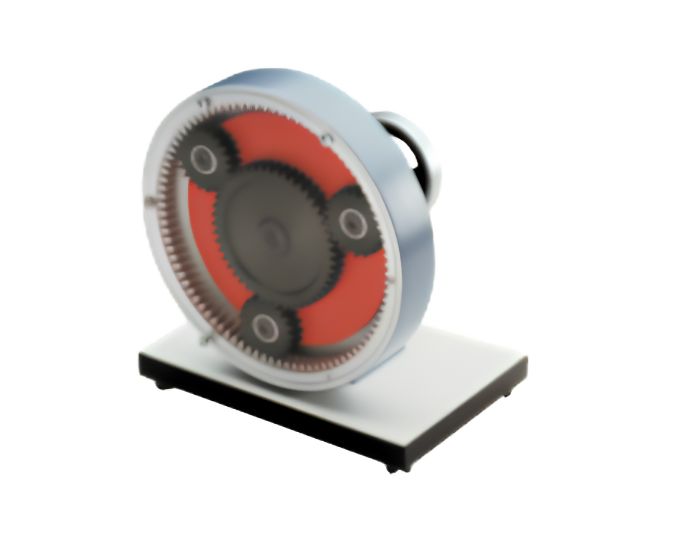
The Dynamic Behavior of Planetary Gear Apparatus is a laboratory teaching system developed for detailed experimental study of planetary or epicyclic gear systems.
Planetary gear trains are compact mechanical transmission arrangements consisting of interconnected gears whose relative motion enables a wide range of speed and torque relationships.
The apparatus provides a clearly visible planetary gear arrangement that enables students to observe the interaction of the individual gear components during practical experiments.
One of the primary experiments is the determination of transmission ratio for a locked gear configuration. By fixing an appropriate member and operating the remaining gear arrangement, students can investigate the resulting input-to-output speed relationship.
The apparatus also enables the measurement of forces acting on a locked gear. This provides practical understanding of load transmission and reaction forces within a planetary gear system.
Another important experiment involves studying gear acceleration under constant driving torque. Students can observe the dynamic response of the rotating system when a controlled torque is applied.
The influence of transmission ratio on the dynamic behaviour of the gear system can also be investigated. Different operating conditions allow students to understand how transmission relationships affect rotational speed, torque, and acceleration.
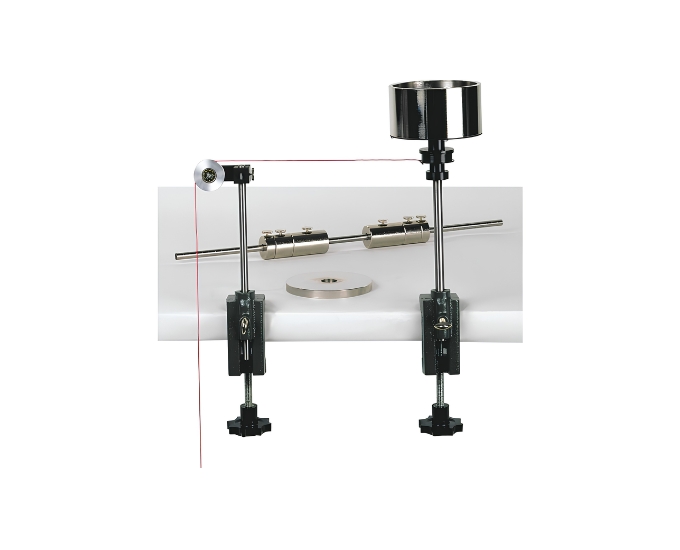
The apparatus enables determination of the reduced mass moment of inertia of the rotating system. This helps students understand how the inertia of multiple rotating components can be represented relative to a selected shaft or system coordinate.
Energy behaviour can also be investigated through the conversion of potential energy into kinetic energy. This experiment provides a practical demonstration of energy transformation within a mechanical transmission system.
The setup can be used to determine frictional effects within the gear mechanism. Comparing available and transmitted energy provides insight into mechanical losses caused by gear contact, bearings, and other moving components.
Students can subsequently determine gear efficiency, allowing theoretical mechanical transmission concepts to be compared with experimental performance.
The apparatus provides practical understanding of planetary gearing, transmission ratio, torque, acceleration, rotational inertia, energy conversion, friction, and mechanical efficiency.
Micro Technologies supplies Dynamic Behavior of Planetary Gear Apparatus and other Theory of Machines and Dynamics of Machines laboratory equipment for engineering colleges, universities, polytechnic institutes, ITIs, and technical training centres.
Features
- Educational planetary gear dynamics apparatus
- Clearly visible planetary gear arrangement
- Suitable for locked-gear experiments
- Transmission-ratio determination
- Force measurement on locked gear
- Constant driving torque experiments
- Gear acceleration investigation
- Transmission-ratio influence studies
- Reduced mass moment of inertia determination
- Potential-to-kinetic energy conversion study
- Friction determination
- Gear-efficiency determination
- Suitable for rotational dynamics studies
- Compact laboratory configuration
- Robust construction for institutional use
Benefits
- Provides practical understanding of planetary gear systems
- Combines kinematic and dynamic gear experiments
- Enables experimental transmission-ratio determination
- Helps students understand forces within a gear train
- Demonstrates acceleration under applied torque
- Enables investigation of equivalent rotational inertia
- Provides practical energy-conversion experiments
- Helps quantify frictional losses
- Enables experimental gear-efficiency determination
- Connects theoretical gear dynamics with practical measurements
Product Specifications
| Specification | Details |
|---|---|
| Product Name | Dynamic Behavior of Planetary Gear Apparatus |
| Product Type | Gear Dynamics Laboratory Apparatus |
| Gear System | Planetary / Epicyclic Gear Train |
| Primary Study | Dynamic Behavior of Planetary Gearing |
| Transmission Ratio | Determination Supported |
| Locked Gear Study | Supported |
| Locked Gear Force Measurement | Supported |
| Driving Condition | Constant Torque Study |
| Gear Acceleration Study | Supported |
| Mass Moment of Inertia | Reduced Inertia Determination |
| Energy Conversion | Potential to Kinetic Energy |
| Friction Study | Supported |
| Gear Efficiency | Determination Supported |
| Motion Type | Rotational |
| Application | Theory & Dynamics of Machines Laboratory |
Experiments Performed
- Determination of transmission ratio for a locked gear
- Measurement of forces acting on a locked gear
- Investigation of planetary gear motion
- Study of gear acceleration under constant driving torque
- Investigation of the influence of transmission ratio
- Determination of reduced mass moment of inertia
- Study of rotational inertia of the gear system
- Conversion of potential energy into kinetic energy
- Investigation of energy transfer through the gear train
- Determination of friction
- Investigation of mechanical losses
- Determination of gear efficiency
- Study of torque transmission
- Study of dynamic response of planetary gears
- Comparison of theoretical and experimental gear behaviour
Applications
- Dynamics of Machines Laboratories
- Theory of Machines Laboratories
- Kinematics of Machines Laboratories
- Mechanical Engineering Laboratories
- Automobile Engineering Laboratories
- Machine Design Laboratories
- Mechanical Transmission Laboratories
- Mechatronics Laboratories
- Automotive Engineering Laboratories
- Engineering Colleges
- Universities
- Polytechnic Institutes
- ITIs
- Technical Training Centres
- Research & Educational Laboratories
FAQs
What is the Dynamic Behavior of Planetary Gear Apparatus used for?
The apparatus is used to investigate planetary gear dynamics, including transmission ratios, gear forces, acceleration, rotational inertia, energy conversion, friction, and efficiency.
What is a planetary gear system?
A planetary or epicyclic gear system is a gear arrangement in which multiple gears interact while one or more gear axes may move relative to another gear axis.
Can the transmission ratio be determined experimentally?
Yes. The apparatus enables determination of the transmission ratio under suitable configurations, including a locked-gear arrangement.
Can forces on a locked gear be measured?
Yes. Measurement of forces acting on a locked gear is one of the experimental objectives of the apparatus.
Can gear acceleration be studied?
Yes. Gear acceleration can be investigated under a constant driving torque to study the dynamic response of the system.
Can the effect of transmission ratio be investigated?
Yes. Students can investigate how the transmission ratio influences the dynamic characteristics of the planetary gear arrangement.
Can mass moment of inertia be determined?
Yes. The apparatus enables determination of the reduced mass moment of inertia of the rotating system.
Can energy conversion be demonstrated?
Yes. The apparatus can be used to investigate the conversion of potential energy into rotational kinetic energy.
Can friction be determined?
Yes. Experimental measurements can be used to evaluate friction and associated mechanical losses within the system.
Can gear efficiency be calculated?
Yes. The apparatus supports experimental determination of gear efficiency by analyzing input and useful transmitted energy or power under the specified experimental arrangement.
Is this suitable for Dynamics of Machines laboratories?
Yes. It is particularly suitable for Dynamics of Machines, Theory of Machines, Mechanical Engineering, Automobile Engineering, and related laboratory courses.
Why Choose Our Products
- Comprehensive planetary gear dynamics study
- Transmission-ratio experiments
- Locked-gear force measurement
- Constant-torque acceleration studies
- Reduced moment-of-inertia determination
- Potential and kinetic energy investigation
- Friction and mechanical-loss analysis
- Gear-efficiency determination
- Clear gear mechanism visualization
- Suitable for advanced engineering education
- Customized configurations available
- Institutional and bulk supply support
Call to Action
Looking for a Dynamic Behavior of Planetary Gear Apparatus for your engineering laboratory? Micro Technologies supplies planetary gear trainers, gear dynamics apparatus, Theory of Machines equipment, and Dynamics of Machines laboratory systems for universities, engineering colleges, polytechnic institutes, ITIs, and technical training centres. Contact us for technical specifications, customized configurations, institutional orders, bulk supply, distributor inquiries, government tenders, or a competitive quotation.