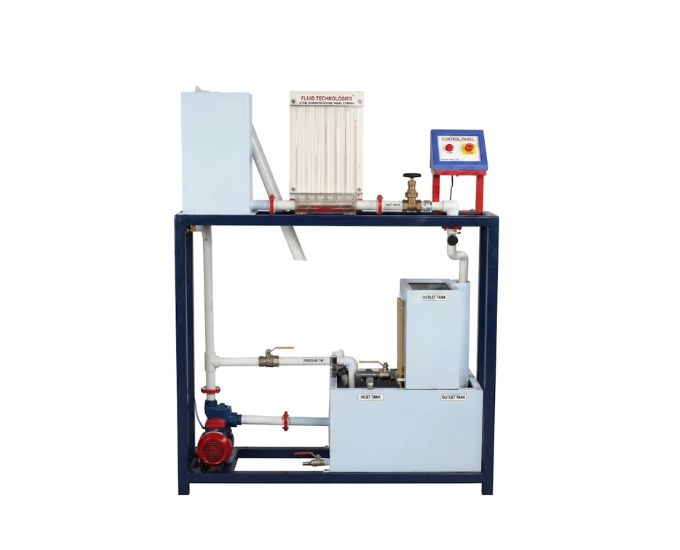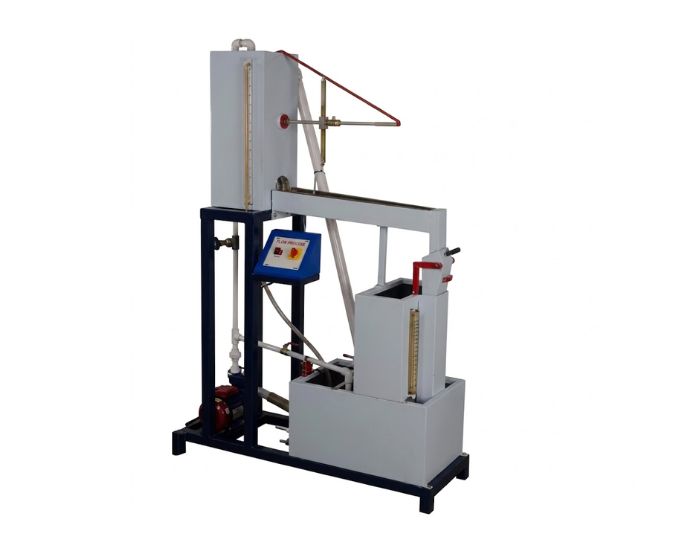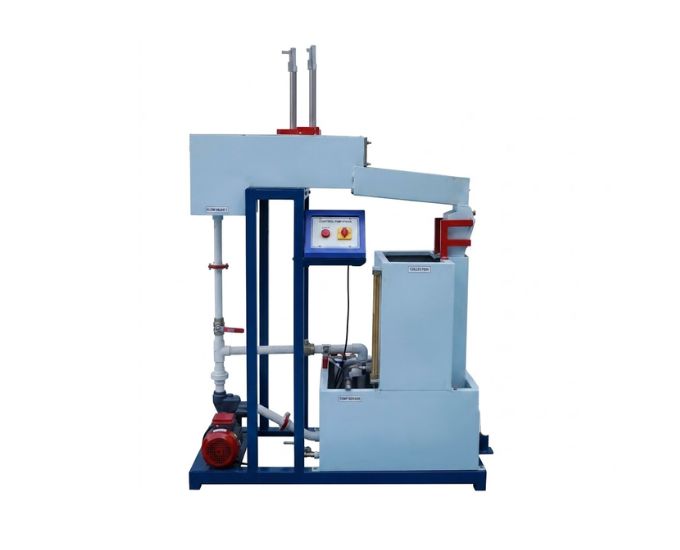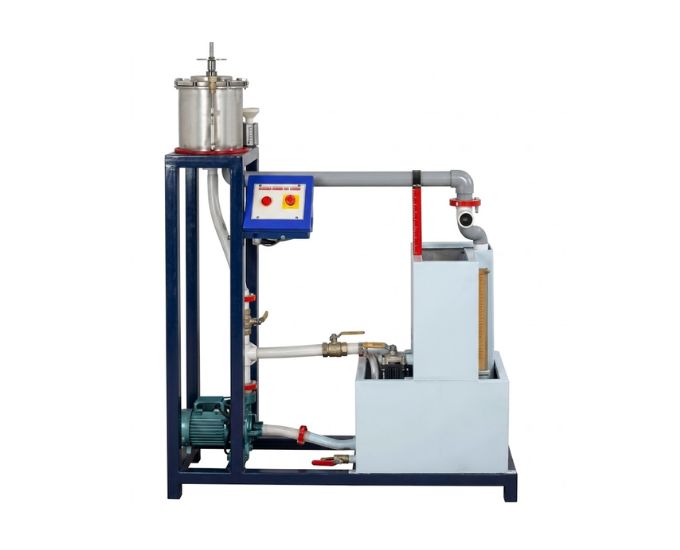

Characteristics of Nozzle Apparatus
Product Specification Sheet
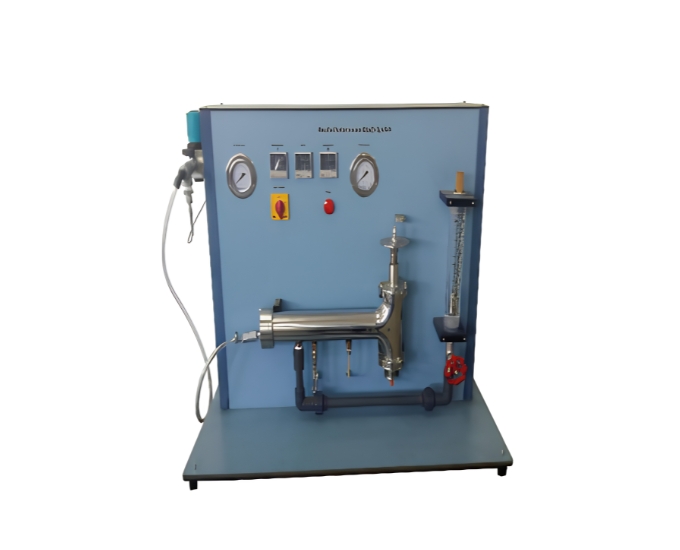
Characteristics of Nozzle Apparatus
Model Number: MTFM-132
The Characteristics of Nozzle Apparatus is an engineering laboratory setup designed for the experimental study of fluid flow through a nozzle. The apparatus enables students to determine the critical pressure ratio, demonstrate the choking effect, determine flow velocity at the narrowest cross-section, measure the reaction or action force produced by the flowing fluid, and determine nozzle efficiency using thrust measurements. It provides a practical platform for understanding nozzle flow and compressible fluid-flow principles.
Product Specification
The Characteristics of Nozzle Apparatus is an educational engineering laboratory system designed to investigate the operating characteristics and performance of a nozzle under different pressure and flow conditions.
The apparatus enables students to study how pressure changes influence the flow of fluid through a nozzle. By varying operating conditions and recording the corresponding measurements, important nozzle characteristics can be experimentally determined and compared with theoretical relationships.
One of the primary experiments performed with the apparatus is the determination of the critical pressure ratio. Students can investigate the relationship between upstream and downstream pressure and identify the conditions under which the flow reaches its limiting state.
The setup also provides a clear demonstration of the choking effect. Choked flow occurs when the mass flow rate through the nozzle reaches a maximum value for the given upstream conditions and further reduction in downstream pressure does not produce a corresponding increase in mass flow rate.
Another important experiment is the determination of flow velocity at the narrowest cross-section of the nozzle. Measurements obtained during operation can be used to evaluate fluid velocity and understand how changes in cross-sectional area influence nozzle flow behaviour.
The apparatus also enables measurement of the reaction or action force of the flowing fluid. This experiment demonstrates the relationship between fluid momentum and the force generated by fluid discharge through a nozzle.
Nozzle efficiency can be experimentally determined using thrust measurements. By comparing measured performance with theoretical values, students can evaluate nozzle efficiency and gain practical understanding of energy conversion within a nozzle.
The apparatus is particularly useful for studying critical pressure ratio, choked flow, nozzle velocity, fluid momentum, thrust, reaction force, pressure variation, and nozzle efficiency.
Micro Technologies supplies Characteristics of Nozzle Apparatus for engineering colleges, universities, polytechnic institutes, technical training centres, and research laboratories requiring practical fluid mechanics, thermodynamics, and compressible-flow laboratory equipment.
Features
- Designed for studying nozzle characteristics
- Enables determination of critical pressure ratio
- Demonstrates the choking effect
- Suitable for choked-flow experiments
- Determines velocity at the narrowest nozzle section
- Enables measurement of reaction or action force
- Suitable for thrust measurement
- Enables determination of nozzle efficiency
- Pressure measurement arrangement
- Flow measurement arrangement
- Suitable for multiple operating conditions
- Robust educational laboratory construction
Benefits
- Provides practical understanding of nozzle flow
- Demonstrates critical pressure conditions experimentally
- Clearly explains the phenomenon of choking
- Helps students understand flow acceleration through a nozzle
- Demonstrates the relationship between fluid momentum and force
- Enables experimental thrust measurement
- Allows nozzle efficiency to be determined
- Connects theoretical compressible-flow concepts with practical observations
- Suitable for repeated engineering laboratory experiments
Product Specifications
| Specification | Details |
|---|---|
| Product Name | Characteristics of Nozzle Apparatus |
| Product Type | Fluid Flow / Engineering Laboratory Apparatus |
| Primary Study | Characteristics of Nozzle |
| Pressure Study | Critical Pressure Ratio |
| Flow Phenomenon | Choking Effect |
| Velocity Study | Flow Velocity at Narrowest Cross-Section |
| Force Measurement | Reaction / Action Force |
| Performance Measurement | Nozzle Efficiency |
| Efficiency Method | Thrust Measurement |
| Pressure Measurement | Pressure Gauge Arrangement |
| Flow Measurement | Flow Measuring Arrangement |
| Flow Conditions | Adjustable |
| Application | Fluid Mechanics & Compressible Flow Laboratory |
| Suitable For | Engineering Colleges, Universities, Polytechnics & Technical Institutes |
Experiments Performed
- Determination of critical pressure ratio
- Demonstration of choking effect
- Study of choked flow through a nozzle
- Determination of flow velocity at the narrowest cross-section
- Measurement of reaction force of flowing fluid
- Measurement of action force produced by fluid flow
- Measurement of nozzle thrust
- Determination of nozzle efficiency using thrust
- Study of pressure variation through a nozzle
- Investigation of nozzle performance at different operating conditions
Applications
- Fluid Mechanics Laboratories
- Compressible Flow Laboratories
- Mechanical Engineering Laboratories
- Thermodynamics Laboratories
- Thermal Engineering Laboratories
- Engineering Colleges
- Universities
- Polytechnic Institutes
- Technical Training Centres
- Research and Educational Laboratories
FAQs
What is the Characteristics of Nozzle Apparatus used for?
The apparatus is used to study nozzle flow characteristics, including critical pressure ratio, choking effect, flow velocity, reaction force, thrust, and nozzle efficiency.
What is the critical pressure ratio in a nozzle?
The critical pressure ratio is associated with the pressure condition at which the flow through a nozzle reaches the critical or choked state.
What is the choking effect?
Choking occurs when the flow reaches a limiting condition at the minimum-area section of the nozzle, restricting further increase in mass flow rate for fixed upstream conditions despite additional reduction in downstream pressure.
Can the choking effect be demonstrated experimentally?
Yes. One of the primary functions of the apparatus is to experimentally demonstrate choking by observing nozzle behaviour at different pressure conditions.
Can flow velocity be determined using this apparatus?
Yes. The apparatus enables determination of flow velocity at the narrowest cross-section of the nozzle.
Can reaction force be measured?
Yes. The reaction or action force produced by the flowing fluid can be measured to investigate the momentum effects associated with nozzle discharge.
Can nozzle thrust be measured?
Yes. The apparatus provides an arrangement for studying thrust generated by the flowing fluid.
Can nozzle efficiency be determined?
Yes. Experimental thrust measurements can be used to determine and evaluate nozzle efficiency.
Is this apparatus suitable for engineering colleges?
Yes. It is suitable for mechanical engineering, fluid mechanics, thermodynamics, thermal engineering, and compressible-flow laboratory courses.
Can the apparatus be customized?
Yes. The nozzle configuration, pressure measurement arrangement, flow measurement system, and other components can be configured according to institutional laboratory requirements.
Why Choose Our Products
- Multiple nozzle experiments in one setup
- Suitable for critical pressure and choking studies
- Practical thrust and reaction-force measurement
- Suitable for nozzle efficiency determination
- Student-friendly experimental configuration
- Durable construction for regular laboratory use
- Customized configurations available
- Institutional and bulk supply support
Call to Action
Looking for a reliable Characteristics of Nozzle Apparatus for your engineering laboratory? Micro Technologies supplies fluid mechanics and compressible-flow laboratory equipment for universities, engineering colleges, polytechnic institutes, technical training centres, and research facilities. Contact us for technical requirements, customized configurations, institutional orders, bulk supply, distributor inquiries, government tenders, or a competitive quotation.