
Cavitation Demonstrator
Product Specification Sheet
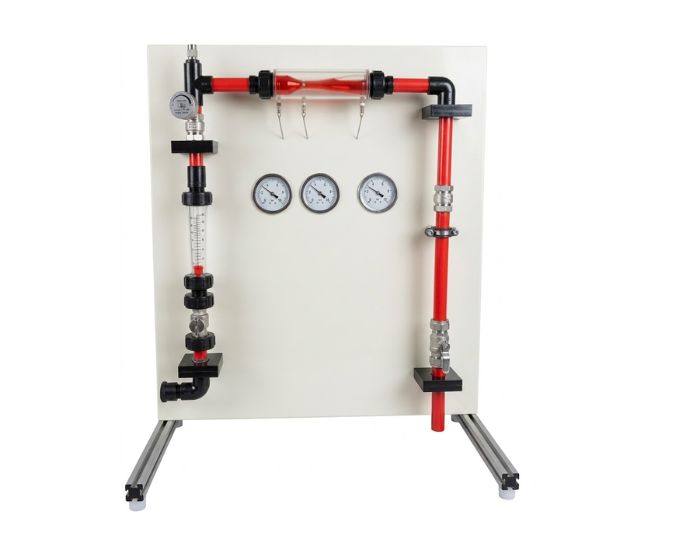
Cavitation Demonstrator
Model Number: MTHB-150.23
The Cavitation Demonstrator is an educational fluid mechanics laboratory apparatus designed for the visualization of vapor bubble formation in a Venturi nozzle and determination of the cavitation number. The system enables students to observe how a reduction in local static pressure can lead to cavitation and to investigate the relationship between flow velocity, pressure, vapor pressure, and cavitation behaviour.
Product Specification
The Cavitation Demonstrator is a practical educational laboratory apparatus developed for studying the formation and behaviour of cavitation in flowing liquids.
Manufactured by Micro Technologies, the apparatus provides students with a clear visual demonstration of vapor bubble formation in a Venturi nozzle while allowing important pressure and flow parameters associated with cavitation to be investigated experimentally.
Cavitation occurs when the local static pressure of a flowing liquid falls sufficiently close to or below its vapor pressure. Under these conditions, small vapor-filled cavities or bubbles can form within the liquid.
The apparatus incorporates a specially designed Venturi test section through which water flows. As water approaches the restricted throat section, its velocity increases and static pressure decreases.
Under suitable operating conditions, the pressure near the Venturi throat becomes low enough for vapor bubbles to form. The transparent observation section allows students to directly observe the onset and development of cavitation.
As the fluid moves away from the low-pressure region and enters a region of pressure recovery, the vapor bubbles can collapse. This behaviour provides students with a practical demonstration of why cavitation can cause noise, vibration, surface erosion, and performance deterioration in hydraulic equipment.
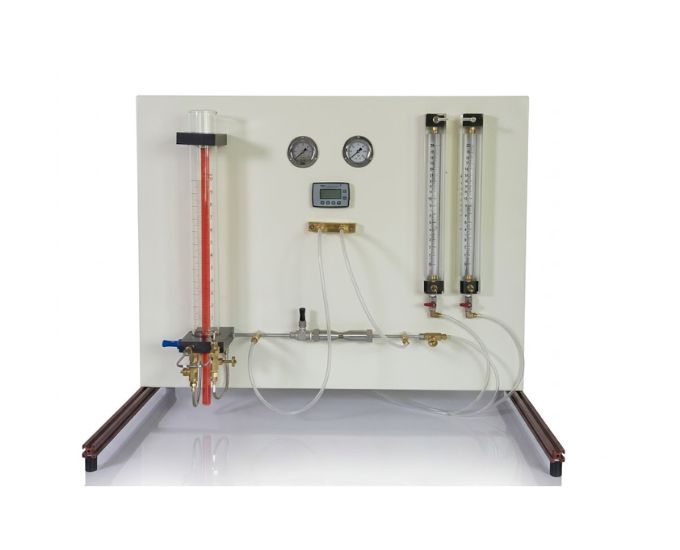
Pressure measuring instruments are provided at suitable locations to observe pressure conditions within the experimental circuit. By varying the flow conditions and recording the corresponding measurements, students can investigate the onset of cavitation and determine the cavitation number.
The apparatus is especially useful for explaining cavitation in pumps, hydraulic turbines, valves, propellers, nozzles, and other fluid systems where local pressure may fall significantly during operation.
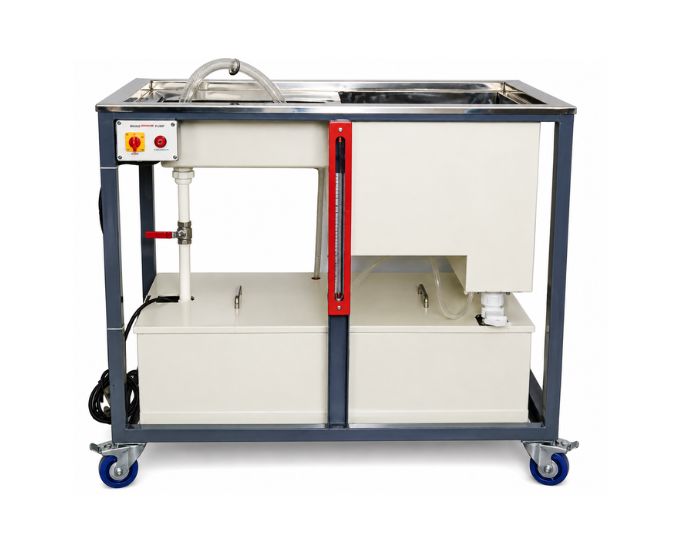
Its compact vertical panel design, visible piping arrangement, pressure gauges, and transparent test section make it suitable for engineering laboratory practicals, demonstrations, and technical training.
Features
- Visual demonstration of cavitation
- Venturi nozzle experimental section
- Visible vapor bubble formation
- Transparent observation section
- Cavitation onset investigation
- Cavitation number determination
- Multiple pressure measurement points
- Pressure gauge arrangement
- Adjustable water-flow conditions
- Flow-control valves
- Demonstrates pressure reduction at Venturi throat
- Pressure recovery observation
- Suitable for theoretical and experimental studies
- Clearly arranged hydraulic circuit
- Compact laboratory panel
- Robust educational construction
- Suitable for repeated student experiments
Benefits
- Provides direct visualization of cavitation
- Demonstrates vapor bubble formation in flowing water
- Helps students understand the relationship between pressure and velocity
- Enables cavitation number to be determined
- Demonstrates low-pressure conditions in a Venturi
- Provides practical understanding of cavitation onset
- Helps explain bubble collapse and associated effects
- Connects theoretical fluid mechanics with real hydraulic phenomena
- Useful for hydraulic machinery education
- Suitable for demonstrations and practical examinations
Product Specifications
| Specification | Details |
|---|---|
| Product Name | Cavitation Demonstrator |
| Product Type | Fluid Mechanics Experimental Apparatus |
| Experimental Study | Cavitation |
| Working Medium | Water |
| Test Section | Venturi Nozzle |
| Observation | Vapor Bubble Formation |
| Test Section Visibility | Transparent / Visible Section |
| Pressure Measurement | Pressure Gauge Arrangement |
| Flow Control | Adjustable |
| Primary Parameter | Cavitation Number |
| Phenomenon Studied | Pressure-Induced Vapor Bubble Formation |
| Experimental Conditions | Variable Water Flow |
| Hydraulic Circuit | Integrated Piping Arrangement |
| Mounting | Laboratory Panel / Frame |
| Operation | Educational / Experimental |
| Application | Fluid Mechanics & Hydraulic Machinery Laboratories |
Main Components
The apparatus typically incorporates:
- Venturi nozzle test section
- Transparent cavitation observation section
- Water inlet piping
- Water outlet piping
- Flow-control valves
- Pressure gauges
- Pressure tapping points
- Flow regulation arrangement
- Hydraulic connections
- Supporting panel
- Rigid laboratory frame
Experiments Performed
- Visualize vapor bubble formation in a Venturi nozzle
- Demonstrate the cavitation phenomenon
- Determine the cavitation number
- Observe the onset of cavitation
- Study pressure variation through a Venturi nozzle
- Investigate pressure reduction at the Venturi throat
- Observe the effect of increasing fluid velocity
- Study vapor bubble behaviour under changing flow conditions
- Investigate pressure recovery downstream of the throat
- Relate local static pressure to cavitation formation
- Study the influence of flow conditions on cavitation
- Compare cavitating and non-cavitating operating conditions
Parameters Studied
The apparatus can be used to investigate:
- Fluid velocity
- Static pressure
- Pressure difference
- Venturi throat pressure
- Vapor pressure
- Flow rate
- Cavitation onset
- Vapor bubble formation
- Cavitation number
- Pressure recovery
- Flow conditions
Cavitation Phenomenon
Cavitation can occur when the local pressure of a flowing liquid decreases sufficiently to approach its vapor pressure.
Inside the Venturi section:
- Water enters the converging passage.
- Flow area decreases.
- Fluid velocity increases.
- Static pressure decreases.
- Low pressure develops near the throat.
- Vapor bubbles may begin to form.
- Downstream pressure subsequently recovers.
- Vapor bubbles may collapse as pressure rises.
This makes the Venturi arrangement an effective method for visually demonstrating cavitation under controlled laboratory conditions.
Cavitation Number
The cavitation number is a dimensionless parameter used to characterize the tendency of a flowing liquid to cavitate.
A commonly used form is:
σ = (P − Pv) / (½ρV²)
Where:
- σ = Cavitation number
- P = Relevant local or reference pressure
- Pv = Vapor pressure of the liquid
- ρ = Fluid density
- V = Reference flow velocity
Experimental pressure and flow measurements can be used to investigate the cavitation number under different operating conditions.
Effects of Cavitation
Cavitation is important in engineering because repeated formation and collapse of vapor bubbles may contribute to:
- Surface erosion
- Pitting of components
- Excessive noise
- Mechanical vibration
- Reduced hydraulic performance
- Unstable flow
- Reduced pump or turbine efficiency
- Damage to hydraulic components
The demonstrator helps students understand why cavitation must be considered during hydraulic system and machinery design.
Educational Objectives
The apparatus helps students understand:
- Cavitation
- Vapor pressure
- Vapor bubble formation
- Bubble collapse
- Venturi flow
- Static pressure
- Pressure reduction
- Pressure recovery
- Fluid velocity
- Cavitation number
- Hydraulic system performance
- Cavitation effects on hydraulic machinery
Engineering Applications
Cavitation principles are particularly relevant to:
- Centrifugal pumps
- Hydraulic turbines
- Marine propellers
- Control valves
- Venturi systems
- Nozzles
- High-velocity piping
- Hydroelectric equipment
- Process piping systems
- Water distribution systems
- Hydraulic machinery
Applications
- Fluid Mechanics Laboratories
- Hydraulic Engineering Laboratories
- Hydraulic Machinery Laboratories
- Mechanical Engineering Laboratories
- Civil Engineering Laboratories
- Chemical Engineering Laboratories
- Process Engineering Laboratories
- Water Resources Engineering Laboratories
- Engineering Colleges
- Universities
- Polytechnic Institutes
- Technical Training Centres
- Research Laboratories
FAQs
What is a Cavitation Demonstrator?
A Cavitation Demonstrator is a fluid mechanics laboratory apparatus used to visually demonstrate vapor bubble formation caused by low-pressure conditions in flowing liquid.
What is the main objective of the apparatus?
The main objective is the visualization of vapor bubble formation in a Venturi nozzle and determination of the cavitation number.
What is cavitation?
Cavitation is the formation of vapor-filled cavities or bubbles in a liquid when local pressure falls sufficiently close to or below the liquid's vapor pressure.
Why is a Venturi nozzle used?
A Venturi creates a region of increased fluid velocity and reduced static pressure near its throat, making it suitable for demonstrating cavitation under controlled conditions.
Can vapor bubbles be observed directly?
Yes. The apparatus incorporates a suitable visible test section so that cavitation and vapor bubble formation can be observed during the experiment.
Can the cavitation number be determined?
Yes. Appropriate pressure and flow measurements can be used to calculate and investigate the cavitation number.
Why do cavitation bubbles collapse?
When the bubbles move from a low-pressure region into a region where pressure increases above the vapor pressure, the vapor cavities can collapse.
Why is cavitation harmful to hydraulic machinery?
Repeated bubble collapse near solid surfaces can contribute to erosion, pitting, noise, vibration, and reduced equipment performance.
Where does cavitation commonly occur?
Cavitation can occur in pumps, turbines, propellers, valves, nozzles, and other hydraulic systems where local fluid pressure becomes sufficiently low.
Is this apparatus suitable for engineering colleges?
Yes. It is suitable for fluid mechanics, mechanical, civil, hydraulic, chemical, process, and hydraulic machinery laboratories.
Why Choose Our Products
- Clear visualization of cavitation
- Venturi nozzle experimental arrangement
- Cavitation number determination
- Pressure and flow studies
- Visible vapor bubble formation
- Practical hydraulic phenomenon demonstration
- Compact educational configuration
- Robust laboratory construction
- Suitable for repeated student practicals
- Institutional and bulk laboratory supply
- Customized configurations available
- Technical and project support
Call to Action
Looking for a reliable Cavitation Demonstrator for your fluid mechanics laboratory? Micro Technologies manufactures and supplies fluid mechanics, hydraulic machinery, and hydraulic engineering laboratory equipment for universities, engineering colleges, polytechnics, research institutes, and technical training centres. Contact us for complete laboratory setups, customized configurations, institutional projects, bulk requirements, distributor inquiries, or a competitive quotation.