
Calibration of Rotameter Apparatus
Product Specification Sheet
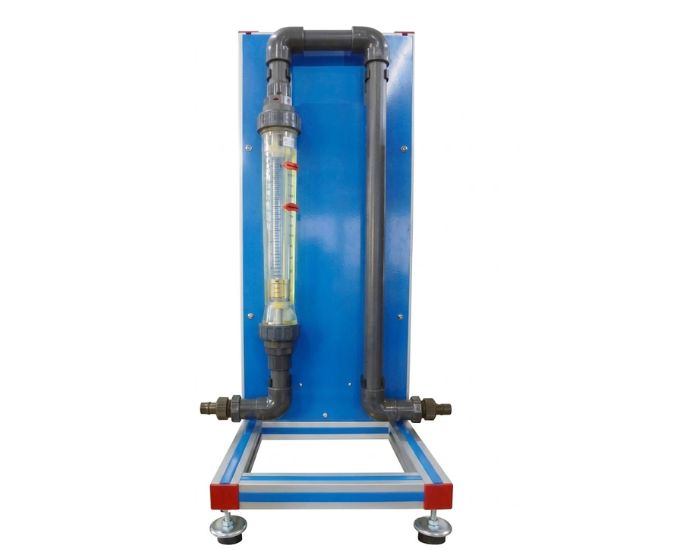
Calibration of Rotameter Apparatus
Model Number: MTHB-150.26
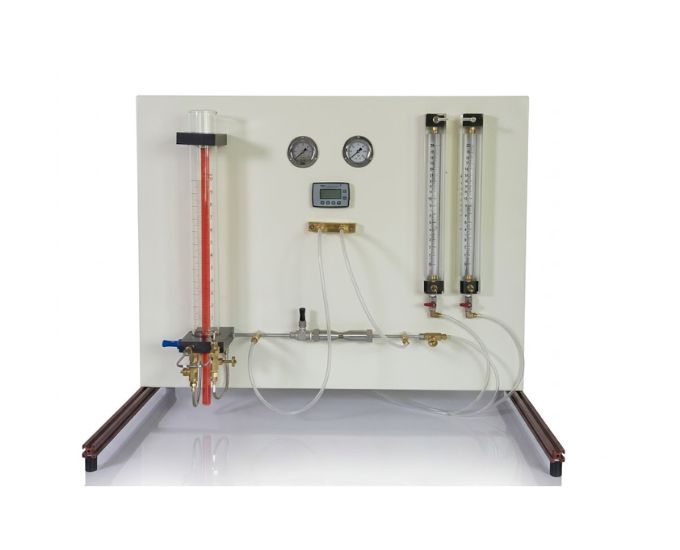
The Calibration of Rotameter Apparatus is an educational fluid mechanics laboratory system designed for the demonstration of flow measurement and use of a rotameter for calibration. It allows students to observe variable-area flow measurement, determine actual water flow rates, compare them with rotameter readings, and develop a calibration relationship for the instrument.
Product Specification
The Calibration of Rotameter Apparatus is a practical educational laboratory system developed to demonstrate the operation, use, and calibration of a rotameter for measuring fluid flow rate.
Manufactured by Micro Technologies, the apparatus provides students with hands-on experience in one of the commonly used methods of variable-area flow measurement.
A rotameter consists primarily of a vertically mounted tapered tube containing a freely moving float. Fluid enters from the lower section of the tube and flows upward around the float.
As the flow rate increases, the upward forces acting on the float cause it to rise within the tapered tube. As the tube becomes wider toward the top, the available annular flow area around the float increases until an equilibrium position is reached.
The position of the float therefore provides an indication of the fluid flow rate.
The apparatus allows students to compare the indicated rotameter reading with an independently determined actual flow rate. By taking readings at several operating points, a rotameter calibration curve can be prepared.
This experimental procedure helps students understand instrument calibration, flow measurement accuracy, indicated versus actual flow rate, and the practical use of variable-area flowmeters.
The flow rate can be varied using a suitable control valve, enabling multiple readings to be obtained over the operating range of the apparatus.
Students can record the rotameter indication and corresponding reference flow measurement at each condition. These observations can then be plotted to determine the calibration characteristics of the instrument.
The compact vertical arrangement makes the equipment suitable for fluid mechanics, hydraulic engineering, instrumentation, mechanical engineering, and process engineering laboratories.
Features
- Demonstration of flow measurement
- Rotameter calibration experiment
- Variable-area flow measurement
- Vertically mounted rotameter
- Clearly visible float movement
- Graduated flow indication
- Adjustable water flow
- Flow-control arrangement
- Reference flow measurement facility
- Multiple calibration points
- Calibration curve preparation
- Comparison of indicated and actual flow rate
- Simple experimental operation
- Compact vertical configuration
- Robust laboratory construction
- Suitable for repeated student practicals
Benefits
- Provides practical understanding of rotameter operation
- Demonstrates variable-area flow measurement
- Enables experimental calibration of a rotameter
- Allows indicated and actual flow rates to be compared
- Helps students understand calibration curves
- Provides hands-on flow measurement experience
- Demonstrates the importance of instrument calibration
- Supports theoretical and experimental analysis
- Useful for instrumentation and fluid mechanics training
- Suitable for practical examinations and demonstrations
Product Specifications
| Specification | Details |
|---|---|
| Product Name | Calibration of Rotameter Apparatus |
| Product Type | Flow Measurement & Calibration Apparatus |
| Measuring Instrument | Rotameter |
| Flowmeter Type | Variable Area Flowmeter |
| Working Medium | Water |
| Installation | Vertical |
| Primary Study | Flow Measurement |
| Main Experiment | Rotameter Calibration |
| Flow Regulation | Adjustable |
| Indication | Float Position / Graduated Scale |
| Reference Measurement | Suitable Actual Flow Measurement Arrangement |
| Experimental Output | Calibration Data / Calibration Curve |
| Parameters Studied | Flow Rate, Indicated Flow & Actual Flow |
| Operation | Educational / Experimental |
| Application | Fluid Mechanics & Hydraulic Engineering Laboratories |
Main Components
The apparatus typically incorporates:
- Rotameter
- Transparent tapered measuring tube
- Float
- Graduated measuring scale
- Water inlet connection
- Water outlet connection
- Flow-control valve
- Reference flow measurement arrangement
- Hydraulic connecting pipes
- Supporting frame
- Laboratory mounting structure
Experiments Performed
- Demonstrate fluid flow measurement
- Study the operation of a rotameter
- Calibrate a rotameter
- Measure flow rate using a rotameter
- Determine actual water flow rate
- Compare indicated and actual flow rates
- Obtain readings at different flow conditions
- Prepare a rotameter calibration curve
- Determine the relationship between float position and flow rate
- Study variable-area flow measurement
- Investigate instrument measurement characteristics
- Evaluate calibration behaviour over the operating range
Parameters Studied
The apparatus can be used to investigate:
- Water flow rate
- Rotameter indication
- Actual flow rate
- Float position
- Flow area
- Calibration reading
- Measurement variation
- Flowmeter response
- Calibration characteristics
Rotameter Principle
A rotameter operates on the variable-area flow measurement principle.
Water flows upward through a vertically mounted tapered tube containing a float. As the flow increases, the float rises until the forces acting on it reach equilibrium.
Because the tube cross-sectional area increases with height, the annular area available for flow around the float also increases as the float rises.
The resulting float position corresponds to a particular flow rate and can be read from the graduated scale.
Rotameter Calibration
Calibration involves comparing the reading indicated by the rotameter with a reference measurement of the actual flow rate.
A typical experimental procedure includes:
- Establish water flow through the rotameter.
- Adjust the flow using the control valve.
- Record the rotameter reading.
- Determine the corresponding actual flow rate.
- Repeat the procedure at several flow settings.
- Compare indicated and actual flow values.
- Plot a calibration curve.
This allows students to understand how calibration improves confidence in flow measurement.
Calibration Curve
Experimental observations can be plotted as:
Actual Flow Rate vs. Rotameter Reading
The resulting graph can be used to evaluate the calibration characteristics of the flowmeter across its experimental operating range.
Educational Objectives
The apparatus helps students understand:
- Rotameter operation
- Variable-area flowmeters
- Fluid flow measurement
- Flowmeter calibration
- Float equilibrium
- Flow-rate indication
- Actual versus indicated flow
- Calibration curves
- Measurement accuracy
- Flow-control techniques
- Practical instrumentation
- Experimental data analysis
Engineering Applications
Rotameter measurement principles are relevant to:
- Water treatment systems
- Chemical processing
- Process plants
- Laboratory fluid systems
- Cooling-water circuits
- Industrial water systems
- Pilot plants
- Research installations
- Process instrumentation
- Flow monitoring systems
- Hydraulic experiments
Applications
- Fluid Mechanics Laboratories
- Hydraulic Engineering Laboratories
- Mechanical Engineering Laboratories
- Civil Engineering Laboratories
- Chemical Engineering Laboratories
- Process Engineering Laboratories
- Instrumentation Laboratories
- Engineering Colleges
- Universities
- Polytechnic Institutes
- Technical Training Centres
- Research Laboratories
FAQs
What is a Calibration of Rotameter Apparatus?
It is an educational laboratory apparatus used to demonstrate fluid flow measurement and experimentally calibrate a rotameter against a reference flow measurement.
What is the main objective of the apparatus?
The main objective is the demonstration of flow measurement and use of a rotameter for calibration.
What is a rotameter?
A rotameter is a variable-area flowmeter that typically uses the position of a float inside a vertically mounted tapered tube to indicate fluid flow rate.
Why is a rotameter mounted vertically?
Vertical mounting allows the float to respond properly to the balance of gravitational, buoyancy, and fluid forces on which conventional rotameter operation depends.
How is a rotameter calibrated?
The rotameter reading is compared with an independently determined reference flow rate at several operating points. These values can then be used to develop a calibration curve.
Can a calibration curve be plotted?
Yes. Rotameter readings and corresponding actual flow measurements can be plotted to obtain an experimental calibration curve.
What happens to the float when flow rate increases?
As the flow rate increases, the float generally rises to a higher equilibrium position within the tapered tube.
What parameters can students study?
Students can study rotameter indication, actual flow rate, float position, calibration characteristics, and the relationship between indicated and reference flow.
Where are rotameters commonly used?
Rotameters are used in laboratories, process plants, water systems, chemical processing, pilot plants, and various industrial flow-monitoring applications.
Is this apparatus suitable for engineering colleges?
Yes. It is suitable for fluid mechanics, mechanical, civil, hydraulic, chemical, process, and instrumentation engineering laboratories.
Why Choose Our Products
- Practical rotameter calibration
- Variable-area flow measurement study
- Clearly visible float movement
- Adjustable flow conditions
- Calibration curve determination
- Actual and indicated flow comparison
- Simple educational operation
- Robust laboratory construction
- Suitable for repeated student experiments
- Institutional and bulk laboratory supply
- Customized configurations available
- Technical and project support
Call to Action
Looking for a reliable Rotameter Calibration Apparatus for your laboratory? Micro Technologies manufactures and supplies flow measurement, fluid mechanics, and hydraulic engineering laboratory equipment for universities, engineering colleges, polytechnics, research institutes, and technical training centres. Contact us for complete laboratory setups, customized configurations, institutional projects, bulk requirements, distributor inquiries, or a competitive quotation.