
Product Description
Burette: A Precision Instrument for Laboratory Titration
A burette is a vital piece of laboratory glassware used to accurately measure and dispense liquids in scientific experiments. It is commonly used in chemistry, pharmaceutical, environmental, and research laboratories for titration and other analytical procedures. The burette allows laboratory professionals to release controlled amounts of liquid with high precision, making it essential for experiments where exact measurements are required.
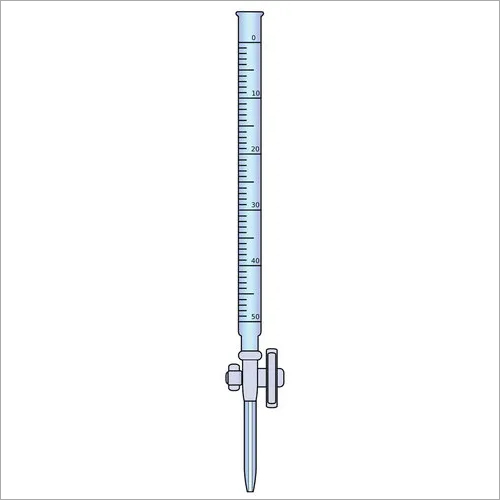
A burette typically consists of a long, transparent tube with graduation marks along its length and a stopcock valve at the bottom to control the flow of liquid. It is mounted vertically on a stand during experiments so that liquids can be released drop by drop into a flask or beaker.
What is a Burette?
A burette is a cylindrical, graduated glass tube designed to deliver measured volumes of liquids. It is mainly used in titration experiments where one solution is slowly added to another until a chemical reaction reaches its endpoint. Because titration requires high accuracy, burettes are manufactured with precise volume markings that allow scientists to read measurements up to fractions of a milliliter.
Most burettes are made from borosilicate glass, which is known for its durability, chemical resistance, and ability to withstand temperature changes. In some cases, plastic burettes are also used, especially in educational laboratories where safety and durability are important.
Main Components of a Burette
Graduated Tube
The long glass tube contains measurement markings that allow users to read the volume of liquid dispensed. These graduations are usually marked in milliliters (mL).
Stopcock Valve
The stopcock is a rotating valve at the bottom of the burette that controls the flow of liquid. By adjusting the stopcock, the user can release liquid slowly or stop the flow completely.
Burette Tip
The narrow tip at the bottom ensures that the liquid flows smoothly and accurately into the receiving container during titration.
Clamp and Stand
A burette is held vertically using a clamp attached to a laboratory stand to ensure stability and accuracy during experiments.
Common Specifications of a Burette
| Feature | Description |
|---|---|
| Material | Borosilicate glass or plastic |
| Capacity | Common sizes include 25 mL and 50 mL |
| Graduation | Typically marked in 0.1 mL increments |
| Accuracy | High precision measurement for titration |
| Valve Type | Glass stopcock or PTFE stopcock |
| Application | Chemical analysis, titration, laboratory experiments |
Types of Burettes
Glass Burettes
Glass burettes are widely used in professional laboratories due to their high accuracy and chemical resistance. They are ideal for analytical chemistry experiments.
Plastic Burettes
Plastic burettes are lighter and less fragile than glass versions. They are commonly used in schools and training laboratories.
Digital Burettes
Digital burettes are advanced instruments that provide electronic measurement readings and improved accuracy for laboratory research.