
Ballistic Pendulum Apparatus
Product Specification Sheet
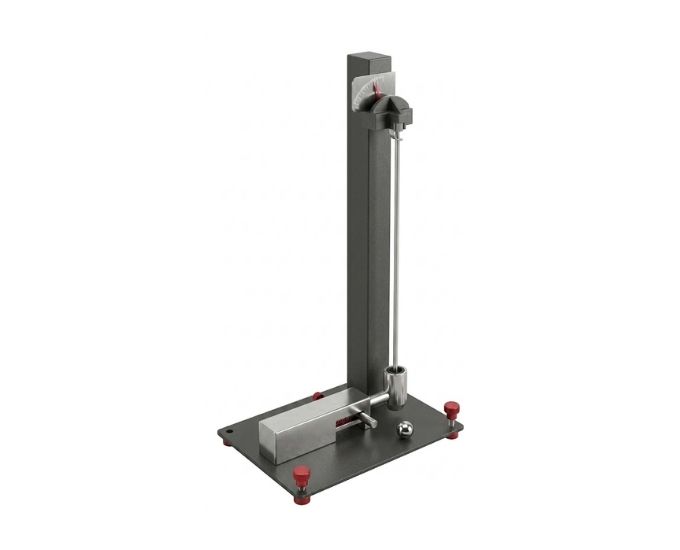
Ballistic Pendulum Apparatus
Model Number: MTM-56
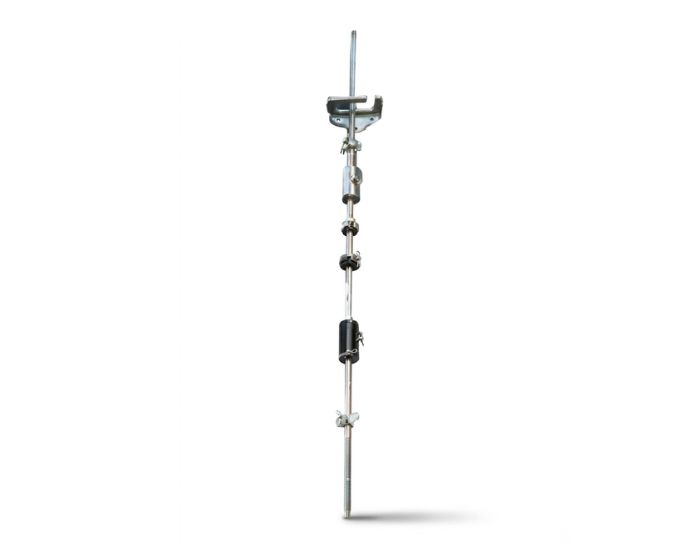
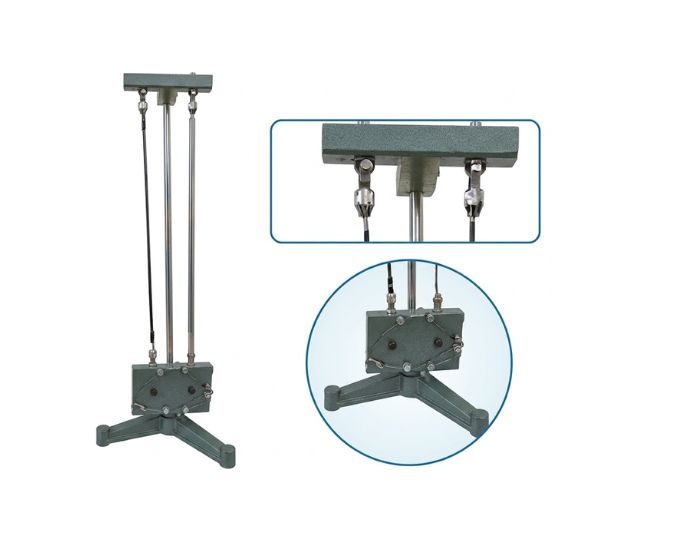
The Ballistic Pendulum Apparatus from Micro Technologies is designed for practical investigation of momentum conservation, projectile motion and collision dynamics. It combines a stable base, pendulum assembly and controlled vertical pendulum arrangement to support repeatable experiments. The apparatus allows measurement of pendulum deflection angle, enabling students to calculate momentum transfer and estimate projectile velocity after an inelastic collision. An instruction manual is supplied.
Product Specification
The Ballistic Pendulum Apparatus from Micro Technologies is a precision mechanics laboratory apparatus designed to demonstrate fundamental principles of momentum conservation, projectile motion and collision behavior.
The ballistic pendulum is a classic experimental method used to determine the velocity of a projectile by combining the principles of conservation of momentum and conservation of mechanical energy.
The apparatus features a robust and stable base designed to support the experimental assembly securely during repeated laboratory trials.
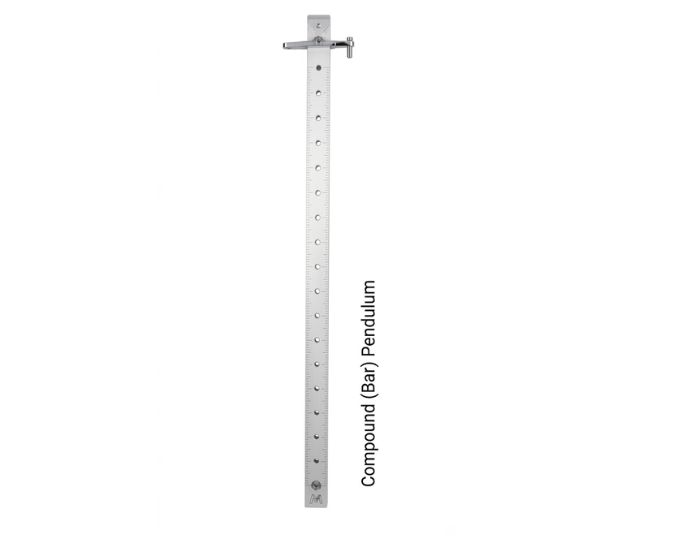
A pendulum arrangement is incorporated into the system and maintained in an appropriate vertical position for controlled experiments.
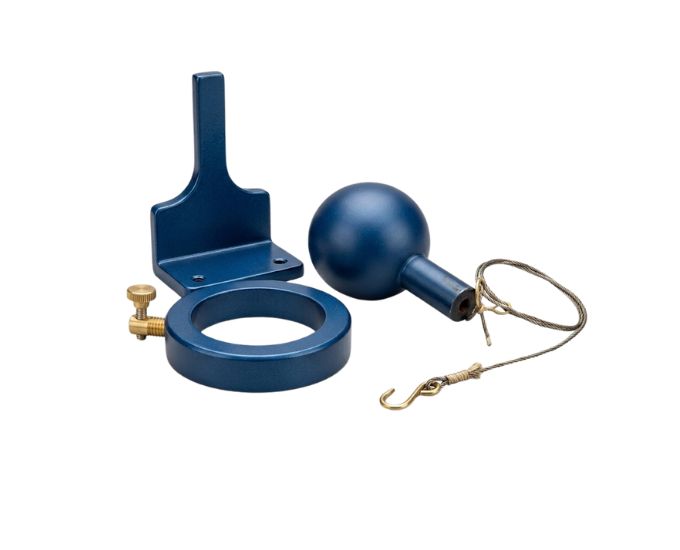
During a typical ballistic pendulum experiment, a projectile is launched toward the pendulum and becomes captured by or interacts with the pendulum according to the experimental configuration.
The initial collision is treated as an inelastic collision, during which momentum is transferred from the moving projectile to the pendulum system.
The principle of conservation of momentum can be expressed as:
mv = (M + m)V
where:
m = Mass of Projectile
v = Initial Projectile Velocity
M = Mass of Pendulum
V = Velocity of Combined System Immediately After Collision
After the collision, the pendulum swings upward. The kinetic energy of the combined moving system is converted into gravitational potential energy as the pendulum rises.
This stage can be represented as:
½(M + m)V² = (M + m)gh
where:
h = Vertical Rise of Pendulum
g = Acceleration Due to Gravity
By measuring the pendulum's maximum deflection and using the known geometry of the system, students can determine the vertical rise and calculate the post-collision velocity.
The original projectile velocity can then be estimated by combining the momentum and energy relationships.
The apparatus provides an effective way to demonstrate that different conservation principles may apply to different stages of the same experiment.
During the collision itself, momentum is conserved approximately, while mechanical kinetic energy is generally not conserved because the collision is inelastic.
During the subsequent pendulum swing, mechanical energy can be analyzed by considering the conversion of kinetic energy into gravitational potential energy, with experimental losses acknowledged.
The apparatus enables accurate observation or measurement of the pendulum deflection angle, an important experimental parameter for determining the resulting pendulum displacement.
Students can perform repeated trials and compare calculated projectile velocities, helping develop practical understanding of experimental uncertainty, repeatability and measurement accuracy.
The experiment also strengthens understanding of related mechanics concepts such as impulse, kinetic energy, gravitational potential energy, angular displacement and collision dynamics.
The stable construction helps maintain consistent alignment during laboratory demonstrations and quantitative experiments.
A comprehensive instruction manual is included to support experimental setup, operation and calculations.
Manufactured and supplied by Micro Technologies, the Ballistic Pendulum Apparatus is suitable for physics and mechanics laboratories requiring a quantitative apparatus for momentum, collision and projectile-velocity investigations.
Features
- Ballistic Pendulum Apparatus
- Designed for momentum conservation experiments
- Suitable for projectile-motion studies
- Supports projectile velocity determination
- Stable supporting base
- Controlled pendulum arrangement
- Pendulum maintained in vertical setup
- Deflection-angle measurement
- Suitable for inelastic collision studies
- Supports momentum-transfer calculations
- Useful for kinetic and potential energy studies
- Repeatable experimental configuration
- Suitable for quantitative mechanics practicals
- Robust laboratory construction
- Instruction manual included
Benefits
- Demonstrates conservation of momentum practically
- Provides a method for estimating projectile velocity
- Connects collision theory with pendulum motion
- Helps distinguish momentum conservation from energy conservation
- Supports quantitative experimental calculations
- Deflection measurement provides useful experimental data
- Stable base improves repeatability
- Helps students investigate inelastic collisions
- Develops measurement and data-analysis skills
- Suitable for advanced mechanics laboratory practicals
Product Specifications
| Specification | Details |
|---|---|
| Product Name | Ballistic Pendulum Apparatus |
| Product Type | Momentum & Projectile Motion Apparatus |
| Experimental Principle | Ballistic Pendulum Method |
| Base | Stable Laboratory Base |
| Pendulum Arrangement | Vertical / Controlled |
| Measurement | Pendulum Deflection Angle |
| Collision Study | Inelastic Collision |
| Primary Application | Conservation of Momentum |
| Additional Application | Projectile Velocity Determination |
| Related Studies | Momentum, Energy, Collision & Projectile Motion |
| Operation | Mechanical |
| Instruction Manual | Included |
| Use | Physics / Mechanics Laboratory |
Applications
- Conservation of momentum experiments
- Ballistic pendulum experiments
- Projectile velocity determination
- Projectile motion studies
- Inelastic collision experiments
- Momentum-transfer calculations
- Pendulum deflection studies
- Kinetic energy investigations
- Potential energy experiments
- Collision dynamics studies
- Impulse and momentum demonstrations
- Mechanics laboratory practicals
- Physics laboratory experiments
Available Variants
Ballistic Pendulum Apparatus, Momentum Conservation Pendulum, Projectile Velocity Apparatus, Ballistic Pendulum Experiment Set, Collision and Momentum Apparatus, Mechanics Lab Ballistic Pendulum, Physics Lab Momentum Apparatus
SKU System
MT-BPA-Series
FAQs
What is a Ballistic Pendulum Apparatus used for?
It is used to investigate conservation of momentum, inelastic collisions and projectile velocity through the motion of a pendulum after impact.
What principle does a ballistic pendulum use?
The experiment combines conservation of momentum during collision with the conversion of kinetic energy into gravitational potential energy during the subsequent pendulum swing.
Can projectile velocity be determined using this apparatus?
Yes. By measuring the pendulum deflection and using the known experimental parameters, the initial projectile velocity can be calculated or estimated.
What happens during the collision?
The projectile transfers momentum to the pendulum. In a typical ballistic-pendulum analysis, the collision is treated as inelastic.
Is kinetic energy conserved during the collision?
Not generally. In an inelastic collision, some kinetic energy is transformed into heat, sound, deformation and other forms of energy.
What is measured during the experiment?
A key measurement is the maximum pendulum deflection angle, which can be used to determine the vertical displacement of the pendulum.
Can the apparatus demonstrate conservation of energy?
The pendulum's upward swing can be analyzed in terms of the conversion of post-collision kinetic energy into gravitational potential energy, allowing energy concepts to be investigated.
Is the apparatus suitable for quantitative experiments?
Yes. It is designed to support calculations involving momentum transfer, pendulum displacement and projectile velocity.
Is the apparatus supplied with instructions?
Yes. A comprehensive instruction manual is included for guided experimentation.
Where can the Ballistic Pendulum Apparatus be used?
It is suitable for physics laboratories, mechanics laboratories, colleges, universities and scientific research or teaching facilities.
Why Choose Our Products
- Manufactured and supplied by Micro Technologies
- Robust and stable laboratory construction
- Suitable for momentum conservation experiments
- Supports projectile velocity calculations
- Designed for controlled pendulum movement
- Enables deflection-angle measurement
- Useful for collision and energy studies
- Comprehensive instruction manual included
- Institutional and bulk procurement available
- OEM requirements supported
Call to Action
Equip your mechanics laboratory with the Ballistic Pendulum Apparatus from Micro Technologies for practical investigations of momentum conservation, projectile velocity and collision dynamics. Contact us for institutional pricing, bulk laboratory procurement, OEM supply and customized quotations.