
Aepinus Condenser
Product Specification Sheet
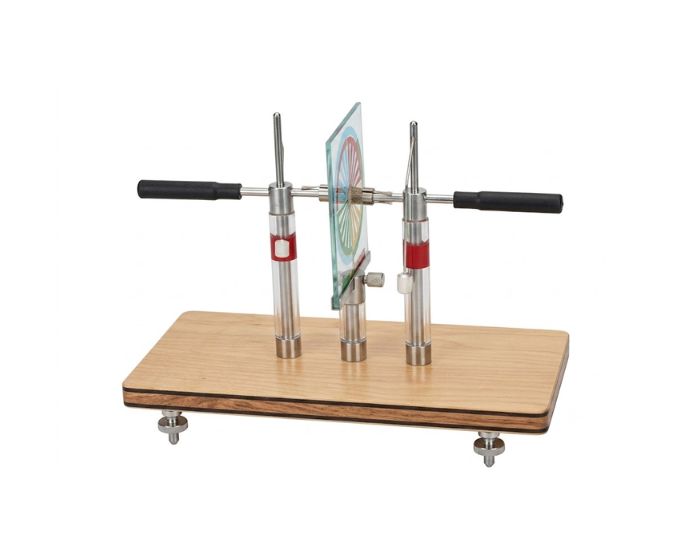
Aepinus Condenser
Model Number: MT-1060
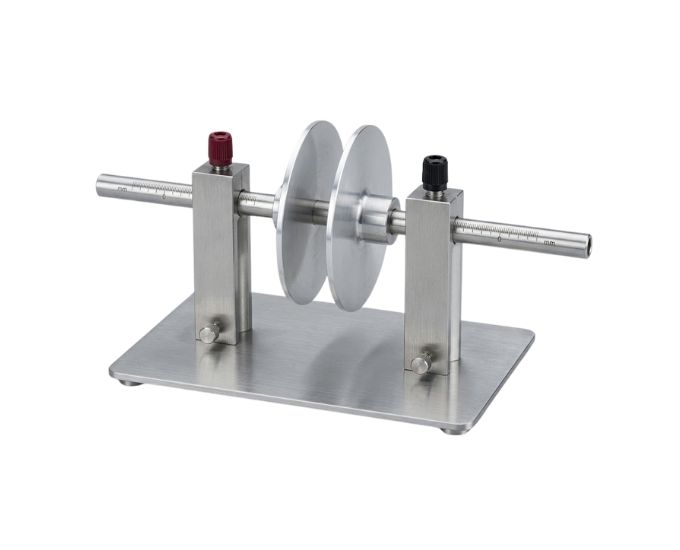
The Aepinus Condenser from Micro Technologies is a classic electrostatics laboratory apparatus designed for investigations involving capacitance, electrostatic induction, charge storage, plate separation and dielectric materials. The MT-1060 incorporates conducting plates with an intermediate insulating plate in an adjustable laboratory arrangement, allowing important capacitor and electrostatic principles to be demonstrated practically.
Product Specification
The Aepinus Condenser from Micro Technologies is designed for experimental investigations of capacitance and electrostatic phenomena. Its open laboratory construction makes the arrangement of conducting and insulating elements clearly visible, providing a practical way to connect capacitor theory with physical observations.
The MT-1060 incorporates conducting plates arranged with an intermediate insulating or dielectric plate. The components are supported on a stable laboratory base and can be positioned according to the requirements of suitable electrostatics experiments.
The apparatus is useful for demonstrating the fundamental behaviour of a capacitor or condenser. When opposite electric charges are established on separated conducting plates, electrical energy can be stored in the electric field associated with the arrangement.
One of the important applications of the Aepinus Condenser is the investigation of dielectric effects. Introducing an insulating material between the conducting surfaces changes the effective permittivity of the region and consequently influences the capacitance of the arrangement.
The apparatus can therefore be used to compare capacitor behaviour with air and with a suitable dielectric material between the plates. This provides a direct experimental introduction to permittivity and dielectric constant.
Plate separation is another important factor affecting capacitance. In an idealized parallel-plate arrangement, capacitance is approximately described by C = εA/d, where ε represents permittivity, A is the effective overlapping area and d is the separation between the conducting plates.
The MT-1060 also supports demonstrations involving electrostatic induction. Charge redistribution on conducting components can be investigated when charged bodies or conductors are brought into suitable positions without necessarily requiring direct electrical contact.
Its open configuration makes it possible to observe how changes in plate position and dielectric placement alter the experimental arrangement. This is particularly useful for understanding the physical factors that influence capacitance rather than treating a capacitor only as an enclosed electrical component.
The apparatus can be used with a compatible electroscope, electrometer, electrostatic generator or other charge-detection equipment depending on the laboratory experiment being performed.
Comparative experiments may be carried out by altering one experimental parameter at a time, such as plate spacing or dielectric placement, while maintaining the remaining conditions as consistently as possible.
The Aepinus Condenser is also useful for broader discussions involving electric potential, electric fields, charge separation, electrostatic energy and capacitor construction.
Its stable base provides convenient support for repeated laboratory investigations, while the exposed arrangement offers easy access to the experimental components.
Manufactured and supplied by Micro Technologies, the Aepinus Condenser is suitable for physics laboratories, electrostatics laboratories and scientific experimental facilities requiring practical apparatus for capacitance and electrostatic studies.
Features
- Classic Aepinus condenser configuration
- Conducting plate arrangement
- Intermediate dielectric plate
- Adjustable experimental configuration
- Stable laboratory base
- Open and clearly visible construction
- Suitable for capacitance experiments
- Supports dielectric-effect investigations
- Useful for electrostatic induction demonstrations
- Suitable for charge-storage studies
- Supports plate-separation investigations
- Useful for permittivity experiments
- Compatible with suitable electrostatic instruments
- Mechanical laboratory arrangement
- Suitable for repeated experimental use
Benefits
- Demonstrates fundamental capacitor principles
- Helps investigate capacitance practically
- Shows the influence of dielectric materials
- Supports electrostatic induction experiments
- Helps explain charge separation and storage
- Allows investigation of plate-spacing effects
- Provides practical understanding of permittivity
- Open configuration improves observation of components
- Complements other electrostatics apparatus
- Suitable for repeated laboratory investigations
Product Specifications
| Specification | Details |
|---|---|
| Product Name | Aepinus Condenser |
| Model No. | MT-1060 |
| Product Type | Electrostatics Laboratory Apparatus |
| Configuration | Aepinus Condenser |
| Conducting Elements | Plate Type |
| Dielectric Element | Intermediate Insulating Plate |
| Arrangement | Adjustable |
| Primary Study | Capacitance |
| Related Study | Electrostatic Induction |
| Dielectric Study | Supported |
| Charge Storage Study | Supported |
| Supporting Structure | Laboratory Base |
| Operation | Mechanical / Electrostatic |
| Application Area | Physics / Electrostatics |
| Use | Laboratory / Demonstration |
Available Model
| Model No. | Product |
|---|---|
| MT-1060 | Aepinus Condenser |
Applications
- Capacitance experiments
- Aepinus condenser experiments
- Electrostatic induction demonstrations
- Dielectric material investigations
- Dielectric constant experiments
- Permittivity studies
- Charge storage demonstrations
- Charge separation experiments
- Plate-separation investigations
- Electric field studies
- Electric potential demonstrations
- Capacitor principle experiments
- Electrostatics laboratory practicals
- Physics laboratory experiments
Available Variants
Aepinus Condenser, Condenser Aepinus, Aepinus Capacitor, Aepinus Condenser Apparatus, Electrostatic Condenser, Laboratory Aepinus Condenser, Capacitance Demonstration Apparatus, Dielectric Condenser Apparatus
SKU System
MT-AC-1060
FAQs
What is an Aepinus Condenser used for?
An Aepinus Condenser is used for experiments involving capacitance, electrostatic induction, dielectric effects, charge storage and plate separation.
What is the Micro Technologies model number?
The Micro Technologies model number is MT-1060.
What is a condenser in electrostatics?
In traditional terminology, a condenser is essentially a capacitor—an arrangement of conductors separated by an insulating medium that can store separated electric charge and electrical energy.
Can dielectric materials be studied with this apparatus?
Yes. The intermediate insulating plate allows suitable experiments involving the effect of a dielectric material on capacitance.
What happens when a dielectric is introduced between the plates?
Under otherwise equivalent conditions, introducing a dielectric with relative permittivity greater than air generally increases the capacitance of the arrangement.
Can plate separation affect capacitance?
Yes. For an idealized parallel-plate capacitor, increasing the distance between the plates while keeping other parameters unchanged decreases capacitance.
Can the apparatus demonstrate electrostatic induction?
Yes. The Aepinus Condenser can support experiments involving charge redistribution and electrostatic induction using appropriate experimental procedures.
Can it be used for charge-storage demonstrations?
Yes. The arrangement demonstrates the basic principle of storing separated electric charge on conducting surfaces separated by an insulating region.
Can it be used with an electroscope?
Yes. A compatible electroscope or electrometer can be incorporated into suitable experiments for detecting and comparing electrostatic effects.
Where can the Aepinus Condenser be used?
It is suitable for physics laboratories, electrostatics laboratories and scientific experimental facilities conducting capacitance and electric-charge investigations.
Why Choose Our Products
- Manufactured and supplied by Micro Technologies
- Classic Aepinus condenser configuration
- Suitable for capacitance and dielectric studies
- Useful for electrostatic induction experiments
- Adjustable experimental arrangement
- Stable and reusable laboratory construction
- Suitable for institutional and bulk procurement
- OEM supply requirements supported
Call to Action
Choose the Aepinus Condenser – MT-1060 from Micro Technologies for practical investigations involving capacitance, dielectric effects, electrostatic induction and charge storage. Contact us for competitive pricing, institutional procurement, physics laboratory equipment supply, bulk requirements, OEM orders and customized quotations.