
Adjustable Laboratory Ray Box
Product Specification Sheet
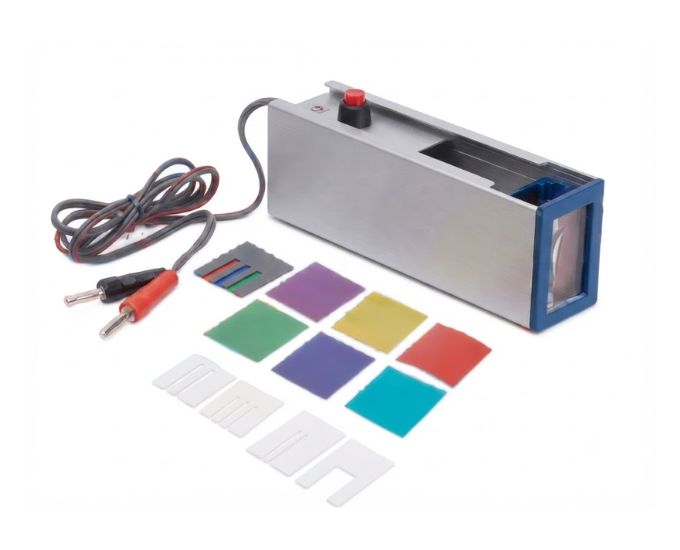
Adjustable Laboratory Ray Box
Model Number: MTO-24
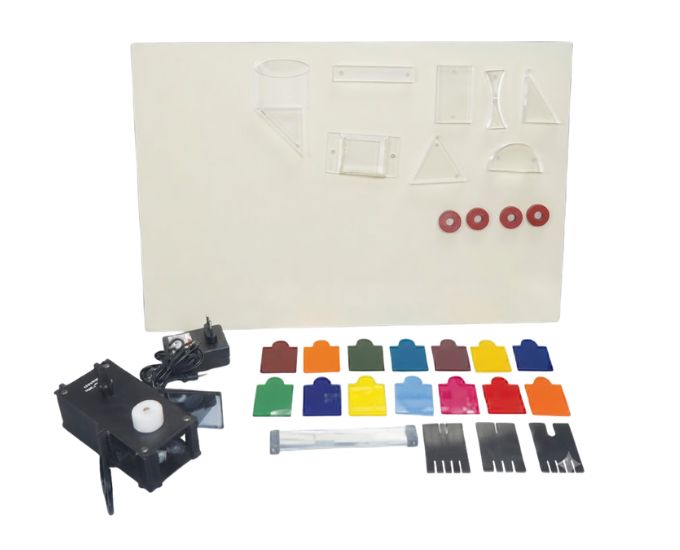
The Adjustable Laboratory Ray Box is a versatile optical light source for producing controlled rays during reflection, refraction, lens, prism, and ray-tracing experiments. Micro Technologies supplies the unit in a rugged sheet-metal enclosure with a 12V, 10W festoon-type axially straight filament lamp. A cartridge accommodates four slit configurations—single, double, triple, and wide—allowing the light pattern to be selected according to the experiment. Five colored filters are also provided for additional light investigations. An integrated convex cylindrical collimating lens allows adjustment of the outgoing beam to produce parallel, converging, or diverging light tracks. Its flexible optical configuration makes the ray box suitable for physics laboratories, optics laboratories, research facilities, universities, colleges, and institutional procurement.
Product Specification
The Adjustable Laboratory Ray Box is a flexible optical light source developed for experiments requiring controlled single, multiple, or broad light tracks. By combining selectable slit patterns with an adjustable cylindrical lens, the apparatus provides a convenient way to configure the beam for different geometrical optics investigations.
The main enclosure is manufactured from rugged sheet metal to provide mechanical strength for regular laboratory operation. Illumination is produced by a 12V, 10W festoon-type lamp with an axially straight filament. This filament arrangement works with the slit system and collimating lens to create clearly observable light paths across a suitable working surface.
Micro Technologies supplies the Adjustable Laboratory Ray Box with a cartridge accommodating four slit configurations: single, double, triple, and wide. Users can quickly select the required slit pattern according to the experiment being performed. A single ray is useful for studying incidence, reflection, and refraction, while multiple rays make lens convergence and divergence easier to visualize.
The integrated convex cylindrical collimating lens provides an additional level of beam control. By adjusting the lens position, the emitted light can be arranged into approximately parallel tracks or configured to demonstrate converging and diverging behaviour. This makes the unit suitable for work with convex and concave lenses, prisms, mirrors, rectangular optical blocks, and semi-circular blocks.
Five color filters are included, extending the apparatus beyond standard white-light ray tracing and allowing suitable investigations involving colored light.
With four selectable slit patterns, adjustable beam formation, durable construction, and a practical low-voltage lamp system, the Adjustable Laboratory Ray Box provides a versatile solution for repeated optics experiments and complete laboratory installations.
Features
- Rugged sheet-metal enclosure
- 12V, 10W festoon-type lamp
- Axially straight filament configuration
- Four selectable slit patterns
- Single, double, triple, and wide slit options
- Five colored filters included
- Convex cylindrical collimating lens
- Adjustable parallel, converging, and diverging light tracks
- Compatible with lenses, mirrors, prisms, and optical blocks
- Suitable for a broad range of ray-optics experiments
Benefits
- Four slit options provide greater experimental flexibility
- Adjustable collimating lens allows different beam configurations
- Multiple rays simplify convergence and divergence observations
- Color filters broaden the range of light investigations
- Rugged metal housing supports repeated laboratory use
- One apparatus can support numerous optics experiments
- Low-voltage operation provides a practical laboratory configuration
Product Specifications
| Specification | Details |
|---|---|
| Product Name | Adjustable Laboratory Ray Box |
| Internal Model No. | MT-30410 |
| Product Type | Multi-Slit Optical Ray Source |
| Enclosure Material | Sheet metal |
| Lamp Type | Festoon-type axial filament lamp |
| Lamp Rating | 12V, 10W |
| Filament | Axially straight |
| Slit System | Cartridge type |
| Slit Options | Single, double, triple and wide |
| Number of Slit Patterns | 4 |
| Color Filters | 5 |
| Collimating Lens | Convex cylindrical lens |
| Beam Adjustment | Parallel, converging and diverging |
| Power Requirement | Suitable 12V supply |
| Calibration | Optical alignment verification as required |
| Usage / Application | Reflection, refraction, lenses, prisms and ray tracing |
| Compliance Standard | Laboratory-grade optical and electrical construction |
Available Variants
- Standard Adjustable Laboratory Ray Box
- Ray Box with four-position slit cartridge
- Ray Box with color-filter set
- Ray Box with adjustable collimating lens
- Complete ray-optics configuration with accessories
SKU System
- MT-ARB-12V10W – 12V, 10W Adjustable Ray Box
- MT-ARB-4SL – Four-Slit Ray Box
- MT-ARB-COL – Ray Box with Collimating Lens
- MT-ARB-FLT – Ray Box with Color Filters
- MT-ARB-CUS – Customized Ray Box
FAQs
What is the Adjustable Laboratory Ray Box used for?
The apparatus provides controlled light rays for experiments involving reflection, refraction, lenses, prisms, and ray tracing. Its adjustable configuration supports several different optical arrangements.
What slit options are available?
Four slit patterns are provided: single, double, triple, and wide. They are mounted in a cartridge arrangement for convenient selection during different experiments.
What is the lamp rating?
The standard ray box uses a 12V, 10W festoon-type lamp with an axially straight filament, providing suitable illumination for laboratory ray-optics work.
What is the purpose of the cylindrical lens?
The convex cylindrical lens acts as a collimating and beam-adjustment component. Its position can be altered to obtain approximately parallel, converging, or diverging light tracks.
Are color filters supplied with the Ray Box?
Yes. Five colored filters are supplied with the apparatus, allowing additional experiments involving filtered and colored light.
Can it produce multiple light rays?
Yes. Double and triple slit options produce multiple tracks, while the single slit provides an individual ray and the wide slit provides a broader light output.
Can it be used with lenses and prisms?
Yes. The ray box can be combined with convex and concave lenses, prisms, transparent blocks, mirrors, and other suitable optical components.
Does the Ray Box require calibration?
Routine calibration is generally unnecessary for qualitative experiments. The lamp, slit cartridge, and cylindrical lens should remain properly aligned for consistent ray formation.
How should the apparatus be maintained?
Keep the slit openings and cylindrical lens clean, and periodically inspect the lamp and electrical connections. Disconnect the power supply before lamp replacement or maintenance.
Can Adjustable Ray Boxes be ordered in bulk?
Yes. Bulk quantities can be supplied for physics laboratories, optics laboratories, universities, colleges, research facilities, distributors, and institutional laboratory projects.
Are replacement lamps and accessories available?
Compatible replacement lamps, filters, slit components, and related optics accessories may be supplied according to required specifications and availability.
Can the Ray Box configuration be customized?
Accessory combinations, packaging, and certain technical configurations may be customized for larger procurement requirements depending on manufacturing feasibility.
Why Choose Our Products
- Four selectable slit configurations in one apparatus
- Adjustable cylindrical collimating lens
- Durable sheet-metal construction
- Quality-checked optical and electrical assembly
- Bulk supply capability for laboratories, institutions, and distributors
Call to Action
Looking for Adjustable Laboratory Ray Boxes for ray tracing, reflection, refraction, or complete optics laboratory setups? Contact Micro Technologies for competitive quotations, bulk orders, institutional procurement, distributor inquiries, replacement accessories, and customized configurations.