
Acrylic Optical Triangle
Product Specification Sheet
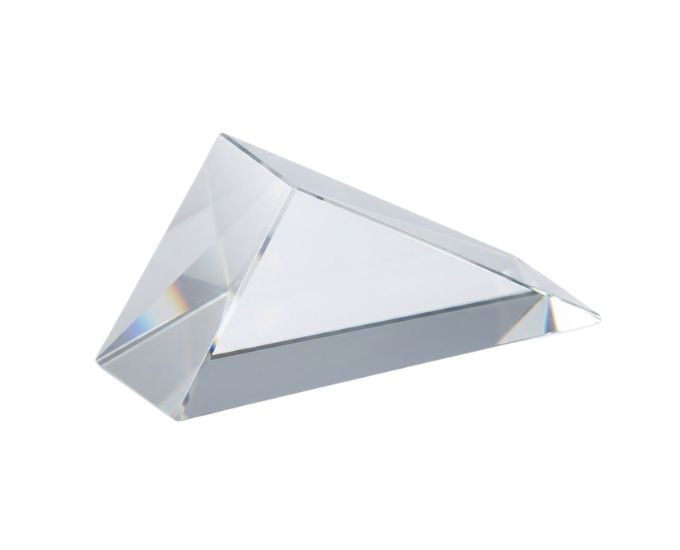
Acrylic Optical Triangle
Model Number: MTO-12
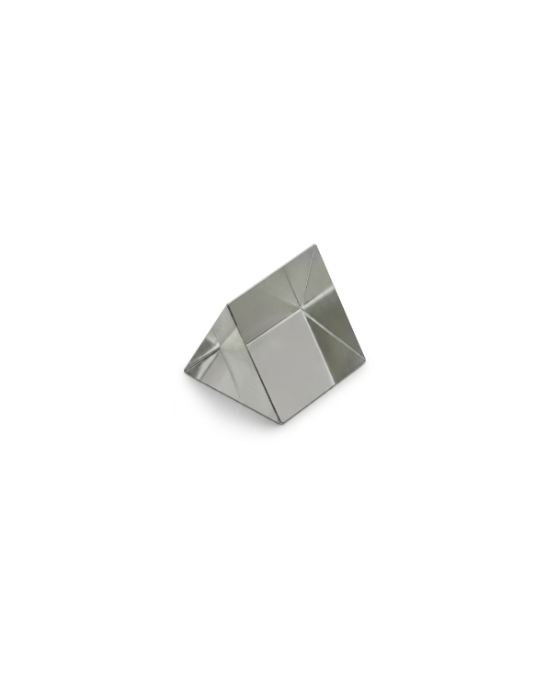
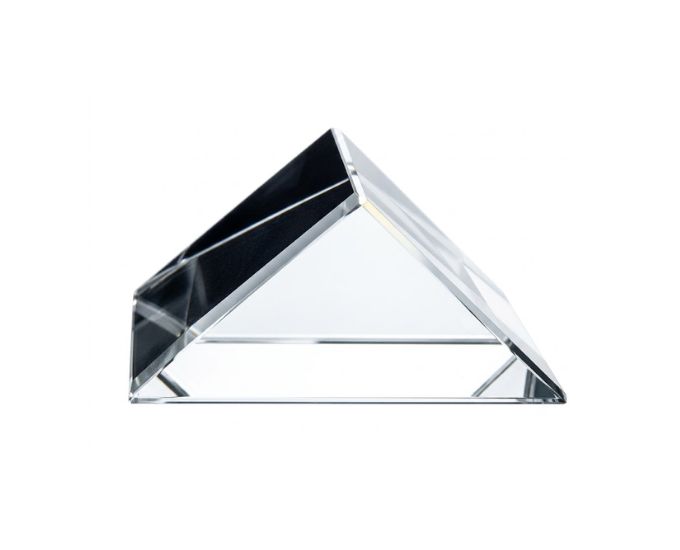
The Acrylic Optical Triangle is a transparent optical component used for practical investigations involving refraction, ray deviation, critical angle, and total internal reflection. Micro Technologies supplies the triangular block with a 75 mm hypotenuse in two angular configurations: 90° × 60° × 30° and 90° × 45° × 45°. The clear acrylic body provides good visibility of light paths as rays enter and leave different faces of the block. Its defined angular geometry makes it useful for comparing the behaviour of light at different angles of incidence. Lightweight, reusable, and convenient to position, the optical triangle can be incorporated with ray boxes, optical boards, light sources, and angular measuring accessories in physics laboratories, optics laboratories, research facilities, universities, colleges, and institutional laboratory setups.
Product Specification
The Acrylic Optical Triangle is a transparent triangular optical block used for investigating how light changes direction when travelling between air and acrylic. Its precisely defined angular geometry makes it useful for experiments involving refraction, ray deviation, critical angle, and total internal reflection.
The optical triangle is available in two standard profiles. The first has angles of 90°, 60°, and 30°, while the second uses a 90°, 45°, and 45° configuration. Both variants have an approximate hypotenuse length of 75 mm. These different angular arrangements allow laboratories to investigate the behaviour of light under varying incidence conditions and compare ray paths through different triangular geometries.
Micro Technologies supplies the Acrylic Optical Triangle for use with suitable ray boxes, narrow light sources, optical boards, protractors, and related optics accessories. As a light ray enters one surface, it changes direction according to the refractive properties of acrylic and the angle of incidence. The ray can then undergo further refraction or internal reflection as it reaches another face.
The triangular profile is particularly useful for examining how optical geometry affects the direction of transmitted and reflected rays. Under appropriate conditions, the apparatus can also demonstrate critical-angle behaviour and total internal reflection within a transparent medium.
Clear acrylic construction provides good optical visibility while remaining comparatively lightweight and convenient to handle. With no moving components, electrical parts, or adjustment mechanisms, the triangle requires minimal routine maintenance. Its optical faces should simply be kept clean and protected from scratching.
Available in two practical angular configurations, the Acrylic Optical Triangle provides a versatile and economical component for routine geometrical optics investigations, laboratory kits, and bulk institutional procurement.
Features
- Transparent acrylic optical construction
- Triangular geometry for ray-optics investigations
- Available in 90° × 60° × 30° configuration
- Available in 90° × 45° × 45° configuration
- Approximate hypotenuse length of 75 mm
- Suitable for light refraction experiments
- Supports ray-deviation investigations
- Useful for critical-angle and internal-reflection studies
- Lightweight and convenient to position
- Reusable construction with minimal maintenance
Benefits
- Two angular profiles broaden experimental possibilities
- Clear acrylic provides convenient observation of ray paths
- Supports refraction and total internal reflection investigations
- Defined angles simplify comparative optics experiments
- Lightweight construction makes handling and positioning easier
- Reusable design provides good long-term procurement value
- Suitable for optics kits and quantity laboratory installations
Product Specifications
| Specification | Details |
|---|---|
| Product Name | Acrylic Optical Triangle |
| Internal Model Series | MT-30270 |
| Product Type | Triangular Optical Acrylic Block |
| Material | Clear acrylic |
| Shape | Right-angle triangle |
| Angular Options | 90° × 60° × 30° / 90° × 45° × 45° |
| Hypotenuse Length | Approx. 75 mm |
| Optical Behaviour | Refraction / internal reflection |
| Transparency | Clear |
| Surface Finish | Optical-grade smooth surfaces |
| Capacity | Not applicable |
| Accuracy / Tolerance | Laboratory-grade dimensional consistency |
| Calibration Standard | Not required |
| Stopper Type | Not applicable |
| Color | Clear / transparent |
| Usage / Application | Refraction, ray tracing and internal reflection |
| Compliance Standard | Laboratory-grade manufacturing and optical quality |
Available Variants
| Internal Model No. | Angular Profile | Hypotenuse |
|---|---|---|
| MT-30270/1 | 90° × 60° × 30° | 75 mm |
| MT-30270/2 | 90° × 45° × 45° | 75 mm |
SKU System
- MT-AOT-3060-75 – 30°-60°-90° Acrylic Triangle
- MT-AOT-4545-75 – 45°-45°-90° Acrylic Triangle
- MT-AOT-SET75 – Complete Two-Triangle Set
- MT-AOT-CUS – Customized Optical Triangle
FAQs
What is an Acrylic Optical Triangle used for?
It is used for optics experiments involving refraction, ray deviation, critical angle, and total internal reflection. Its triangular geometry provides several surfaces and incidence angles for practical investigations.
What angular configurations are available?
Two standard configurations are available: 90° × 60° × 30° and 90° × 45° × 45°. Both versions have an approximate hypotenuse length of 75 mm.
Can the triangle demonstrate refraction?
Yes. A suitable light ray passing from air into acrylic changes direction at the optical boundary. The incident and refracted rays can be observed and compared using appropriate measuring accessories.
Can it demonstrate total internal reflection?
Yes. Under suitable incidence conditions, light travelling within the acrylic can undergo total internal reflection at an acrylic-air boundary.
Can it be used with a ray box?
Yes. The Acrylic Optical Triangle can be combined with a ray box or another suitable narrow light source for observing refraction, deviation, and internal reflection.
What is the advantage of having two angular variants?
Different angular profiles allow the behaviour of light to be examined at different optical geometries. This provides greater flexibility for comparative ray-tracing experiments.
Does the Acrylic Optical Triangle require calibration?
The triangle itself does not require routine calibration. For quantitative experiments, any protractor, angular scale, or other measuring instrument used with it should be appropriately verified.
How durable is the acrylic construction?
Acrylic is lightweight and convenient for repeated laboratory handling. However, its optical surfaces should be protected from scratches, excessive impact, and harsh cleaning chemicals.
How should the optical surfaces be cleaned?
Use a soft, non-abrasive cloth with an acrylic-compatible cleaning solution. Avoid abrasive materials and strong solvents that could scratch, cloud, or damage the surfaces.
Can Acrylic Optical Triangles be ordered in bulk?
Yes. Bulk quantities can be supplied for physics laboratories, optics laboratories, universities, colleges, laboratory kits, distributors, and institutional procurement projects.
Can custom dimensions or angles be supplied?
Custom sizes or angular profiles may be considered depending on required specifications, quantity, and manufacturing feasibility.
How are the triangles packed for transportation?
Optical surfaces, corners, and edges are protected against scratching and impact during shipping. Additional bulk or export packaging can be arranged according to order requirements.
Why Choose Our Products
- Two useful angular configurations for varied optics experiments
- Clear acrylic construction for easy ray observation
- Consistent 75 mm hypotenuse configuration
- Quality-checked dimensions and optical surfaces
- Bulk supply capability for laboratories, institutions, and distributors
Call to Action
Looking for Acrylic Optical Triangles for refraction, ray tracing, or total internal reflection experiments? Contact Micro Technologies for competitive quotations, institutional orders, distributor inquiries, both standard angular configurations, and bulk supply requirements. Share your required variant and quantity to receive suitable pricing and delivery details.